CM Rekha Gupta: 1 Lakh Smart LED Lights for Delhi After DU Students Flag Dark Spots

Synopsis
Delhi Chief Minister Rekha Gupta has announced a plan to install 1 lakh smart LED streetlights across the capital after Delhi University women students highlighted dangerous dark spots, framing the move as a direct government response to student-driven safety concerns.
Key Takeaways
1 lakh smart LED streetlights are planned for Delhi following student complaints about dark spots near campus areas.
Delhi University women students are explicitly credited by CM Rekha Gupta as the catalyst for the city-wide initiative.
Smart LEDs enable remote monitoring and fault detection, reducing the risk of unnoticed outages in isolated stretches.
The move aligns with India's Smart Cities Mission (launched 2015) and its urban lighting and safety components for Delhi.
Rollout timelines and ward-wise coverage maps have not yet been specified in the announcement.
The initiative is tagged under the #SevaSankalpAbhiyan campaign, framing it as a responsive-governance milestone.
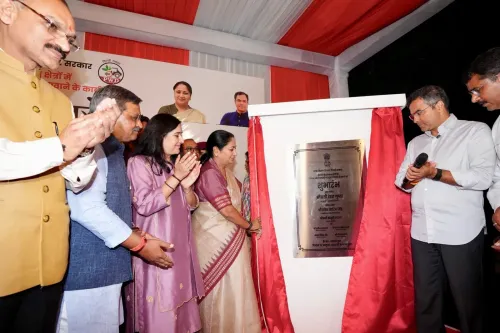
When young women at Delhi University raised their voices about unsafe dark stretches on and around campus, Delhi Chief Minister Rekha Gupta says her administration listened — and is now moving. On Thursday, 15 October 2026, the Chief Minister announced that 1 lakh smart LED streetlights are in the works for the capital, directly crediting students for pushing the issue onto the government's agenda.
DU students spark a city-wide response
The announcement is striking for what it names plainly: a government acting on a ground-level complaint from women students, not from a bureaucratic audit. Gupta's post states without ambiguity — 'DU's young women students flagged dark spots. We acted.' That framing positions the initiative as demand-driven, placing student safety concerns at the originating point of a city-wide infrastructure push.
Dark patches near university campuses and residential lanes have long been documented as contributors to women feeling unsafe in Delhi after hours. The administration's move to cite students publicly acknowledges both the problem and the source — an unusual level of attribution for a civic infrastructure decision.
One lakh smart LEDs: the scale of the plan
The figure of 1 lakh (100,000) smart LED streetlights is the operational centrepiece of the announcement. Smart LEDs — as distinct from conventional sodium-vapour or basic LED fittings — typically allow remote monitoring, automatic dimming, and fault detection, capabilities that reduce the chance of lights failing unnoticed in isolated stretches. The Delhi government has not specified a rollout timeline or ward-wise coverage map in this announcement; those details will determine whether the initiative reaches the highest-risk corridors first.
The upgrade fits within a broader national pattern. India's Smart Cities Mission, launched in 2015, embedded urban lighting and public safety components for major cities including Delhi, and successive administrations have periodically returned to street lighting as a women's safety lever — especially following high-profile incidents that draw national attention to the capital's night-time urban environment.
Where this fits in Delhi's urban safety arc
Gupta tagged the initiative under #ViksitDelhi and #SevaSankalpAbhiyan — the latter a service-commitment campaign that frames governance as responsive delivery. The dual hashtag signals the administration is packaging this as both a development milestone and a civic-responsiveness story heading into what is always a politically charged period in the capital.
Gender-sensitive urban planning — better lighting, safer public transport corridors, well-lit park perimeters — has become a standard plank for Delhi administrations across party lines. What sets this moment apart is the explicit student-feedback loop: women raised the alarm, the government named them, and the infrastructure response followed. Whether that loop extends to post-installation safety audits and student verification will test whether the initiative is transformative or merely large-scale.
One hundred thousand lights across one of the world's most densely populated capitals. The city is watching where they land.
Point of View
A narrative the BJP is keen to own in the capital. The 1 lakh LED figure is ambitious enough to be headline-worthy, but the absence of a published rollout map or timeline is where the credibility test will come. Historically, Delhi's street-lighting gaps have outlasted multiple administrations' promises; what changes the calculus this time is whether the student-feedback loop is institutionalised beyond the announcement. For urban-safety advocates, the real metric is not the number of lights installed but whether high-risk dark corridors — not just high-visibility main roads — are prioritised first.
NationPress
15 Oct 2026
Frequently Asked Questions
Why is Delhi installing 1 lakh smart LED streetlights?
Delhi CM Rekha Gupta announced the initiative after Delhi University women students flagged unsafe dark spots on and around campus, prompting the government to plan a city-wide smart LED streetlight rollout to improve public safety.
What are smart LED streetlights and how are they different from regular ones?
Smart LED streetlights use energy-efficient LEDs paired with remote-monitoring systems that allow authorities to detect faults, adjust brightness automatically, and track outages in real time — reducing the risk of dark stretches going unnoticed.
When will the 1 lakh smart LED lights be installed in Delhi?
CM Rekha Gupta's announcement on 15 October 2026 did not specify a rollout timeline or ward-wise coverage map; those operational details are expected to follow.
How does this relate to women's safety in Delhi?
Dark spots in urban areas are consistently linked to higher risks for women after hours. The initiative directly responds to safety concerns raised by Delhi University women students and is part of a broader pattern of gender-sensitive urban planning in the capital.
What is the Seva Sankalp Abhiyan mentioned by CM Rekha Gupta?
Seva Sankalp Abhiyan is a service-commitment campaign under which the Delhi government frames civic actions as direct responses to public needs; CM Gupta tagged the lighting initiative under this campaign to highlight its responsive-governance angle.