CM Rekha Gupta hails Modi's poverty mission, cites World Bank

Synopsis
Delhi Chief Minister Rekha Gupta credited PM Narendra Modi's Antyodaya-driven welfare agenda for lifting nearly 50 crore Indians out of poverty, citing World Bank recognition, and vowed the mission would press on until every poor family lives with dignity.
Key Takeaways
Delhi CM Rekha Gupta posted on X on 30 October 2026 praising PM Modi's poverty-alleviation record.
She cited a World Bank recognition of nearly 50 crore Indians rising above poverty — a figure that could not be independently verified at time of publication.
The NITI Aayog Multidimensional Poverty Index , published from 2021 onward, documented significant falls in India's poverty headcount using composite indicators.
The Pradhan Mantri Garib Kalyan Anna Yojana , launched in 2020 , is among the flagship schemes cited as part of the welfare delivery architecture.
Gupta framed Garib Kalyan as Modi's 'life's mission' rooted in the Antyodaya principle of uplifting the last person.
She signalled the welfare mission would continue 'with even greater resolve,' keeping the political narrative forward-looking.
Poverty alleviation as a life's calling — that is how Delhi Chief Minister Rekha Gupta framed Prime Minister Narendra Modi's welfare record in a post on X on Friday, 30 October 2026, invoking a claimed World Bank recognition of nearly 50 crore Indians rising above poverty under his leadership.
The Antyodaya argument at the centre of the post
Gupta's message is built around a single, loaded word: Antyodaya — 'upliftment of the last person' — a philosophical anchor the BJP has used since 2014 to frame every major welfare scheme. 'For Hon'ble PM Shri Modi Ji, Garib Kalyan is not merely a policy. It is his life's mission,' she wrote, describing his work as a 'tireless Tapasya' — an act of devotion. The choice of language is deliberate; it casts governance as vocation, not administration.
What the '50 crore' figure rests on
The claim of nearly 50 crore people exiting poverty is politically significant, and its invocation of World Bank recognition lends it an institutional weight that the BJP has frequently sought. India's own NITI Aayog Multidimensional Poverty Index reports, published from 2021 onward, documented steep falls in the poverty headcount using composite indicators — health, education and living standards — rather than income alone. The World Bank has separately tracked global extreme poverty trends in which India's trajectory features prominently. The precise figure cited by Gupta and the specific World Bank document she references could not be independently verified from public records at the time of publication.
The welfare architecture behind the headline number
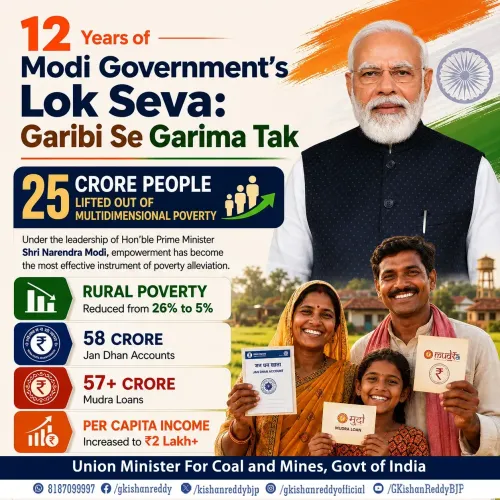
The scaffold supporting these figures is a decade-long stack of targeted schemes. The Pradhan Mantri Garib Kalyan Anna Yojana, launched in 2020 during the COVID-19 pandemic, extended free food grains to hundreds of millions of households and was subsequently made permanent. Alongside it, financial inclusion drives, subsidised housing, rural sanitation and direct-benefit transfers built what the government characterises as a 'last-mile' delivery system. The argument — one the BJP has pressed in every election cycle since 2014 — is that systemic delivery, not ad hoc relief, is what moved the poverty needle.
Gupta's message and its political timing
For Gupta, who governs Delhi as the BJP's chief minister in a city where urban poverty and informal-sector vulnerability are acutely visible, amplifying the poverty-reduction narrative carries both ideological and electoral resonance. Her closing line — that Modi's mission 'will continue with even greater resolve until every poor family has the opportunity to live with dignity, prosperity and hope' — frames welfare not as an achievement to rest on, but as a mandate still in motion. That framing keeps the pitch alive and forward-looking.
The next real test of the numbers comes whenever NITI Aayog or the World Bank publishes its next poverty-update cycle — and whether the trajectory that Gupta is celebrating holds, or begins to flatten.
Point of View
And wrap it in the moral vocabulary of Antyodaya to make it feel like civilisational purpose rather than electoral arithmetic. The framing of poverty reduction as Modi's personal 'tapasya' is consistent with the BJP's decade-long effort to personalise governance outcomes around the Prime Minister's brand. The deliberate forward-looking close — 'will continue with even greater resolve' — signals that the party intends to run the welfare delivery story as a living, ongoing mandate rather than a closed chapter, keeping it politically potent ahead of future electoral cycles.
NationPress
30 Oct 2026
Frequently Asked Questions
What did Delhi CM Rekha Gupta say about PM Modi and poverty?
Rekha Gupta said that Garib Kalyan is PM Modi's life mission, not merely a policy, and credited his leadership with lifting nearly 50 crore Indians out of poverty, citing recognition from the World Bank.
Has the World Bank recognised India's poverty reduction under Modi?
The World Bank has tracked India's progress in global poverty reduction trends, and the Indian government has cited its data in welfare communications, but the specific recognition of 'nearly 50 crore' people cited by Gupta could not be independently verified at the time of publication.
What is Antyodaya and why does the BJP use the term?
Antyodaya means 'upliftment of the last person' and originates from RSS ideologue Pandeya Deendayal Upadhyaya's philosophy. The BJP has used it since 2014 as a governing principle to frame welfare schemes targeted at the poorest households.
What is the Pradhan Mantri Garib Kalyan Anna Yojana?
It is a central government scheme launched in 2020 during the COVID-19 pandemic to provide free food grains to hundreds of millions of beneficiaries; it was subsequently extended and made a permanent feature of India's food security architecture.
How does India measure poverty reduction officially?
India primarily uses the NITI Aayog Multidimensional Poverty Index , which measures poverty across health, education and living-standards indicators rather than income alone; its reports from 2021 onward have documented significant reductions in the poverty headcount.