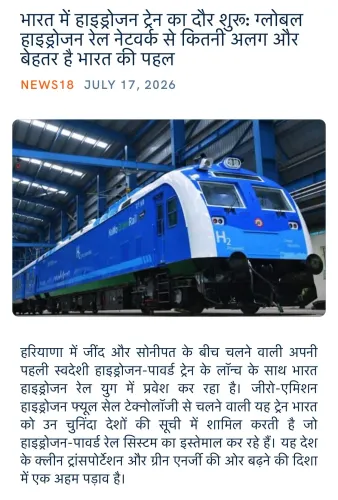
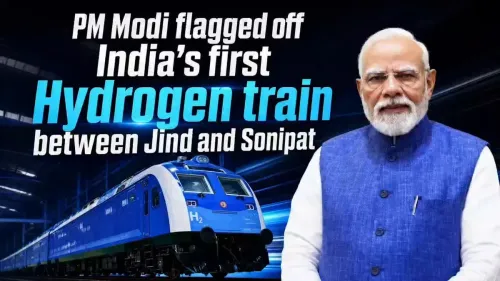
CM Rekha Gupta Hails PM Modi's Hydrogen Train Launch from Haryana

Synopsis
Delhi CM Rekha Gupta amplified PM Narendra Modi's live flagging-off of India's first hydrogen train from Jind, Haryana on 17 July 2026, marking a milestone in Indian Railways' push toward green mobility under the National Green Hydrogen Mission.
Key Takeaways
Delhi CM Rekha Gupta shared a live broadcast of PM Narendra Modi flagging off India's first hydrogen train on 17 July 2026 .
The launch took place at Jind, Haryana , a district in central Haryana with existing rail connectivity.
The event aligns with the National Green Hydrogen Mission , launched in January 2023 to scale hydrogen use in transport and industry.
Indian Railways had committed to hydrogen fuel-cell trains in its 2022-23 budget as part of a net-zero roadmap targeting 2070 .
The project is expected to benefit Haryana rail commuters and could spur domestic fuel-cell manufacturing.
Further route deployments and dedicated Railway Budget allocations will determine the programme's scale-up trajectory.
Delhi Chief Minister Rekha Gupta on Friday, 17 July 2026, shared a live broadcast of Prime Minister Narendra Modi flagging off India's first hydrogen train from Jind, Haryana, calling it a landmark moment for the country's green mobility ambitions.
Context
CM Gupta shared the live event on X, writing: 'LIVE | PM Shri Narendra Modi Ji flags off India's first Hydrogen Train from Jind, Haryana.' The post, carrying an image from the event, directed followers to the broadcast as the flagging-off ceremony unfolded in real time. The choice of Jind — a district in central Haryana with existing rail connectivity — as the launch site signals an intent to pilot hydrogen traction on a regionally significant corridor before wider deployment.
Policy Backdrop
The launch is rooted in a sequence of policy commitments stretching back several years. The National Green Hydrogen Mission, unveiled in January 2023, set out to scale domestic production of green hydrogen and accelerate its use across transport and industry. Indian Railways had already flagged hydrogen fuel-cell trains as a priority in its 2022-23 budget documents, framing them as a key instrument in achieving a net-zero emissions target by 2070.
The broader railway decarbonisation drive has moved on two parallel tracks: rapid electrification of existing diesel routes and selective introduction of hydrogen traction on corridors where overhead electrification remains uneconomical. Today's event marks the transition of the hydrogen train project from planning documents to operational reality.
Stakeholders and Impact
Rail commuters across Haryana stand to be the earliest beneficiaries, with the prospect of quieter, zero-emission services replacing older diesel rolling stock on select routes. For the broader economy, a domestically operated hydrogen train programme could stimulate demand for indigenously manufactured fuel-cell components, reducing dependence on imported crude oil in the transport sector.
The project also carries significance for India's industrial base: scaling hydrogen mobility requires investment in electrolysers, storage infrastructure, and refuelling stations — supply chains that are still nascent. Successful deployment on this corridor could build the commercial case for faster indigenisation of fuel-cell technology.
What's Next
Attention will now turn to the pace of further route deployments and whether the next Railway Budget carries a dedicated outlay for hydrogen train procurement and supporting infrastructure. Policymakers and industry observers will also watch for updates on the domestic fuel-cell manufacturing ecosystem that must scale alongside the rolling stock. A credible expansion roadmap — covering both routes and supply chains — will determine whether today's launch becomes a transformative inflection point or remains a high-profile pilot.
Point of View
Haryana — a state where the BJP holds power — as the launch site is politically deliberate, grounding a national milestone in a friendly jurisdiction. More substantively, the event marks Indian Railways crossing a critical threshold: moving hydrogen traction from policy paper to operational track, which will intensify pressure on the next Railway Budget to back the pilot with a credible procurement pipeline. Whether this launch catalyses a genuine industrial ecosystem for domestic fuel-cell manufacturing, or remains a single high-visibility deployment, will be the real test of the Mission's ambitions.
NationPress
17 Jul 2026
Frequently Asked Questions
What is India's first hydrogen train and where was it launched?
India's first hydrogen train was flagged off by Prime Minister Narendra Modi from Jind, Haryana on 17 July 2026, marking the country's entry into hydrogen-powered rail mobility.
What is the National Green Hydrogen Mission?
The National Green Hydrogen Mission is a central government scheme launched in January 2023 to scale domestic production of green hydrogen and accelerate its use in transport, industry, and other sectors.
Why did Delhi CM Rekha Gupta post about the hydrogen train launch?
CM Rekha Gupta shared a live broadcast of the event on X to highlight the milestone, reflecting BJP leaders' broader effort to amplify major infrastructure launches by PM Modi.
How does the hydrogen train fit into Indian Railways' decarbonisation plan?
Indian Railways identified hydrogen fuel-cell trains in its 2022-23 budget documents as a key tool in achieving net-zero emissions by 2070, complementing its ongoing electrification drive on diesel routes.
What happens after the hydrogen train is flagged off in Jind?
Observers will watch for additional route deployments and a dedicated outlay in the next Railway Budget, as well as progress on building the domestic fuel-cell supply chain needed to scale the programme.