CM Rekha Gupta Hails Rs 2,009 Cr Diwali Bonus for Rail Workers
Synopsis
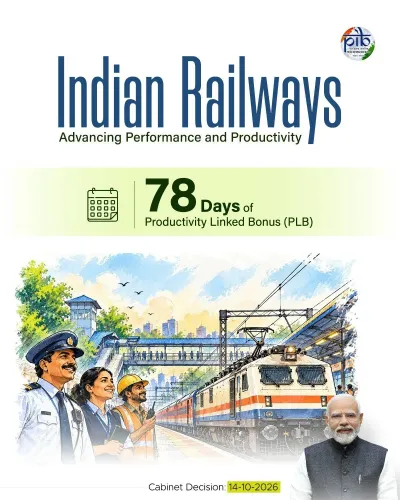
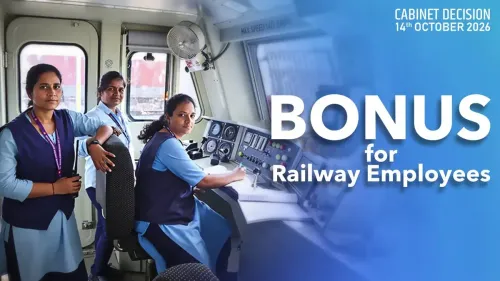
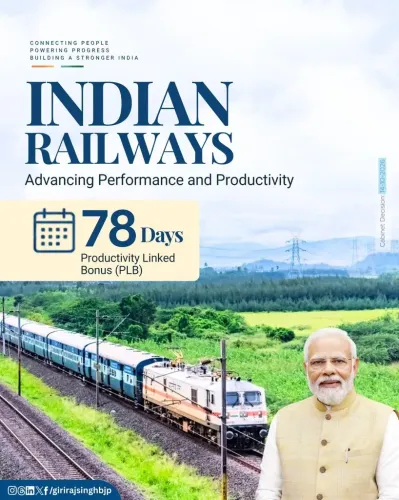
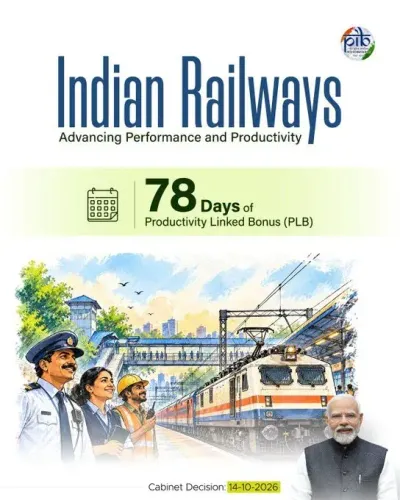
The Union Cabinet approved ₹2,009.61 crore in Performance Linked Bonus — equivalent to 78 days' wages — for over 11.40 lakh Indian Railways employees ahead of Diwali 2026. Delhi CM Rekha Gupta welcomed the move, crediting PM Modi's leadership.
Key Takeaways
The Union Cabinet approved ₹2,009.61 crore in Performance Linked Bonus (PLB) for railway workers on 14 October 2026 .
The bonus covers more than 11.40 lakh Indian Railways employees and is equivalent to 78 days of wages.
The payout is timed ahead of Diwali 2026 , following the government's long-standing pre-festival welfare calendar.
Delhi CM Rekha Gupta publicly credited Prime Minister Narendra Modi for the decision and called it an honour to railway workers' hard work and dedication.
The annual PLB for railways has been a routine Cabinet approval for decades, designed as a performance-linked rather than flat ex-gratia payout.
Just in time for Diwali, the Union Cabinet has cleared a payout of ₹2,009.61 crore in Performance Linked Bonus to more than 11.40 lakh railway employees — a pre-festival gesture that Delhi Chief Minister Rekha Gupta credited to Prime Minister Narendra Modi's leadership on Wednesday, 14 October 2026.
Gupta's post in Hindi announced: 'Aadaraniya Pradhanmantri Shri @narendramodi ji ke netritva mein...' — 'Under the leadership of respected Prime Minister Shri Narendra Modi, the Union Cabinet has approved the payment of ₹2,009.61 crore as 78 days of Performance Linked Bonus (PLB) to more than 11.40 lakh railway workers ahead of Diwali.' She added that the decision will honour the 'hard work and dedication' of railway employees and motivate them to perform even better.
A Festival Ritual Backed by Decades of Precedent
The annual PLB for Indian Railways staff is among the longest-standing pre-festival welfare moves in the central government's calendar. Each year, the Cabinet clears the bonus ahead of Dussehra or Diwali, tying payouts to productivity metrics rather than paying a flat ex-gratia — a design meant to keep the incentive structure performance-anchored rather than purely symbolic.
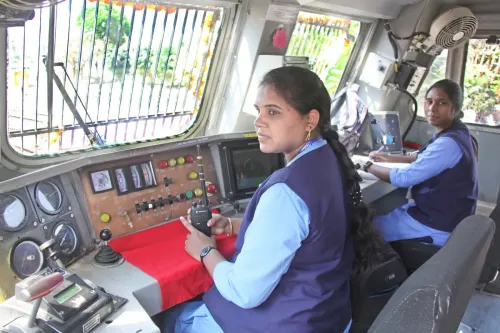
This year's approval covers the entire railway workforce of over 11 lakh employees — from station masters and loco pilots to track maintainers and commercial staff — making it one of the largest single-batch pre-festival disbursements in the public sector. At 78 days' equivalent wages, the quantum sits within the ceiling the government has consistently maintained for Group C and non-gazetted staff across the railways.
Why Railway Workers Watch the Cabinet Calendar Every October
Indian Railways is among the world's largest employers, and its workforce skews heavily towards mid- and lower-pay grades who depend meaningfully on the festival bonus for household expenditure, home repairs, and seasonal purchases. The timing — days before Diwali 2026 — is deliberate: it puts money in workers' hands at peak consumer-spending season.
The announcement also fits a broader pattern of the central government using pre-festival Cabinet meetings to push through employee-welfare decisions, creating a visible rhythm of public-sector benevolence that political leaders across parties are quick to amplify. CM Gupta's post, tagged #CabinetDecisions, follows that playbook precisely.
With funds approved and the festival days away, the operative question now is how quickly the disbursal pipeline moves — and whether the ₹2,009.61 crore reaches accounts before families light the first lamp.
Point of View
High-visibility welfare move that successive governments have used to signal solidarity with organised labour before major festivals — and the BJP has been consistent in amplifying it loudly. CM Rekha Gupta's post is textbook festive-cycle politics: associating her party's national leadership with tangible worker welfare at a moment of peak emotional resonance. The 78-day quantum and the crore-level figure provide shareable specificity that turns a routine Cabinet clearance into a headline. The real policy lens to apply here is fiscal: at ₹2,009 crore in a single disbursement, the cumulative cost of such annual bonuses across all central public sector workforces is substantial — and the government's willingness to sustain that cadence signals a deliberate choice to prioritise organised-sector worker sentiment heading into the festive quarter.
NationPress
14 Oct 2026
Frequently Asked Questions
What is the Performance Linked Bonus (PLB) for railway employees?
PLB is an annual bonus the central government approves for Indian Railways employees, calculated as a number of days' equivalent wages and linked to the system's overall productivity rather than paid as a flat ex-gratia amount. The Cabinet approved 78 days' PLB worth ₹2,009.61 crore for over 11.40 lakh employees ahead of Diwali 2026.
How many railway employees will get the Diwali bonus in 2026?
More than 11.40 lakh (over 1.14 million) Indian Railways employees will receive the PLB approved by the Union Cabinet on 14 October 2026.
How much is the total railway PLB amount approved for 2026?
The Union Cabinet approved ₹2,009.61 crore as Performance Linked Bonus for railway workers, equivalent to 78 days of wages.
Who announced the railway bonus approval?
The Union Cabinet under Prime Minister Narendra Modi approved the bonus. Delhi Chief Minister Rekha Gupta amplified the announcement on X, crediting PM Modi's leadership for the decision.
Is the pre-Diwali railway bonus a new scheme?
No. The annual Performance Linked Bonus for Indian Railways employees has been approved by the central government every year for decades, typically timed before Dussehra or Diwali as part of a long-standing festive-season welfare practice.