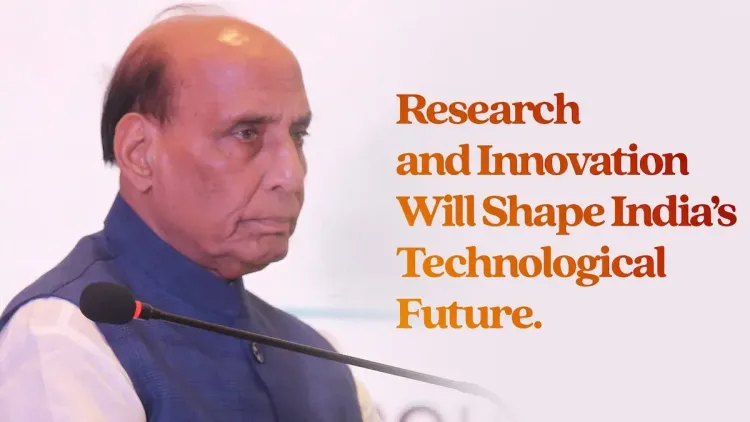
Rajnath Singh backs RDI Scheme to turn labs into national solutions
Synopsis
Union Defence Minister Rajnath Singh endorsed the Research, Development and Innovation Scheme on 14 October 2026, arguing that government-academia-industry collaboration in cybersecurity, semiconductors, quantum technology and healthcare is essential to translating scientific ideas into national solutions under India's Atmanirbhar Bharat framework.
Key Takeaways
Rajnath Singh publicly backed the Research, Development and Innovation (RDI) Scheme on 14 October 2026 , stressing its role in addressing societal and security challenges.
The scheme targets four strategic domains: cybersecurity, healthcare, semiconductors and quantum technology .
Its model relies on a tripartite collaboration between government, academia and industry to translate research into deployable solutions.
The RDI Scheme builds on prior missions including the India Semiconductor Mission (2021) and the National Quantum Mission (2023) .
Singh's endorsement from the Defence Ministry signals that these domains are treated as national security priorities, not just civilian science goals.
Upcoming Union Budget allocations and progress on existing technology missions will be the key indicators of the scheme's real momentum.
From quantum computers to cyber defences, the gap between a scientific idea and a working national asset is where India's ambitions most often stall — and Union Defence Minister Rajnath Singh is pointing directly at that gap. On Wednesday, 14 October 2026, Singh took to X to advocate for the Research, Development and Innovation (RDI) Scheme, calling research 'key to addressing societal challenges and strengthening India's technological capabilities.'
What the RDI Scheme sets out to do
Singh's post frames the RDI Scheme as a translational bridge — a mechanism to move scientific work out of the laboratory and into deployable solutions that serve national priorities. He cited four specific domains: cybersecurity, healthcare, semiconductors and quantum technology. The scheme's architecture, he noted, rests on a three-way collaboration between government, academia and industry — the same tripartite model that has defined India's most ambitious technology programmes of the past decade.
That framing is deliberate. India's semiconductor and quantum missions have both leaned heavily on this partnership structure, and the RDI Scheme appears designed to give that model a unified, cross-domain scaffold rather than leaving each sector to build its own institutional bridge from scratch.
Where RDI fits in India's indigenisation drive
The scheme lands within a well-established policy lineage. The Atmanirbhar Bharat framework, active since 2020, set the strategic objective: reduce import dependence in critical technologies by building domestic capacity from research through to production. The National Education Policy 2020 expanded that mandate into universities, stressing research infrastructure and industry linkages. The India Semiconductor Mission, launched in 2021, and the National Quantum Mission, approved in 2023, then took those principles into specific high-stakes verticals.
The RDI Scheme, as Singh describes it, operates at a level above these individual missions — a horizontal enabler that could accelerate progress across all of them simultaneously by institutionalising the government-academia-industry handshake.
Why Rajnath Singh's voice on this matters
A statement on R&D policy from the Defence Minister is not incidental. Cybersecurity and quantum technology are as much defence priorities as they are civilian ones — quantum-resistant encryption, for instance, is a live concern for military communications globally. Singh's decision to publicly champion the scheme signals that the defence establishment sees RDI not merely as a science ministry concern but as a national security imperative. It also fits his broader record: as Home Minister before the defence portfolio, Singh oversaw security modernisation efforts that repeatedly bumped up against the same problem — India's capacity to generate cutting-edge technology domestically.
Budget lines and mission milestones to watch
The real test of any R&D scheme is what follows the announcement: budget allocations in the next Union Budget, and measurable progress on the National Quantum Mission and Semiconductor Mission will signal whether the RDI framework is gaining traction or stalling at the intent stage. Singh's post plants a public flag — and public flags, in Indian technology policy, tend to sharpen accountability.
India has the research talent. It has the missions. What it has historically struggled to build is the connective tissue between discovery and deployment. The RDI Scheme, if it delivers on the collaboration model Singh describes, is an attempt to manufacture exactly that tissue — at scale, across the sectors that will define the next decade of strategic competition.
Point of View
Not merely a science ministry brief — a significant shift in how India's technology indigenisation agenda is being communicated at the cabinet level. The RDI Scheme appears designed to act as horizontal connective tissue across vertical missions like the Semiconductor and Quantum programmes, addressing the chronic Indian problem of research that never reaches deployment. Positioning the Defence Minister as a champion of translational research also subtly accelerates the dual-use logic — civilian breakthroughs in quantum and cybersecurity feed directly into military modernisation. Whether intent converts to institutional muscle will depend on budget decisions and inter-ministry coordination that is yet to be tested publicly.
NationPress
14 Oct 2026
Frequently Asked Questions
What is the Research, Development and Innovation Scheme in India?
The Research, Development and Innovation (RDI) Scheme is a government-backed initiative designed to advance R&D in strategic domains such as cybersecurity, semiconductors, quantum technology and healthcare through structured collaboration between government agencies, academic institutions and private industry.
Why did Rajnath Singh talk about R&D and not just defence?
As Defence Minister, Singh oversees domains — cybersecurity and quantum technology in particular — that are directly relevant to national security. His backing of the RDI Scheme signals that the defence establishment views translational research in these sectors as a strategic priority, not merely a civilian science concern.
How does the RDI Scheme relate to India's Semiconductor Mission?
The India Semiconductor Mission, launched in 2021, focuses specifically on building domestic chip design and fabrication capacity. The RDI Scheme works at a broader level, providing a shared government-academia-industry collaboration framework that can support semiconductor research alongside quantum and cybersecurity work.
What is India's National Quantum Mission?
The National Quantum Mission was approved in 2023 to develop India's quantum computing and communication capabilities. It is one of the flagship technology programmes the RDI Scheme is expected to complement by helping move quantum research from laboratories into usable national systems.
What should we watch to judge if India's RDI Scheme is actually working?
The clearest signals will be Union Budget allocations earmarked for R&D under this framework, and measurable progress milestones reported by the National Quantum Mission and the India Semiconductor Mission — both of which serve as proxies for whether the broader translational research model is gaining real traction.