CM Rekha Gupta Hails Rs 2,403 Cr Central Package for Delhi
Synopsis
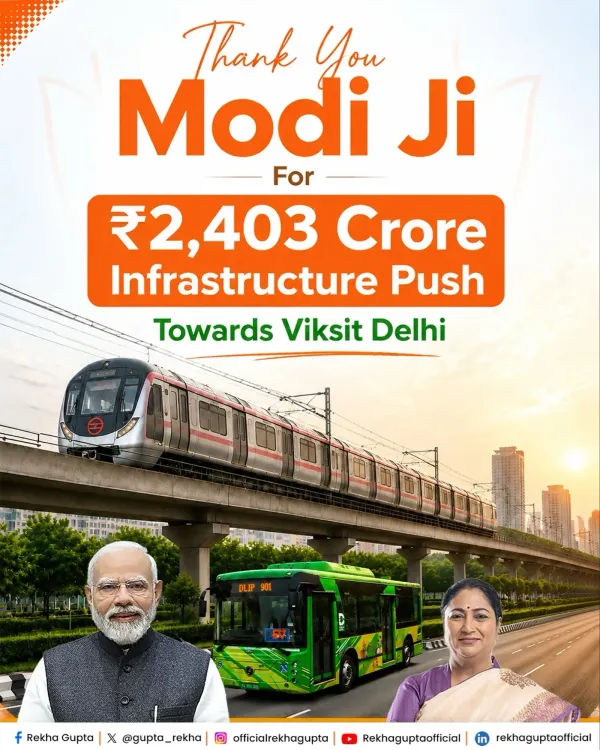
Delhi Chief Minister Rekha Gupta on 14 July 2026 hailed a Union Government-approved package of Rs 2,403 crore for Delhi, covering metro expansion, EV infrastructure, and modern connectivity projects, calling it proof of PM Modi's commitment to a 'Viksit Delhi'.
Key Takeaways
The Union Government has approved a ₹2,403 crore package for infrastructure development in Delhi .
Delhi Chief Minister Rekha Gupta announced and welcomed the package on 14 July 2026 via a thread on X .
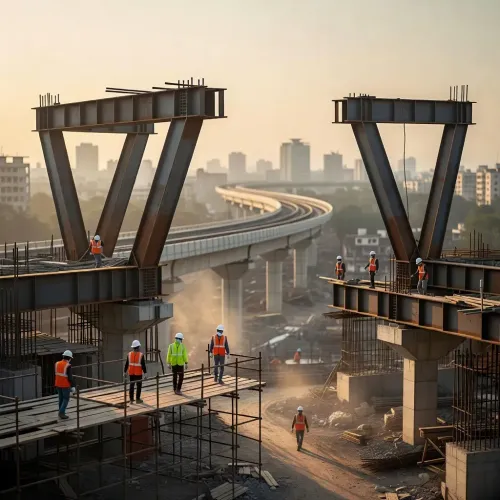
The package covers metro expansion , EV infrastructure , modern connectivity, and other public-interest projects.
The announcement aligns with the national Viksit Bharat 2047 development goal championed by PM Narendra Modi .
Further project-by-project details are expected in subsequent posts from CM Gupta 's thread.
Delhi commuters and residents of one of Asia's most populous capitals are the primary beneficiaries.
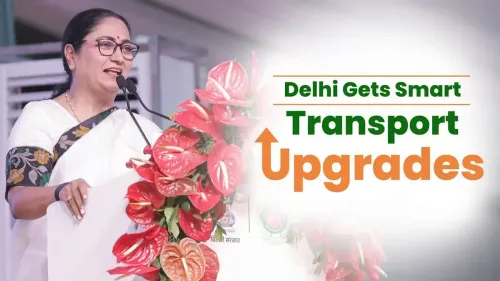
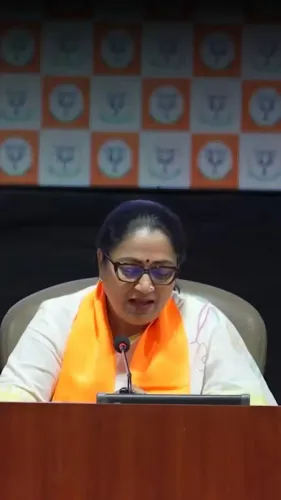
Delhi Chief Minister Rekha Gupta on Tuesday, 14 July 2026, welcomed a ₹2,403 crore package approved by the Union Government for the capital, calling it a testament to Prime Minister Narendra Modi's 'unwavering commitment' to Delhi's development. The package is set to fund metro expansion, modern connectivity, and electric vehicle infrastructure, among other public-interest projects.
Context
Posting on X in Hindi, CM Gupta wrote: 'केंद्र सरकार द्वारा स्वीकृत ₹2,403 करोड़ का यह पैकेज केवल निवेश नहीं, बल्कि दिल्ली के विकास के प्रति आदरणीय प्रधानमंत्री जी की अटूट प्रतिबद्धता का सशक्त प्रमाण है' — ('This ₹2,403 crore package approved by the central government is not merely an investment, but a powerful proof of the honoured Prime Minister's unwavering commitment to Delhi's development'). She framed the announcement as a milestone on the road from a 'Viksit Delhi' (Developed Delhi) to a 'Viksit Bharat' (Developed India), echoing the government's 2047 national development goal.
The Chief Minister also indicated this post was part of a thread, signalling that further details on individual projects would follow.
Policy Backdrop
The central government has a long-standing practice of co-funding urban infrastructure in Delhi, with the Delhi Metro Rail Corporation (DMRC) being a primary vehicle for joint investment. The Union Cabinet approved Phase-IV of the Delhi Metro project as far back as 2019, covering new corridors and extensions across the city.
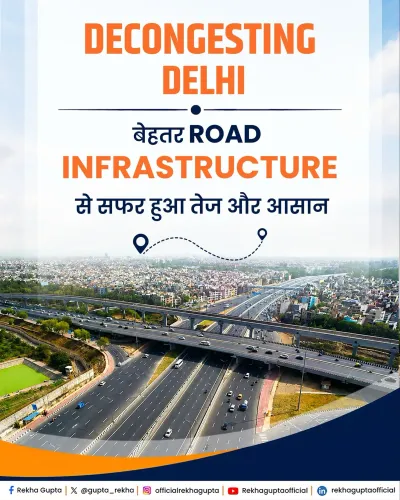
The latest ₹2,403 crore package broadens the scope beyond metro rail to include EV infrastructure and broader connectivity upgrades, aligning with the national push to modernise urban mobility and reduce vehicular emissions in the capital. This pattern of periodic federal funding injections for Delhi's urban framework has been a consistent feature of central-state infrastructure cooperation.
Stakeholders and Impact
Delhi's estimated population of over 2 crore residents stands to benefit directly from improved metro connectivity and cleaner transport options. Daily commuters who rely on the Delhi Metro network — one of the busiest urban rail systems in Asia — are among the most immediate beneficiaries of any capacity or corridor expansion.
The EV infrastructure component is particularly significant as Delhi consistently ranks among India's most air-polluted cities. Expanding charging networks and EV-friendly public infrastructure could accelerate the shift away from petrol and diesel vehicles, with direct implications for air quality and public health.
What's Next
CM Gupta's indication of a thread suggests that project-by-project breakdowns of the ₹2,403 crore allocation are expected to follow. Detailed rollout timelines, tendering processes, and implementation schedules for the metro expansion and EV infrastructure components will be closely watched by urban planners, contractors, and commuters alike.
Parliamentary and assembly-level discussions on the disbursement and monitoring of the package are also anticipated. The announcement sets the tone for Delhi's infrastructure agenda in the coming fiscal period, with the BJP-led state government keen to demonstrate tangible delivery under the broader Viksit Bharat framework ahead of future electoral cycles.
Point of View
403 crore figure is front and centre, but the framing consistently elevates PM Modi as the driving force, a standard BJP communication playbook that ties state delivery to central leadership. The metro-plus-EV combination signals that the Delhi government is attempting to address both the city's chronic congestion and its air quality crisis in a single narrative package. Coming from a Chief Minister whose party recently returned to power in Delhi after a prolonged absence, the announcement also serves as early proof-of-governance to a sceptical urban electorate. The 'Viksit Delhi to Viksit Bharat' framing embeds local infrastructure spending within the ruling party's macro-national vision, making it simultaneously a state and a national political asset.
NationPress
14 Jul 2026
Frequently Asked Questions
What is the Rs 2,403 crore package for Delhi announced in 2026?
The ₹2,403 crore package is a Union Government-approved fund for Delhi covering metro rail expansion, EV infrastructure, modern connectivity upgrades, and other public-interest projects, as announced by Delhi Chief Minister Rekha Gupta on 14 July 2026.
Who is Rekha Gupta and what is her role in Delhi?
Rekha Gupta is the Chief Minister of Delhi and a senior BJP leader. She leads the Delhi state government and has been a prominent voice for central-state infrastructure collaboration in the capital.
What projects will the Delhi central package fund?
According to CM Rekha Gupta's post, the package will fund metro expansion, modern connectivity infrastructure, electric vehicle (EV) charging and support infrastructure, and several other public-interest projects in Delhi.
What is Viksit Delhi and how does it connect to Viksit Bharat?
'Viksit Delhi' is a development vision for a modernised, well-connected Delhi, framed by the BJP government as a building block toward 'Viksit Bharat' — PM Modi's national goal of a fully developed India by 2047.
How does the Delhi Metro expansion fit into this package?
Metro expansion is one of the key components of the ₹2,403 crore package. The Delhi Metro has been expanding in phases since the early 2000s, with Phase-IV approved in 2019. The new central funding is expected to accelerate further corridor additions and capacity upgrades.