CM Revanth Reddy Urges Youth to Build AI-Era Skills
Synopsis
On World Youth Skills Day, 15 July 2026, Telangana CM Revanth Reddy called on youth to continuously upgrade skills for an AI-era world, citing the state's Young India Skills University and modernised ATCs and Polytechnic Colleges as concrete steps toward reducing skill-mismatch unemployment.
Key Takeaways
Revanth Reddy issued a World Youth Skills Day message on 15 July 2026 urging continuous upskilling in an AI-driven world.
He stated that a skills mismatch between the workforce and modern industry demands is a direct cause of unemployment.
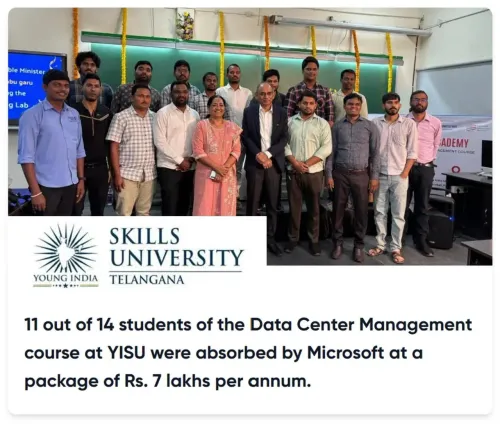
The Telangana government has established the Young India Skills University as a dedicated institution for vocational and skill-based higher education.
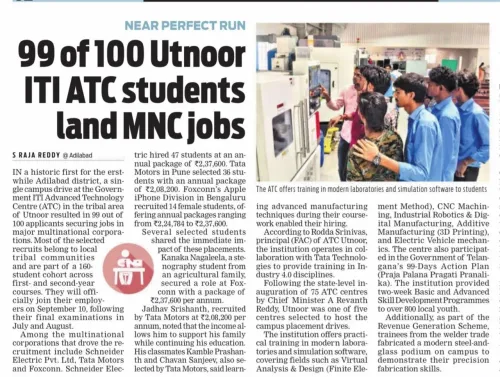
ATCs (Advanced Training Centres) and Polytechnic Colleges are being modernised into technology hubs under the state's skilling push.
The CM framed skills as 'a strong foundation for social progress and national development,' not merely a tool for individual employment.
Telangana's approach aligns with the national Skill India Mission launched in 2015 , with added emphasis on continuous reskilling.
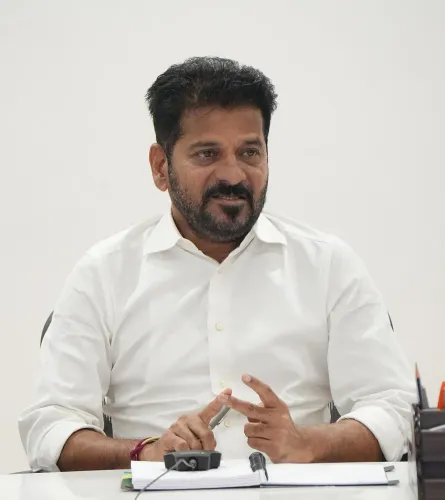
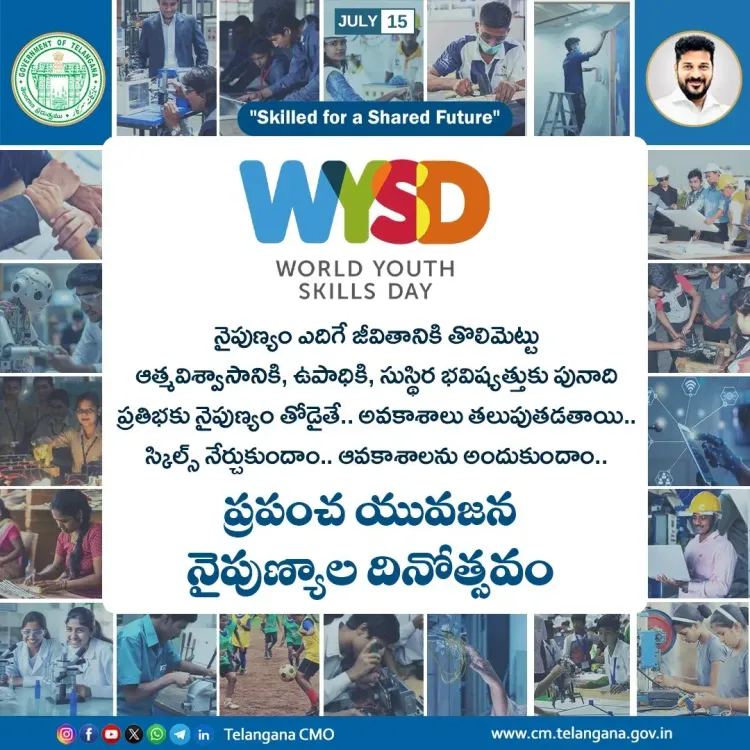
On the occasion of World Youth Skills Day, 15 July 2026, the Chief Minister's Office of Telangana shared a message from Chief Minister A. Revanth Reddy urging the state's youth to continuously upgrade their skills to keep pace with a rapidly changing world shaped by Artificial Intelligence. The message highlighted the government's institutional push — including the establishment of the Young India Skills University and modernisation of ATCs and Polytechnic Colleges — to ensure skill-based education reaches every young person in Telangana.
Context
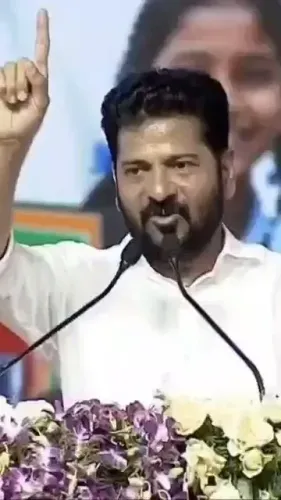
World Youth Skills Day is observed every year on 15 July, a date recognised by the United Nations since 2014 to promote the importance of equipping youth with skills for employment and entrepreneurship. CM Revanth Reddy used the occasion to deliver a pointed message to Telangana's youth: 'నేర్చుకోవడం ఆపొద్దు... స్కిల్స్ పెంచుకుకోవాలి' ('Never stop learning... keep building your skills'). He added that skills are not only a path to personal success but 'a strong foundation for social progress and national development.'
The CM further noted that a mismatch between the skills available in the workforce and those demanded by modern systems is a direct driver of unemployment — a concern increasingly acute as AI reshapes labour markets globally.
Policy Backdrop
The Telangana government has pursued a multi-pronged strategy to institutionalise skill development. Beyond upgrading existing ATCs (Advanced Training Centres) and Polytechnic Colleges into modern technology hubs, the state has established the Young India Skills University, a dedicated institution for vocational and skill-based higher education. The university is designed to align course offerings with the demands of contemporary industries, including technology-driven sectors.
This state-level effort dovetails with the national Skill India Mission, launched by the Government of India in 2015, which sought to scale vocational training and treat skills as economic and social infrastructure. Telangana's approach places a distinct emphasis on continuous reskilling — the idea that a single round of training is insufficient in an era of rapid technological change.
Stakeholders and Impact
The primary beneficiaries of these initiatives are Telangana's youth, particularly students enrolled in polytechnic programmes and those seeking vocational pathways alongside or instead of conventional academic degrees. The broader pattern across Indian states — of building dedicated skill universities and upgrading ITIs and polytechnics — reflects a shared recognition that AI-driven disruption demands proactive workforce preparation.
For students and job-seekers, the message carries a practical implication: academic qualifications alone may not suffice. The CM's statement that 'skill is the path to self-confidence, employment, and a sustainable future' frames reskilling not as a remedial measure but as a core life strategy. Employers and industry bodies in Telangana stand to benefit from a workforce better aligned with evolving technological requirements.
What's Next
Attention will now turn to the rollout metrics and course catalogue of the Young India Skills University, as well as the pace and quality of modernisation at ATCs and Polytechnic Colleges across the state. State budget allocations for these institutions in upcoming fiscal cycles will be a key indicator of how firmly skill development is prioritised beyond ceremonial occasions. As AI continues to redraw the boundaries of human labour, Telangana's ability to translate political messaging into measurable skilling outcomes will determine whether its youth gain a genuine competitive edge.
Point of View
Technology-aware governance ahead of future electoral cycles. By anchoring the message to AI and citing a tangible institution — the Young India Skills University — the CM moves beyond routine ceremonial rhetoric toward a claim of concrete delivery. The emphasis on continuous reskilling, rather than one-time training, reflects a sophisticated understanding of how AI-driven labour markets work, and positions Telangana within a broader national and global conversation about the future of work. Whether the institutional infrastructure can match the ambition of the messaging will be the real test.
NationPress
15 Jul 2026
Frequently Asked Questions
What did CM Revanth Reddy say on World Youth Skills Day 2026?
CM Revanth Reddy urged Telangana's youth to continuously upgrade their skills to keep pace with AI and rapid global changes, stating that skills are the foundation of personal success, social progress, and national development.
What is the Young India Skills University in Telangana?
Young India Skills University is a state-established institution in Telangana focused on modern skill-based and vocational higher education, designed to align training with the demands of contemporary industries.
When is World Youth Skills Day observed?
World Youth Skills Day is observed every year on 15 July. It was recognised by the United Nations in 2014 to promote the importance of equipping youth with skills for employment and entrepreneurship.
How is Telangana upgrading its skill development infrastructure?
The Telangana government is modernising ATCs (Advanced Training Centres) and Polytechnic Colleges into technology hubs and has established the Young India Skills University as a dedicated skilling institution.
Why does CM Revanth Reddy link skill gaps to unemployment?
The CM stated that a mismatch between skills available in the workforce and those demanded by modern systems is a direct driver of unemployment, a concern that has grown sharper as AI reshapes labour markets.