CM Rio Pushes for Multi-Year PPP Deals to Drive Nagaland Growth

Synopsis
Nagaland Chief Minister Neiphiu Rio has called on roundtable stakeholders to move beyond discussion and forge concrete multi-year partnerships combining CSR, philanthropy, government programmes, and private-sector expertise to drive inclusive growth in Nagaland.
Key Takeaways
CM Neiphiu Rio urged a stakeholder roundtable to convert dialogue into binding, multi-year development partnerships.
The proposed model combines CSR funding, philanthropy, government programmes, and private-sector expertise in a blended-finance structure.
Rio framed Nagaland's progress as part of India's broader aspiration for an inclusive and prosperous nation.
Northeastern India , including Nagaland, has long pursued PPP-driven development to address regional infrastructure and economic disparities.
The Chief Minister's language positions Nagaland's development dividend as a national gain, strengthening the case for corporate and institutional investment.
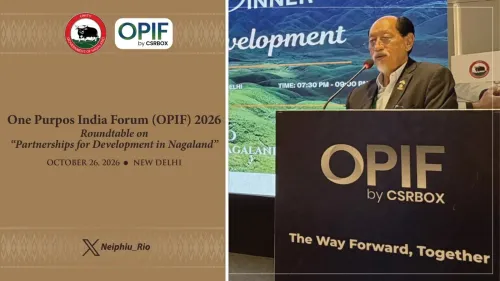
Nagaland Chief Minister Neiphiu Rio has issued a clear call to action at a stakeholder roundtable, urging participants to move past conversation and into concrete, multi-year commitments that braid together CSR funding, philanthropy, government programmes, and private-sector expertise to accelerate the state's development.
From talking shop to binding commitment
The Chief Minister's message was pointed: roundtables that end only in minutes and good intentions are not enough. Rio explicitly called for multi-year partnerships that lock in accountability across four distinct streams — corporate social responsibility, philanthropic capital, state and central government schemes, and the operational know-how of private enterprise. The blended-finance architecture he described is increasingly the preferred model for closing development gaps in regions where public budgets alone cannot keep pace with need.
Why Nagaland, and why now
Nagaland, a landlocked state in northeastern India, has long contended with infrastructure deficits, a thin industrial base, and geographic remoteness that raises the cost of every project. Yet it sits at the centre of India's Act East Policy corridor, giving it strategic importance that attracts attention from both New Delhi and private investors. Northeastern states have increasingly used public-private partnerships and centrally sponsored schemes to bridge regional disparities — and Rio's push aligns squarely with that national thrust.
Rio framed Nagaland's progress not as a regional ask but as part of a 'shared aspiration for an inclusive and prosperous India' — language that positions the state's development dividend as a national gain, not a charity transfer. That framing matters when pitching multi-year commitments to corporate boardrooms.
The partnership model Rio is betting on
The four-pillar model Rio outlined — CSR, philanthropy, government programmes, private expertise — is significant because it distributes risk and ensures no single funding stream becomes a chokepoint. CSR mandates under India's Companies Act create a legal obligation for larger firms; philanthropy brings flexible, patient capital; government schemes provide scale and legitimacy; private-sector expertise supplies the execution muscle that public projects often lack. Stacking all four into a single multi-year vehicle is the architecture that development economists argue delivers the most durable outcomes in underserved regions.
Whether the roundtable produces binding term sheets or remains aspirational will be the metric to watch. The Chief Minister has drawn the line clearly — now the partners must step across it.
Point of View
Multi-year blended-finance model reflects a maturation in how northeastern state governments pitch development to the private sector — less supplication, more partnership architecture. By explicitly tying Nagaland's progress to India's national inclusivity narrative, he is borrowing the rhetorical toolkit that has made schemes like PM GatiShakti politically and financially viable. The real test is whether the roundtable produces legally binding, time-bound commitments or dissolves into goodwill communiques. For a state at the crossroads of the Act East corridor, the difference between those two outcomes is measured in decades of development.
NationPress
27 Oct 2026
Frequently Asked Questions
What did Nagaland CM Neiphiu Rio say at the roundtable?
CM Neiphiu Rio called on roundtable participants to move beyond discussions and form concrete multi-year partnerships that combine CSR, philanthropy, government programmes, and private-sector expertise to drive Nagaland's development.
What is a blended-finance model in the context of state development?
A blended-finance model combines multiple funding streams — such as corporate CSR mandates, philanthropic grants, government schemes, and private investment — to reduce risk and ensure more durable, well-resourced development outcomes.
Why is Nagaland's development important for India's broader goals?
Nagaland sits on India's Act East Policy corridor in the northeast, making its development strategically significant for regional connectivity, trade, and the national goal of reducing economic disparities across states.
What is the NDPP and who leads it?
The Nationalist Democratic Progressive Party (NDPP) is a political party in Nagaland led by Chief Minister Neiphiu Rio, who has governed the state and championed peace and development initiatives in the northeast.
What multi-year partnership outcomes should be watched for?
Follow-up announcements from the referenced roundtable — including signed partnership agreements, committed CSR allocations, or jointly funded government-private programmes — will indicate whether Rio's call translated into binding action.