CM Sai Assures Adequate Fertilizer Supply for Kharif Season
Synopsis
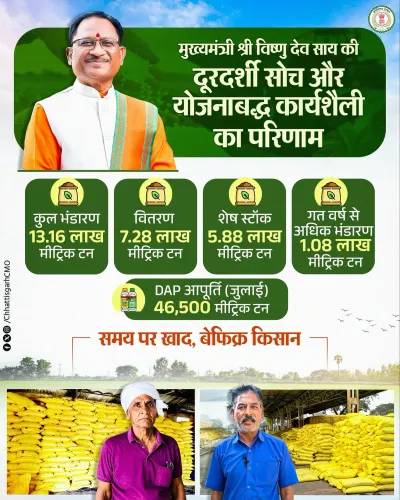
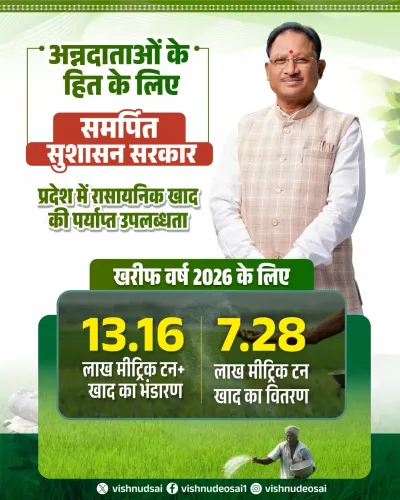
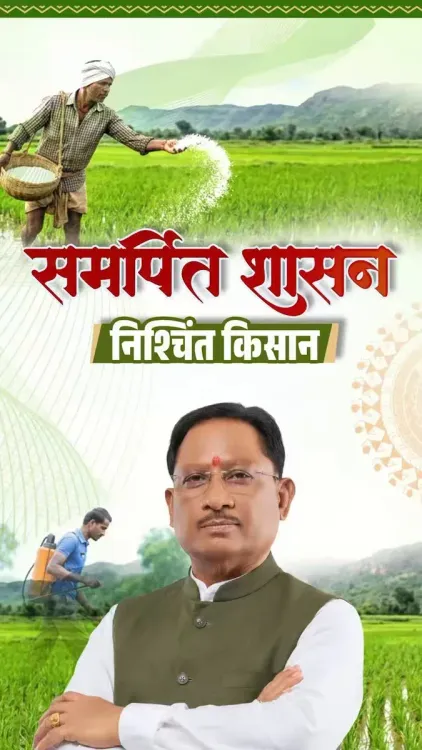
Chhattisgarh Chief Minister Vishnu Deo Sai on July 7, 2026, pledged adequate fertilizer storage, regular supply, and timely distribution for the Kharif season, reaffirming the state's commitment to uninterrupted support for its farming community.
Key Takeaways
CM Vishnu Deo Sai posted on July 7, 2026 assuring continuous fertilizer availability for the Kharif 2026 season.
The state has committed to adequate storage, regular supply, and timely distribution of fertilizers for farmers.
Chhattisgarh is a major rice-producing state where paddy is the principal Kharif crop, making fertilizer supply critical.
Fertilizer allocation is governed under the central government's Nutrient Based Subsidy scheme , operational since 2010 .
The BJP administration under CM Sai , in office since December 2023 , has prioritised timely agricultural input delivery as a stated policy goal.
Coordination between the state agriculture department and the Union Ministry of Chemicals and Fertilizers will be key to translating the assurance into ground-level delivery.
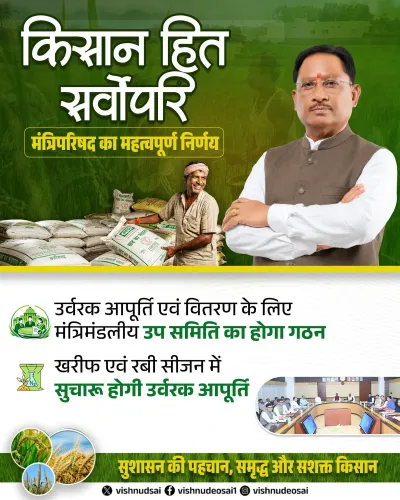
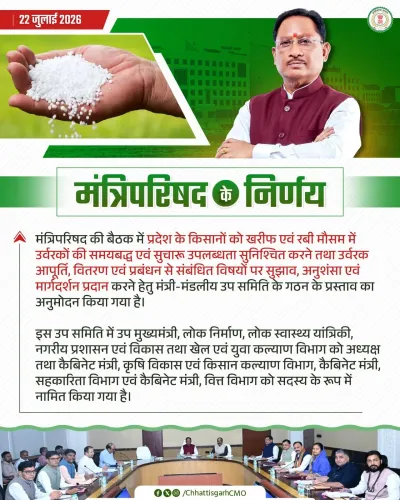
Chhattisgarh Chief Minister Vishnu Deo Sai on Tuesday, July 7, 2026, assured farmers that adequate fertilizer stocks are being maintained for the ongoing Kharif season, with regular supply and timely distribution being ensured across the state.
Context
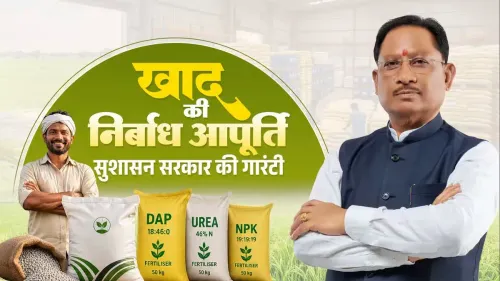
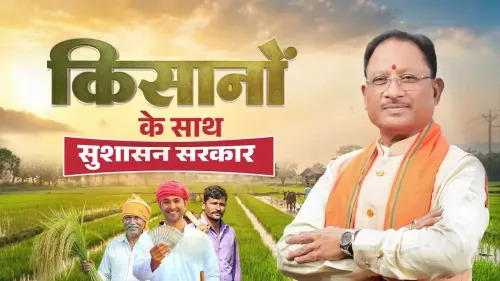
Posting in Hindi on X, CM Sai stated: 'Kharif season mein kisanon ke liye khad ka paryapt bhandaran, niyamit aapurti aur samayabaddh vitaran lagatar sunishchit kiya ja raha hai' ('Adequate storage, regular supply, and timely distribution of fertilizers for farmers in the Kharif season are being continuously ensured'). He added that the state's resolve is to ensure farmers receive fertilizers on time, farming proceeds without interruption, and annadata ('food providers') continue to receive every possible support.
The statement comes at the peak sowing window of the Kharif 2026 season, when demand for fertilizers — particularly urea and DAP — surges across paddy-cultivating districts in Chhattisgarh.
Policy Backdrop
Chhattisgarh is one of India's major rice-producing states, with paddy being the principal Kharif crop. The state's fertilizer availability depends on allocations decided at the national level and on port-to-district logistics coordinated between the state agriculture department and the Union Ministry of Chemicals and Fertilizers.
The Nutrient Based Subsidy (NBS) scheme, operational since 2010, provides decontrolled fertilizers at subsidised rates to farmers under a central government framework. State governments work within this structure to manage last-mile delivery. Issuing pre-Kharif assurances on fertilizer availability is a standard practice among agricultural states to signal administrative readiness before sowing peaks.
Following the 2023 Chhattisgarh assembly elections, the BJP administration under CM Sai stated its intent to prioritise timely delivery of agricultural inputs as part of its broader commitment to the farming community.
Stakeholders and Impact
The assurance is directed primarily at small farmers and paddy cultivators, who are most vulnerable to supply disruptions during the critical early-sowing period. Any shortage or delay in fertilizer availability during June-August can directly affect crop yield and, in turn, the state's overall foodgrain output.
Chhattisgarh's agrarian economy means that a large share of the state's rural population depends on the Kharif harvest for income and sustenance. Timely fertilizer distribution is therefore not only an agricultural concern but also a matter of rural economic stability.
What's Next
Coordination meetings between the Chhattisgarh Agriculture Department and the Union Ministry of Chemicals and Fertilizers ahead of peak Kharif demand will be closely watched to assess whether allocation targets are being met at the district level. The state government's follow-through on ground-level distribution will determine whether this assurance translates into uninterrupted supply for farmers across all regions.
Point of View
But in Chhattisgarh's case it carries added political weight: the BJP won the 2023 state elections partly on an agrarian welfare platform, and any visible failure in fertilizer delivery would carry direct electoral consequences in a predominantly rural state. The post's emphasis on the word 'resolve' ('sankalp') signals this is framed as a governance commitment, not merely a logistics update. Broader, it reflects the centre-state coordination challenge under the NBS framework, where states must manage last-mile delivery within nationally determined allocation caps. Observers will watch whether district-level stock positions bear out the assurance as peak sowing demand arrives in July-August.
NationPress
6 Oct 2026
Frequently Asked Questions
Is there enough fertilizer for Kharif 2026 in Chhattisgarh?
CM Vishnu Deo Sai stated on July 7, 2026, that adequate fertilizer storage, regular supply, and timely distribution are being continuously ensured for the Kharif season in Chhattisgarh.
What is the Kharif season in India?
The Kharif season is India's monsoon-dependent cropping period running roughly from June to October, accounting for the bulk of the country's foodgrain output, with paddy being the principal crop in states like Chhattisgarh.
What is the Nutrient Based Subsidy scheme for fertilizers?
The Nutrient Based Subsidy (NBS) scheme, introduced by the central government in 2010, provides decontrolled fertilizers to farmers at subsidised rates, replacing the earlier retention price scheme for non-urea fertilizers.
Who is Vishnu Deo Sai?
Vishnu Deo Sai is a BJP leader serving as Chief Minister of Chhattisgarh since December 2023, following the party's victory in the state assembly elections held that year.
Why is fertilizer supply important for Chhattisgarh farmers?
Chhattisgarh is a major rice-producing state with a predominantly agrarian economy. Any disruption in fertilizer supply during the critical June-August sowing window can directly affect paddy yields and rural incomes across the state.