CM Sai Ensures Fertilizer Supply for Chhattisgarh Kharif 2026
Synopsis
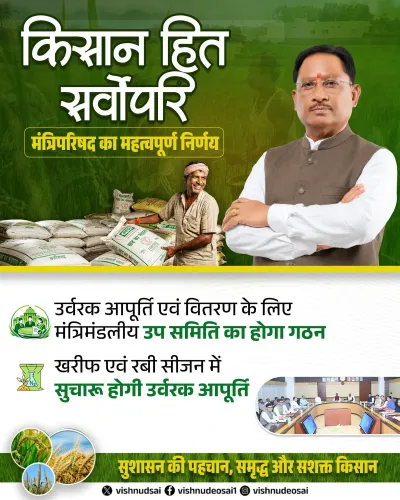
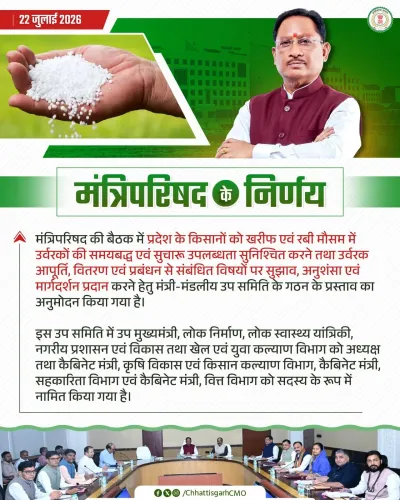
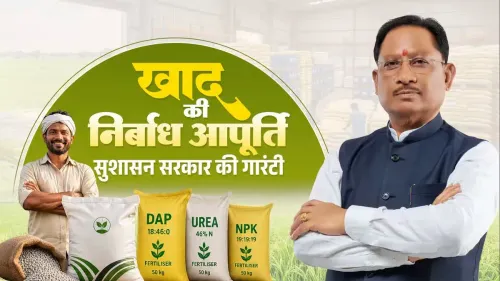
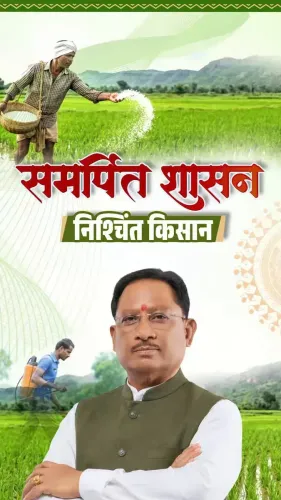
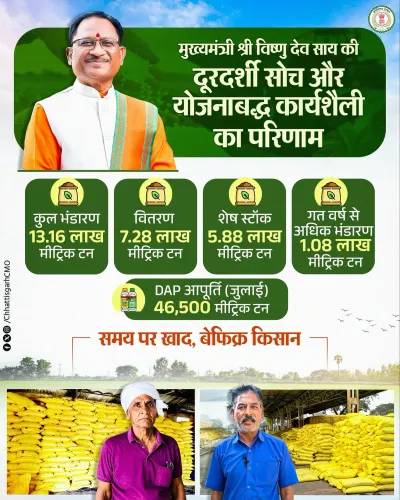
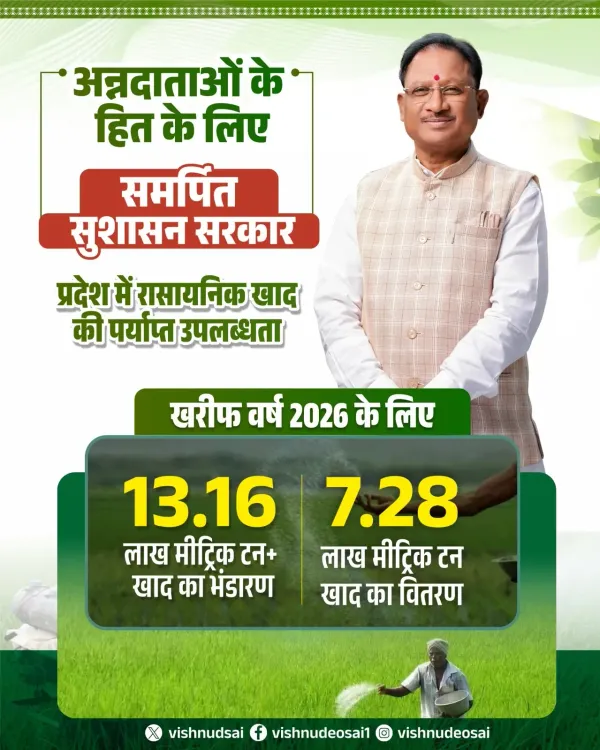
Chhattisgarh Chief Minister Vishnu Deo Sai announced on 4 July 2026 that adequate chemical fertilizer supplies have been secured for the Kharif 2026 season, pledging that farmers will receive inputs on time for uninterrupted sowing operations across the state.
Key Takeaways
Chief Minister Vishnu Deo Sai announced adequate chemical fertilizer availability for Kharif 2026 on 4 July 2026 .
The government stated that timely fertilizer access is its 'highest priority' for the state's farming community.
The announcement targets uninterrupted sowing operations during Chhattisgarh 's paddy-dominant Kharif cycle.
CM Sai framed the measure within a 'su-shasan' (good governance) commitment to farmer welfare and prosperity.
District-level distribution by cooperative societies will determine last-mile delivery success.
State fertilizer distribution reports and supplementary budget moves for agriculture inputs are the next key indicators to watch.
Chhattisgarh Chief Minister Vishnu Deo Sai on Saturday, 4 July 2026 announced that adequate chemical fertilizer supplies have been secured across the state ahead of the Kharif 2026 sowing season, reaffirming his government's commitment to uninterrupted agricultural operations for farmers.
Context
Posting in Hindi on X, Chief Minister Sai wrote: 'अन्नदाताओं की हर जरूरत का समय पर समाधान हमारी सरकार की सर्वोच्च प्राथमिकता है' ['Timely resolution of every need of the food-providers is the highest priority of our government']. He added that fertilizer availability has been ensured so that farmers receive inputs on time and farming work proceeds 'smoothly without any disruption.'
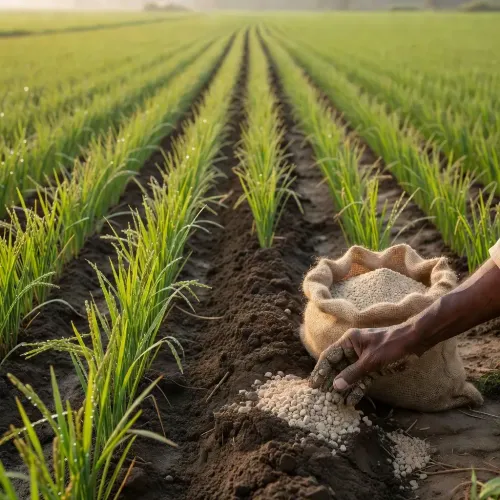
The announcement comes weeks before the main Kharif sowing window, when demand for chemical fertilizers — primarily urea and di-ammonium phosphate (DAP) — peaks sharply across Chhattisgarh's paddy-dominant agricultural belt.
Policy Backdrop
The central government has coordinated with state governments each year to pre-position fertilizer stocks before the Kharif season, with allocations flowing through the Ministry of Agriculture and the Department of Fertilizers. Chhattisgarh, a major paddy-producing state in central India, depends heavily on timely input supply to sustain output during the June-to-October crop cycle.
Since at least 2014, pre-season fertilizer assurances have been a standard feature of state agricultural planning, but their political salience has grown as input shortages in previous years caused sowing delays and yield losses in several states. Chief Minister Sai, who took office in December 2023, has consistently framed agricultural welfare measures within a 'su-shasan' ['good governance'] narrative that links administrative delivery to rural prosperity.
BJP-governed states have broadly adopted this framing — connecting pre-season input assurances to a larger promise of farmer welfare — as part of both governance strategy and rural electoral outreach.
Stakeholders and Impact
The primary beneficiaries are Chhattisgarh's farming communities, who rely on chemical fertilizers to prepare paddy fields at the onset of the monsoon. Disruptions in fertilizer supply at this stage can delay transplanting, reduce yields, and push up input costs for smallholders who lack the capital to source alternatives from open markets.
District-level agriculture officials and cooperative societies responsible for fertilizer distribution are the key implementation actors. Their on-ground execution will determine whether the state-level assurance translates into last-mile availability in rural blocks and mandis.
What's Next
Attention will now shift to state-level fertilizer distribution reports and any supplementary budget announcements for agriculture inputs ahead of the active sowing window. The government's ability to maintain supply continuity through the peak demand period — typically July to August — will be the practical test of this commitment. Any shortfall at the district or block level is likely to draw opposition scrutiny and farmer-group responses in the weeks ahead.
Point of View
The government simultaneously signals competence to farmers and distances itself from the supply-chain failures that have periodically embarrassed state administrations across party lines. The timing — weeks before peak sowing demand — is deliberate: it sets a public benchmark against which delivery will be measured, raising the political stakes of any subsequent shortfall. Seen in a broader arc, this is consistent with the Sai government's post-December 2023 effort to consolidate its rural support base in a state where paddy farming and MSP politics remain central to electoral outcomes.
NationPress
3 Oct 2026
Frequently Asked Questions
Has Chhattisgarh secured enough fertilizer for Kharif 2026?
Chief Minister Vishnu Deo Sai announced on 4 July 2026 that adequate chemical fertilizer supplies have been secured across Chhattisgarh for the Kharif 2026 sowing season, with the aim of ensuring farmers receive inputs without disruption.
What is the Kharif season in Chhattisgarh?
The Kharif season in Chhattisgarh runs roughly from June to October and is dominated by paddy cultivation. Timely availability of fertilizers such as urea and DAP is critical for transplanting and yield during this period.
Who is Vishnu Deo Sai?
Vishnu Deo Sai is the Chief Minister of Chhattisgarh and a BJP leader who took office in December 2023. He has prioritised farmer welfare and agricultural support as central planks of his administration.
Why do Indian states announce fertilizer availability before Kharif?
Pre-season fertilizer assurances are a standard part of state agricultural planning in India. Supply disruptions at the onset of sowing can delay planting, reduce yields, and raise costs for smallholder farmers who depend on timely input access.
What does 'su-shasan' mean in the context of CM Sai's announcement?
'Su-shasan' is a Hindi term meaning 'good governance.' Chief Minister Sai used it to frame the fertilizer supply assurance as part of a broader administrative commitment to responsive, farmer-focused governance in Chhattisgarh.