CM Sai: Bastar Rising from Naxal Shadow to New Dawn

Synopsis
Chhattisgarh CM Vishnu Deo Sai declared on September 26, 2026 that Bastar is emerging from Naxal insurgency into peace and development, citing PM Modi's resolve and security forces' courage as the turning point.
Key Takeaways
CM Vishnu Deo Sai declared on September 26, 2026 that Bastar is moving from Naxalite darkness into a new era of peace and development.
He credited Prime Minister Narendra Modi's resolve and the courage of security forces for the regional turnaround.
Bastar's transformation is being positioned as central to the BJP's 'Viksit Chhattisgarh' development vision.
India's 2015 National Policy and Action Plan on Left Wing Extremism paired security operations with infrastructure development in affected districts.
Anti-Naxal operations in Bastar intensified from 2019 onward , establishing security camps deep in formerly Maoist-held forests.
Official Naxal violence statistics for 2025-26 are awaited and will serve as a key benchmark for the region's claimed progress.
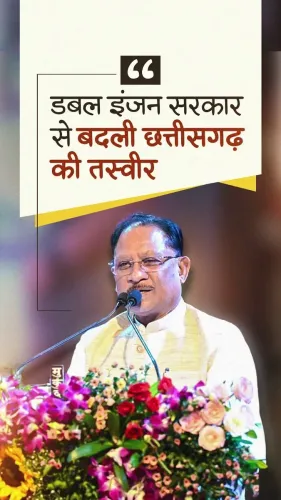
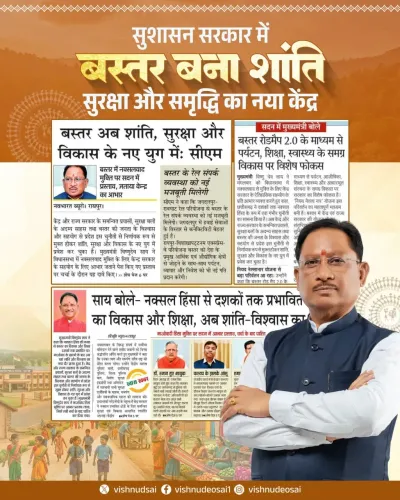
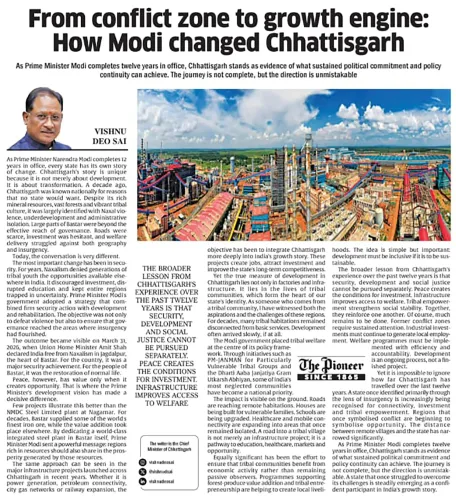
A region once synonymous with insurgency, fear, and isolation is now being held up as proof that India's longest-running internal security crisis can be turned around. On Saturday, September 26, 2026, Chhattisgarh Chief Minister Vishnu Deo Sai declared that Bastar — the vast forested division in southern Chhattisgarh that spent decades at the heart of the Naxalite-Maoist conflict — is stepping into 'a new morning of peace and a new chapter of development.'
Posting on X and tagging Prime Minister Narendra Modi, CM Sai wrote: 'Bastar mein shanti ki nayi subah, vikas ka naya adhyay' — 'A new morning of peace in Bastar, a new chapter of development.' He credited PM Modi's resolve and 'the indomitable courage of our security forces' for pulling Bastar out of what he called the 'darkness of Naxalism' and into a new light of peace and confidence. The statement frames Bastar's transformation as central to the BJP government's larger ambition of a 'Viksit Chhattisgarh' — a developed Chhattisgarh.
Bastar's Long War — and What Changed
Bastar division, comprising seven districts including Sukma, Bijapur, Dantewada, and Kanker, has been the most volatile stretch of India's so-called Red Corridor for over four decades. Maoist cadres controlled vast swathes of forest, disrupted elections, targeted security personnel, and blocked state administration from reaching tribal villages. At its peak, the insurgency rendered large parts of Bastar effectively ungovernable.
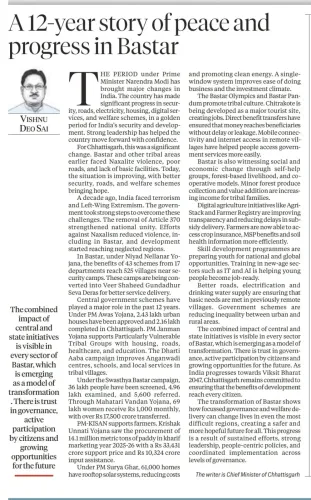
The shift began in earnest with the National Policy and Action Plan to address Left Wing Extremism, formalised in 2015, which paired intensified security operations with a development push — roads, mobile connectivity, schools, and banking access — to restore civilian life in cleared areas. From 2019 onward, Chhattisgarh security forces alongside central paramilitary units escalated anti-Naxal operations in Bastar, establishing forward camps deep in forests previously held by Maoists.
Security Gains Paving Way for 'Viksit Chhattisgarh'
The BJP's broader governance pitch in Chhattisgarh since CM Sai took office in December 2023 has consistently linked security gains in Bastar to the state's development agenda. Roads built into formerly inaccessible tribal hamlets, mobile towers erected in conflict zones, and the return of local governance structures to villages long controlled by Maoist 'jan adalats' — these are presented as proof that the security-plus-development formula is working.
The tribal communities of Bastar — numerically and culturally the most affected by decades of crossfire between state forces and Maoist cadres — stand at the centre of this claimed transformation. Whether that shift is felt on the ground, in income, in safety, in institutional trust, will ultimately define what the 'new morning' actually means for the region.
The official release of Naxal-violence statistics for 2025-26 and the rollout of specific Bastar development schemes announced by the state government will put hard numbers to the narrative CM Sai is building — and the data, when it comes, will be the real verdict on Bastar's new chapter.
Point of View
Reinforcing the BJP's national narrative that decisive leadership — not just administrative process — broke the Maoist stranglehold. The framing of Bastar as a 'Viksit Chhattisgarh' flagship also serves to preemptively convert security achievements into electoral capital ahead of future state cycles. Historically, governments have struggled to translate cleared zones into lasting civilian governance, making the delivery of visible development in Bastar the real test of this optimism. Until hard data on violence reduction and tribal welfare arrives for 2025-26, the declaration remains a political aspiration as much as an administrative milestone.
NationPress
26 Sept 2026
Frequently Asked Questions
What did CM Vishnu Deo Sai say about Bastar?
CM Vishnu Deo Sai declared on September 26, 2026 that Bastar is emerging from the darkness of Naxalism into a new dawn of peace and development, crediting PM Modi and India's security forces for the transformation.
What is 'Viksit Chhattisgarh' and how does Bastar fit in?
'Viksit Chhattisgarh' is the BJP state government's vision for a fully developed Chhattisgarh. CM Sai positions Bastar's peace and security gains as a cornerstone of realising this larger development goal.
What is the history of Naxalism in Bastar?
Bastar has been the most volatile zone of India's Red Corridor for over four decades, with Maoist insurgents controlling large forest areas, disrupting governance, and targeting security forces. Coordinated operations since 2019 have significantly reduced their territorial hold.
What is India's policy on Left Wing Extremism?
India's 2015 National Policy and Action Plan on Left Wing Extremism uses a dual approach: intensified security operations alongside development initiatives like roads, mobile towers, and schools to restore civilian administration in Maoist-affected districts.
When did Vishnu Deo Sai become Chief Minister of Chhattisgarh?
Vishnu Deo Sai became Chief Minister of Chhattisgarh in December 2023 after the BJP won the state assembly elections.