CM Sai Blames Congress Appeasement for 1947 Partition
Synopsis
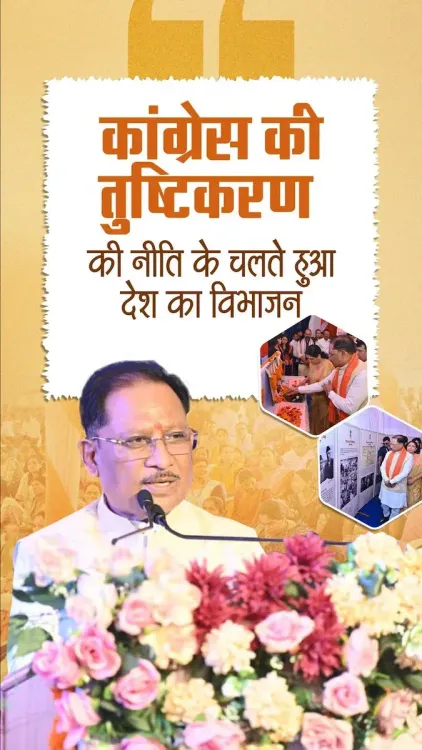
Chhattisgarh Chief Minister Vishnu Deo Sai, on the eve of Independence Day, blamed Congress's appeasement politics for the 1947 Partition, saying lakhs of Indians suffered and died as a result — a recurring BJP charge ahead of national commemorations.
Key Takeaways
Chhattisgarh CM Vishnu Deo Sai posted on 14 August 2026 , the eve of Independence Day, blaming Congress's appeasement politics for the 1947 Partition.
He stated that lakhs of people 'suffered torment and lost their lives' as a direct consequence of that political approach.
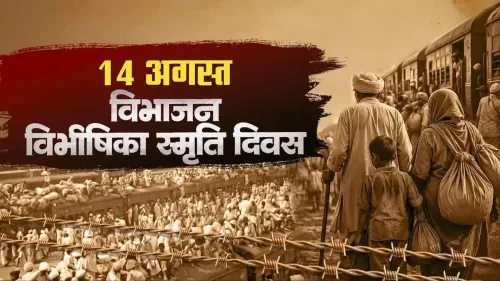
The 1947 Partition displaced an estimated 10–20 million people and killed hundreds of thousands in communal violence.
The BJP has consistently used this historical argument to draw an ideological contrast with Congress, especially around national commemorations.
Congress had not issued a formal response at the time of publication.
On the eve of India's Independence Day, Chhattisgarh Chief Minister Vishnu Deo Sai levelled a pointed historical charge — that Congress's politics of appeasement forced the nation to endure the agony of Partition, costing lakhs of lives.
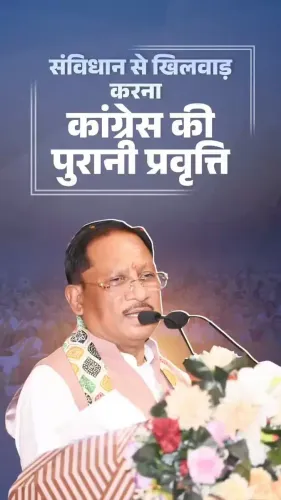
Posting on 14 August 2026, Sai wrote in Hindi: 'Kांग्रेस की तुष्टिकरण की राजनीति के चलते देश को विभाजन का दंश झेलना पड़ा, जिसके कारण लाखों लोगों ने यातनाएं सहीं और अपने प्राण गंवाए.' ('Due to Congress's politics of appeasement, the country had to bear the pain of Partition, because of which lakhs of people suffered torment and lost their lives.')
The wound that 1947 left behind
The Partition of India in August 1947 remains one of modern history's most catastrophic ruptures. British India was divided into two nations — India and Pakistan — triggering communal violence on a scale that still defies easy comprehension. Historians estimate that anywhere between 200,000 and 2 million people were killed in the accompanying violence, and roughly 10 to 20 million were displaced across the newly drawn borders. The human cost — massacres, forced migrations, broken families — has never fully left the subcontinent's collective memory.BJP's long-running Congress indictment
Sai's statement fits squarely into a well-established BJP political narrative: that the Indian National Congress, through its handling of communal negotiations with the Muslim League and British authorities in the years leading to independence, bears direct responsibility for Partition and its horrors. The Bharatiya Janata Party, which has governed at the Centre since 2014, has consistently deployed this argument — particularly around national commemorations — to draw a sharp ideological contrast with Congress on questions of minority politics and national unity. The timing matters. Statements invoking Partition tend to surface with greater intensity around 14–15 August, when the nation simultaneously mourns the violence of division and celebrates the freedom it came with. That duality gives the charge its emotional charge and political potency.Congress yet to respond
As of the time of publication, the Congress party had not issued a formal response to Sai's post. Historically, the party has pushed back against such characterisations by pointing to the complex, multi-party negotiations — involving Congress, the Muslim League, and British colonial administrators — that preceded Partition, arguing that no single actor bears sole responsibility for its outcome. Whether Congress spokespersons respond and how other BJP leaders amplify Sai's framing in the coming hours will shape the political conversation heading into Independence Day.Point of View
Timed with precision to the most emotionally resonant moment in the Indian calendar — the night before Independence Day. By anchoring a contemporary political charge in a 77-year-old wound, the BJP frames its ideological identity not merely as an electoral choice but as a historical corrective. The statement is unlikely to shift entrenched positions, but it does keep the Partition frame alive in public discourse at a moment when millions are already reflecting on 1947. Congress's response — or silence — will itself be read as a political signal.
NationPress
30 Sept 2026
Frequently Asked Questions
Why is CM Vishnu Deo Sai blaming Congress for the Partition of India?
Sai, echoing a long-standing BJP position, argues that Congress's politics of appeasement in the years before independence failed to prevent the communal division of British India in 1947, leading to mass violence and displacement.
What was the Partition of India and how many people were affected?
The Partition of India in August 1947 divided British India into India and Pakistan. It triggered one of history's largest forced migrations, displacing an estimated 10–20 million people, and communal violence killed hundreds of thousands.
What is BJP's historical argument against Congress on Partition?
The BJP argues that Congress's approach to communal negotiations — particularly with the Muslim League and British colonial authorities — enabled the conditions for Partition, and that its post-independence minority policies continued a pattern of appeasement.
Has Congress responded to Vishnu Deo Sai's statement on Partition?
As of the time of publication, Congress had not issued a formal response to Sai's 14 August 2026 post.
Why do BJP leaders raise the Partition issue around Independence Day?
Independence Day falls on 15 August, the same date India was partitioned in 1947. The dual significance — freedom and rupture — makes it a politically potent moment to invoke Partition's legacy and frame historical accountability debates.