CM Sai Govt Pushes Rural Economy With 125-Day Jobs, Atal Haat
Synopsis
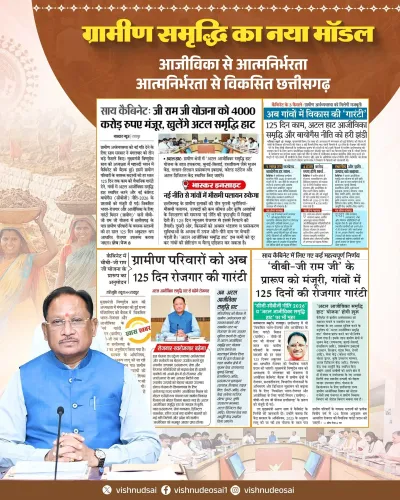
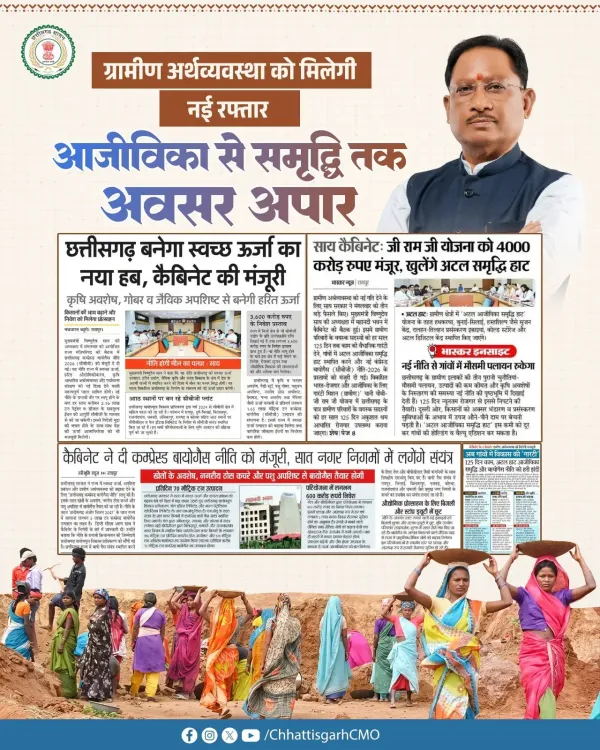
The Chhattisgarh CMO on 24 June 2026 spotlighted three rural-economy pillars under CM Vishnu Deo Sai: a 125-day wage-employment provision, Atal Haat village markets for livelihood enhancement, and a state Biogas Policy — framed as the foundation of a self-reliant, prosperous Chhattisgarh.
Key Takeaways
The Chhattisgarh CMO announced on 24 June 2026 that the Vishnu Deo Sai government is pursuing a multi-pronged rural-economy strategy.
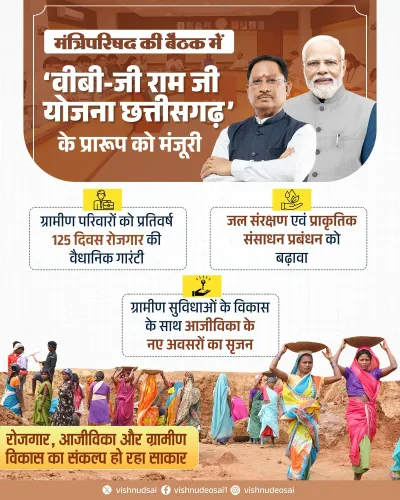
The state offers 125 days of wage employment under a rural jobs scheme, exceeding MGNREGA's central guarantee of 100 days .
Atal Haat outlets provide village-level marketplaces to help rural producers and artisans sell goods and improve income.
A state Biogas Policy promotes household and community biogas plants for clean cooking fuel and supplementary farm income.
The initiatives are framed under the Atmanirbhar Bharat self-reliance agenda, targeting rural labourers, small farmers, and village households.
Progress on biogas installations and actual person-days under the employment scheme in 2026-27 will be the key metrics to watch.
The Chief Minister's Office of Chhattisgarh on Wednesday, 24 June 2026 highlighted a cluster of rural-economy initiatives under the Vishnu Deo Sai government, citing 125-day employment under an expanded rural jobs scheme, the Atal Haat livelihood market programme, and a state Biogas Policy as cornerstones of village-level development.
Context
The CMO's post, written in Hindi, declared that the Vishnu Dev Sarkar (Vishnu Deo Sai government) is 'continuously taking historic decisions to strengthen the rural economy.' It described the three initiatives as 'not merely schemes, but the strong foundation of a self-reliant village, an empowered farmer, and a prosperous Chhattisgarh.' The announcement frames these measures as a unified rural-development agenda rather than standalone welfare steps.
Vishnu Deo Sai has served as Chief Minister of Chhattisgarh since December 2023, leading a BJP government that has placed rural and tribal welfare at the centre of its governance pitch. Chhattisgarh, a central Indian state with a large rural and tribal population, has historically depended on central employment guarantees supplemented by state-level add-ons.
Policy Backdrop
The employment component references a 125-day rural wage-employment provision under a scheme abbreviated as VB-G RAM G — positioned as an extension beyond the 100-day guarantee enshrined in the Mahatma Gandhi National Rural Employment Guarantee Act (MGNREGA) of 2005. Several BJP-governed states have layered state-funded days on top of the central entitlement to signal deeper commitment to rural labour.
The Atal Haat initiative creates village-level vending platforms named after former Prime Minister Atal Bihari Vajpayee, providing rural producers and artisans a structured marketplace to sell goods and diversify household income. The Biogas Policy promotes household and community biogas plants, aiming to supply clean cooking fuel while generating supplementary farm income from organic waste — consistent with the national Atmanirbhar Bharat self-reliance framework.
Stakeholders and Impact
The primary beneficiaries are rural labourers, small and marginal farmers, and village households across Chhattisgarh. The additional employment days are intended to reduce seasonal income gaps, while Atal Haat outlets are designed to cut out middlemen and improve price realisation for local producers.
The Biogas Policy targets households that still rely on firewood or LPG subsidy, offering a decentralised energy alternative that also produces bio-slurry usable as organic fertiliser. Together, the three interventions aim to address income, market access, and energy poverty in a single policy bundle.
What's Next
Independent verification of actual person-days generated under the 125-day provision and the number of operational Atal Haat outlets will be key indicators of on-ground progress during the 2026-27 financial year. Physical progress on biogas plant installations — including household adoption rates and grid-off-take figures — will determine whether the policy delivers its stated clean-energy and income goals.
If implementation matches the stated ambition, the Chhattisgarh model of layering state schemes atop central rural programmes could influence similar policy designs in other BJP-governed states ahead of upcoming assembly cycles.
Point of View
Locally owned development narrative ahead of political cycles. The 125-day employment figure is the sharpest political signal — it positions the Sai government as going beyond the Congress-era MGNREGA baseline, echoing a pattern seen in other BJP states. The Atal Haat branding anchors the initiative in Vajpayee-era nostalgia while the Biogas Policy adds a clean-energy dimension that aligns with national Atmanirbhar optics. Whether the three-pronged bundle translates into measurable rural income gains or remains a communications exercise will depend on implementation data that is yet to be independently verified.
NationPress
24 Jun 2026
Frequently Asked Questions
What is the 125-day employment scheme in Chhattisgarh?
The Chhattisgarh government offers 125 days of wage employment under a state-level rural jobs provision — branded as VB-G RAM G — which extends beyond the 100-day guarantee provided under the central MGNREGA law, giving rural labourers additional income security.
What is Atal Haat in Chhattisgarh?
Atal Haat is a rural market initiative named after former Prime Minister Atal Bihari Vajpayee that creates village-level vending platforms, allowing local producers, farmers, and artisans to sell their goods directly and improve their livelihoods without depending on middlemen.
What does Chhattisgarh's Biogas Policy do?
The Chhattisgarh Biogas Policy promotes the installation of household and community biogas plants to provide clean cooking fuel as an alternative to firewood or LPG, while also generating bio-slurry that can be used as organic fertiliser, supplementing farm income.
Who is the Chief Minister of Chhattisgarh in 2026?
Vishnu Deo Sai is the Chief Minister of Chhattisgarh , serving since December 2023 as the head of the BJP government in the state.
How is Chhattisgarh promoting rural self-reliance?
Chhattisgarh is pursuing rural self-reliance through a combination of extended wage employment ( 125 days ), village-level markets under Atal Haat , and a Biogas Policy for clean energy — all framed within the national Atmanirbhar Bharat agenda to reduce dependence and boost village-level economic activity.