CM Sai's Sushasan Tihar Reaches 14 Districts in Chhattisgarh
Synopsis
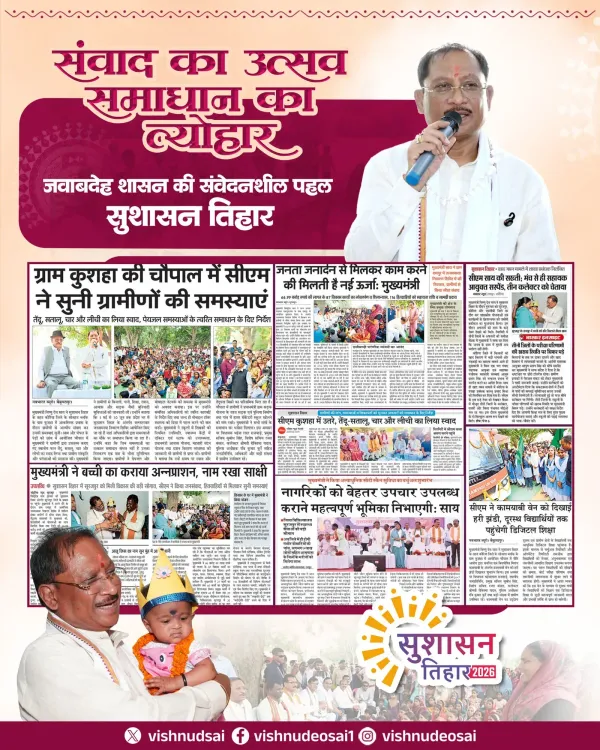
Chhattisgarh Chief Minister Vishnu Deo Sai announced on 22 May 2026 that Sushasan Tihar 2026 has covered 14 districts, conducting village chaupals under trees to resolve public grievances and ensure last-mile delivery of government schemes.
Key Takeaways
Sushasan Tihar 2026 has reached 14 districts in Chhattisgarh as of 22 May 2026 .
Village chaupals are held outdoors — under trees — enabling direct dialogue between citizens and administration.
CM Vishnu Deo Sai has framed the initiative as a janyatra focused on time-bound grievance resolution.
The programme aims to ensure every government scheme reaches the 'last person', with a stated emphasis on trust-building alongside development.
The initiative fits a broader BJP pattern of jan samvad-style outreach seen across multiple states since 2014 .
With 33 districts in the state, roughly 19 remain to be covered in the current cycle.
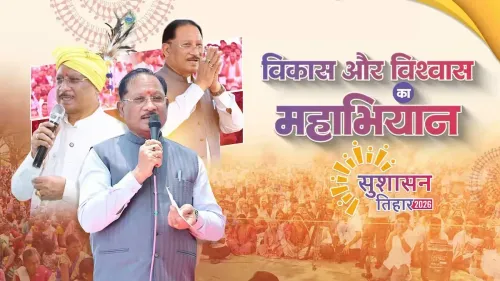
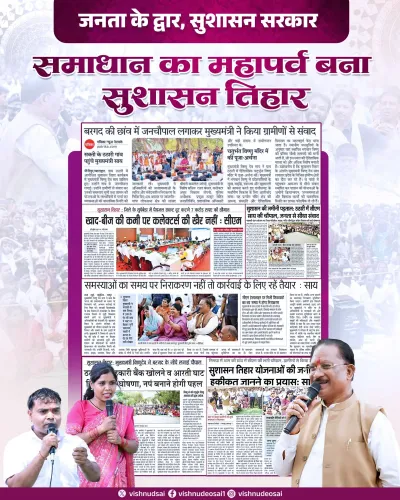
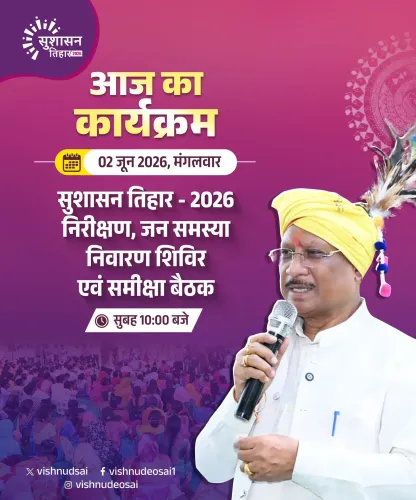
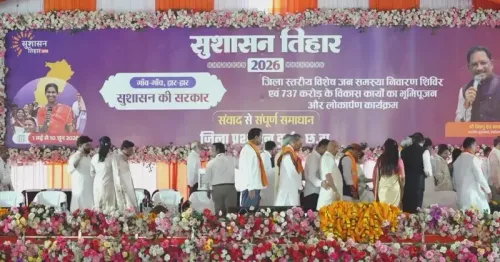
Chhattisgarh Chief Minister Vishnu Deo Sai announced on Friday, 22 May 2026 that the state's ongoing Sushasan Tihar (Good Governance Festival) has now reached 14 districts, with village-level chaupals being held under trees to enable direct dialogue between citizens and administration.
Context
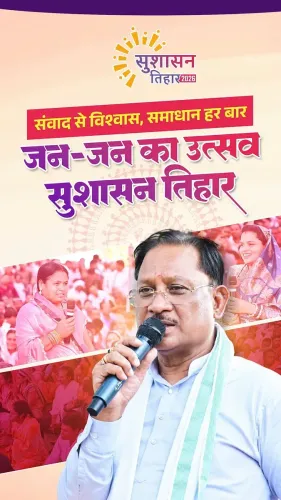
Posting in Hindi on X, CM Sai described the initiative as a 'janyatra' — a people's journey — of dialogue leading to resolution. He wrote: 'Village by village, chaupals are being held in the shade of trees, where people's problems are being resolved through direct conversation.' The post was tagged #SushasanTihar2026, indicating this is the 2026 edition of the programme.
The Chief Minister underlined the government's commitment that 'every scheme's benefit must reach the last person, problems must be resolved in a time-bound manner, and a new light of trust along with development must reach every village and every home.'
Policy Backdrop
The BJP government in Chhattisgarh, which returned to power in December 2023 under Vishnu Deo Sai, has emphasised last-mile delivery of both central and state welfare schemes as a core governance priority. Sushasan Tihar is the state's flagship public-contact programme designed to bring administration directly to villages for grievance redressal and scheme saturation.
The chaupal model — informal open-air gatherings where officials hear public grievances on the spot — draws from a broader tradition of jan samvad (public dialogue) outreach practised across BJP-governed states since 2014. Similar programmes have been run in Madhya Pradesh and other states to improve uptake of welfare entitlements at the grassroots level.
Stakeholders and Impact
Chhattisgarh has a large rural and tribal population spread across 33 districts, making direct administrative outreach logistically significant. The primary beneficiaries of the chaupals are villagers — including members of Scheduled Tribes — who may otherwise face barriers in accessing government offices for scheme enrolment or grievance filing.
With the programme having covered 14 districts so far, roughly 19 districts remain on the itinerary, suggesting the drive is at or past its midpoint. Civil society observers and local panchayat bodies are key intermediaries in mobilising attendance at these village-level sessions.
What's Next
The government is expected to extend Sushasan Tihar 2026 to the remaining districts of Chhattisgarh in the coming weeks. Official data on grievance disposal rates and scheme saturation figures from the completed district rounds will be a key measure of the programme's on-ground impact. The scale and pace of resolution reported at the end of the full cycle will also serve as a political benchmark for the Sai administration ahead of future electoral cycles.
Point of View
Designed to demonstrate administrative responsiveness in a state where rural and tribal voters are decisive. By anchoring the outreach in the symbolically accessible chaupal format, the BJP government signals continuity with grassroots political culture rather than bureaucratic distance. The '14 districts' milestone, announced publicly on social media, serves a dual purpose: it pressures district administrations to perform and it builds a visible public record of delivery. Nationally, it reinforces the party's 'maximum governance' narrative, which has become a standard template for BJP-ruled states seeking to convert welfare spending into durable electoral trust.
NationPress
6 Oct 2026
Frequently Asked Questions
What is Sushasan Tihar in Chhattisgarh?
Sushasan Tihar — meaning 'Good Governance Festival' — is a state government outreach programme in Chhattisgarh where officials hold village-level chaupals to hear public grievances and ensure delivery of welfare schemes directly to citizens.
How many districts has Sushasan Tihar 2026 covered so far?
As of 22 May 2026 , CM Vishnu Deo Sai announced that Sushasan Tihar 2026 has reached 14 districts of Chhattisgarh .
Who launched Sushasan Tihar in Chhattisgarh?
The programme is being run by the BJP government in Chhattisgarh under Chief Minister Vishnu Deo Sai , who took office in December 2023 after the party's assembly election victory.
What is the purpose of village chaupals under Sushasan Tihar?
The chaupals are open-air public gatherings where citizens can directly raise problems with officials, enrol in government schemes, and receive time-bound resolutions — bypassing the need to visit distant government offices.
Is Sushasan Tihar unique to Chhattisgarh?
While Sushasan Tihar is specific to Chhattisgarh , similar jan samvad and chaupal-style outreach programmes have been conducted in other BJP -governed states such as Madhya Pradesh as part of a broader governance-outreach pattern since 2014 .