CM Vishnu Deo Sai links Chhattisgarh drive to Ambedkar ideals
Synopsis
On 26 November 2026, Chhattisgarh CM Vishnu Deo Sai invoked Ambedkar to frame Bastar security, women's reservation, tribal rights and last-mile welfare as constitutional work toward a Developed Chhattisgarh.
Key Takeaways
Chhattisgarh Chief Minister Vishnu Deo Sai posted on 26 November 2026, Constitution Day, linking state policy to Dr Bhimrao Ambedkar's ideals.
He cited peace in Bastar, a campaign against Maoism, women's reservation, tribal rights and last-mile development as proof of constitutional commitment.
The Constitution was adopted on 26 November 1949; Ambedkar chaired the drafting committee.
Chhattisgarh, formed in 2000, has a large tribal population and PESA local-governance provisions.
Sai took office after the 2023 assembly elections and closed with a pledge for a Developed Chhattisgarh.
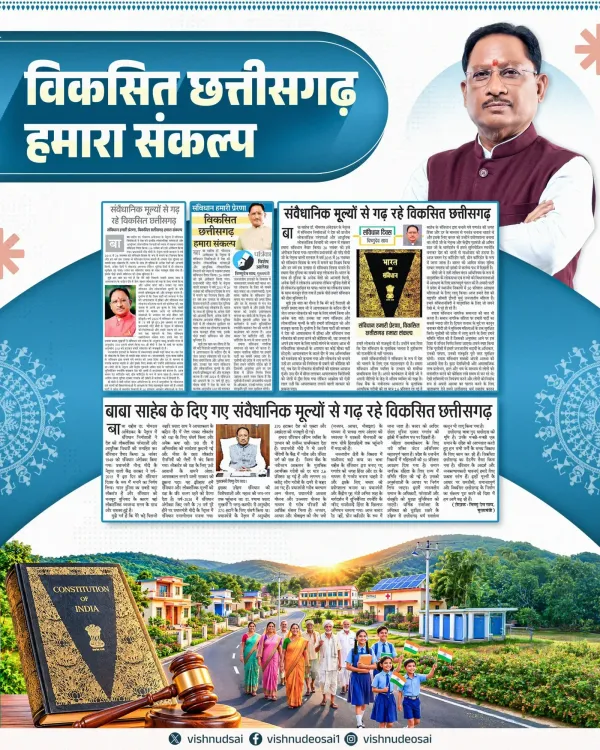
Chhattisgarh Chief Minister Vishnu Deo Sai on 26 November 2026 cast the state's security and welfare push as a test of Bharat Ratna Dr Bhimrao Ambedkar's constitutional ideals, naming peace in Bastar, a campaign against Maoism, women's reservation and last-mile delivery as living proof. Constitution Day, he argued, is not a ritual. It is a yardstick for how a tribal-majority state governs.
Writing in Hindi, Sai said Chhattisgarh is establishing new dimensions of development and good governance by internalising Ambedkar's thoughts and constitutional ideals. He listed shanti ki sthapana (establishment of peace) in Bastar, a decisive campaign against Maoism, women's reservation, protection of tribal society's rights, and taking development to the last person as evidence of that commitment. The close was a pledge: good governance, social justice and all-inclusive development toward a Viksit Chhattisgarh (Developed Chhattisgarh).
Bastar, Maoism and the Constitution Day frame
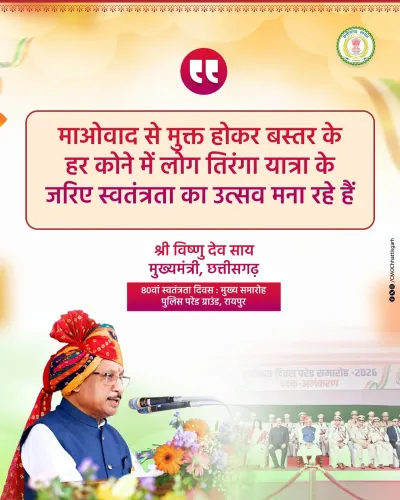
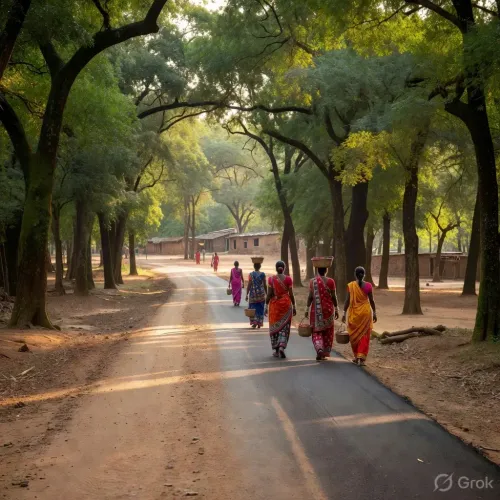
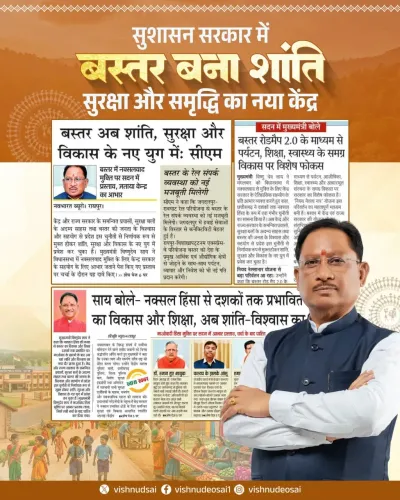
The sharpest line in the post is geographic. Bastar, the forested southern belt long associated with left-wing extremism, sits at the centre of Sai's constitutional argument. He presents security operations and peace as not only a law-and-order task but a duty owed to the Constitution's promise of equal citizenship. Successive governments in the state, carved out of Madhya Pradesh in 2000, have run anti-Maoist campaigns since the early 2000s. Sai, who took office after the 2023 assembly elections, now folds that lineage into Ambedkar's language of rights.
What the post does not do is publish operational numbers. It offers a political claim: that a decisive campaign and the establishment of peace are already part of the state's constitutional record. Independent verification of the current security picture in Bastar is not asserted here. The political signal is clearer than the battlefield ledger.
Tribal rights, PESA and women's reservation
Ambedkar chaired the drafting committee of a Constitution adopted on 26 November 1949. Chhattisgarh's demography makes that anniversary more than ceremonial. A large tribal population, Panchayats (Extension to Scheduled Areas) Act provisions for local self-rule, and long-running debates over land, forest and representation sit behind Sai's list. He groups protection of janjatiya (tribal) rights with women's reservation and last-mile welfare as one package of constitutional fidelity.
That packaging matters in a BJP-ruled state. Across central and eastern India, the party has increasingly invoked Ambedkar to frame welfare and security together: counter-insurgency beside tribal outreach, reservation beside last-mile schemes. Sai's post is that template in miniature. It does not spell out a new law or a numbered scheme. It recasts existing priorities as Ambedkarite proof.
What the next assembly season will test
The unanswered question is delivery. Tribal welfare rollouts, the texture of local governance under PESA, and any central or state review of the Bastar security situation will show whether Constitution Day rhetoric hardens into measurable change. Sai's own test is last-mile: whether the antim vyakti (last person) actually receives what the post promises.
On a day the Republic marks the adoption of its basic law, the Chhattisgarh Chief Minister has chosen to be judged by Bastar, reservation and the last household on the delivery list. That is the argument. The forest belt will decide how it reads.
Point of View
That fusion is politically efficient. It also raises the bar. If Bastar and last-mile delivery remain the proof he offered, later assembly sessions and security reviews will be read as a verdict on the claim, not just as routine governance.
NationPress
26 Nov 2026
Frequently Asked Questions
What did Vishnu Deo Sai say on Constitution Day 2026?
Chhattisgarh Chief Minister Vishnu Deo Sai said the state is setting new dimensions of development and good governance by internalising Dr Bhimrao Ambedkar's thoughts and constitutional ideals. He named peace in Bastar, a campaign against Maoism, women's reservation, tribal rights and last-mile development as proof, and pledged a Developed Chhattisgarh.
Why is 26 November observed as Constitution Day in India?
India observes 26 November as Constitution Day because the Constitution was adopted on that date in 1949. Dr B.R. Ambedkar chaired the drafting committee, which is why political leaders often invoke his legacy on this day.
Who is Vishnu Deo Sai?
Vishnu Deo Sai is the Chief Minister of Chhattisgarh and a BJP leader. He assumed office after the 2023 state assembly elections.
Why does Bastar feature in Chhattisgarh's Constitution Day politics?
Bastar in southern Chhattisgarh has long been affected by Maoist insurgency, so security, peace and tribal rights sit at the centre of state governance debates. Sai treated peace there and a campaign against Maoism as part of the state's constitutional commitment.
What is PESA and why does it matter in Chhattisgarh?
The Panchayats (Extension to Scheduled Areas) Act provides special local self-governance rules in scheduled areas. Chhattisgarh, carved out of Madhya Pradesh in 2000, has a large tribal population, so PESA and tribal rights are core to any claim of constitutional delivery.