CM Sai Welcomes Amit Shah to Chhattisgarh on Rajyotsav
Synopsis
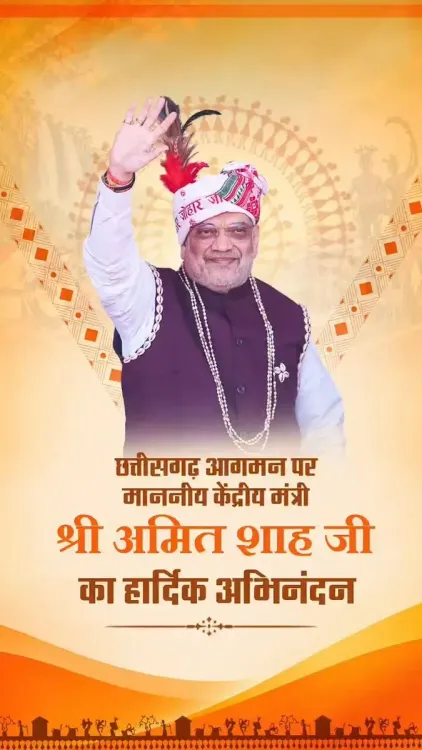
On Chhattisgarh's Rajyotsav, CM Vishnu Deo Sai welcomed Union Home Minister Amit Shah, citing Bastar's security gains as proof of BJP's 'double engine' central-state governance model bearing fruit.
Key Takeaways
Amit Shah visited Chhattisgarh on 1 November , the state's Rajyotsav or foundation day, marking 26 years since its formation in 2000.
CM Vishnu Deo Sai framed Bastar's security progress as a product of the BJP's 'double engine government' model linking central and state action.
Bastar , long the epicentre of Left Wing Extremism in India, has been a focus of sustained Union Home Ministry counter-LWE operations since 2014 .
The BJP returned to power in Chhattisgarh after the December 2023 assembly elections, with Vishnu Deo Sai as Chief Minister.
Similar post-insurgency development framing has been applied in Jharkhand and Odisha , making Chhattisgarh the current showcase of the national LWE narrative.
On the sacred occasion of Chhattisgarh's Rajyotsav — the state's 26th foundation day on 1 November — Chief Minister Vishnu Deo Sai extended a ceremonial welcome to Union Home and Cooperation Minister Amit Shah, invoking the land's identity as the birthplace of Mata Kaushalya and framing Bastar's security transformation as a shared triumph of central-state resolve.
In his post, CM Sai wrote: 'Mata Kaushalya ki pavan dhara Chhattisgarh mein... Bastar aaj Naxalmukt hokar pragati ki nayi udaan bhar raha hai' — ('On the sacred land of Mata Kaushalya, Chhattisgarh... Bastar today, freed from Naxalism, is taking a new flight of progress'). The message credits the 'double engine government' — the BJP's signature phrase for aligned central and state administrations — for driving that shift.
Bastar's Long Road Out of Left Wing Extremism
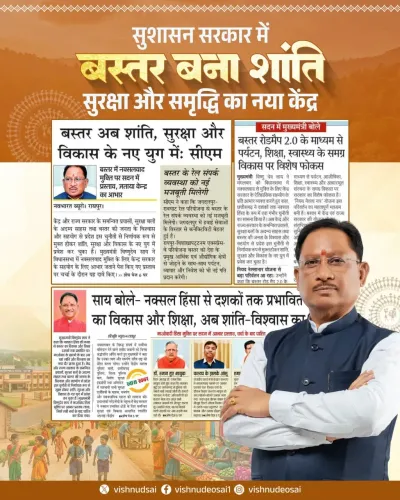
Bastar, the sprawling southern division of Chhattisgarh, has been the epicentre of Left Wing Extremism (LWE) in India for decades. Thick forests, difficult terrain, and deep socio-economic exclusion made the region a stronghold for Naxalite groups, exacting a heavy toll on security forces, civilians, and tribal communities alike. The Union Home Ministry, since 2014, has coordinated multi-state counter-LWE operations alongside state police and the CRPF, gradually shrinking the operational space available to armed groups.
When the BJP returned to power in Chhattisgarh after the December 2023 assembly elections, installing Vishnu Deo Sai as Chief Minister, the party doubled down on the 'double engine' model — pairing central resource deployment with state-level development focus in formerly insurgency-affected districts. Roads, schools, banking connectivity, and mobile coverage followed security clearances into areas that were once unreachable.
Amit Shah's Visit and the Rajyotsav Moment
Chhattisgarh was carved out of Madhya Pradesh on 1 November 2000, making the Rajyotsav a politically charged anniversary. A visit by the Union Home Minister on this date is a deliberate signal — part ceremony, part policy statement — that the Centre treats Chhattisgarh's security and development story as a national showcase. CM Sai's welcome explicitly links Shah's presence to giving 'new momentum to the state's development resolve.'
The broader pattern is visible across India's LWE belt. Similar 'post-insurgency development' framing has been deployed in parts of Jharkhand and Odisha, where reduced violence has been followed by accelerated infrastructure push. Chhattisgarh is now the centrepiece of that narrative — and the Rajyotsav platform amplifies it to a national audience.
What the Rajyotsav Events Could Unlock
Watch for infrastructure announcements and welfare scheme launches tied to the foundation-day events. Central ministers attending state celebrations typically use the occasion to unveil or advance projects that reinforce the Centre-state partnership story. Bastar's tribal communities — long caught between insurgent pressure and state action — stand as the most direct stakeholders in whether development promises translate into lived reality on the ground.
A state that was once synonymous with a relentless Naxal threat now hosts the nation's top security minister on its birthday. That, in itself, is the political headline CM Vishnu Deo Sai is writing.
Point of View
Hosting the Home Minister is also a signal of his own standing within the central hierarchy, less than three years into his tenure. The framing of Bastar as 'Naxal-free' carries electoral and symbolic weight, even as ground conditions warrant careful scrutiny. Across the LWE belt, this blueprint — secure, then develop, then celebrate loudly — is becoming the BJP's template for turning conflict-zone legacies into governance credentials.
NationPress
3 Nov 2026
Frequently Asked Questions
Why did Amit Shah visit Chhattisgarh on 1 November 2026?
Amit Shah visited Chhattisgarh for the state's Rajyotsav, its annual foundation day marking the anniversary of the state's formation on 1 November 2000. CM Vishnu Deo Sai welcomed him and credited his visit with giving new momentum to the state's development resolve.
What is the 'double engine government' that CM Sai mentioned?
The 'double engine government' is a BJP phrase describing the alignment of a BJP-led state government with the BJP-led central government, implying coordinated policy and resource flow. CM Sai used it to credit both the Centre and the state for security and development gains in Bastar.
Is Bastar really free of Naxalites?
CM Sai's post described Bastar as 'Naxalmukt' (Naxal-free) and progressing rapidly. While sustained security operations have significantly reduced Left Wing Extremist activity in the region over the past decade, independent verification of complete Naxal elimination in Bastar is not established in public record.
When was Chhattisgarh formed and what is Rajyotsav?
Chhattisgarh was carved out of Madhya Pradesh on 1 November 2000. Rajyotsav is the state's annual foundation day celebration, marking its establishment as a separate state.
Who is Vishnu Deo Sai and how long has he been Chief Minister?
Vishnu Deo Sai is a BJP leader who became Chief Minister of Chhattisgarh in December 2023 after the BJP won the state assembly elections. He is a prominent tribal leader from the state.