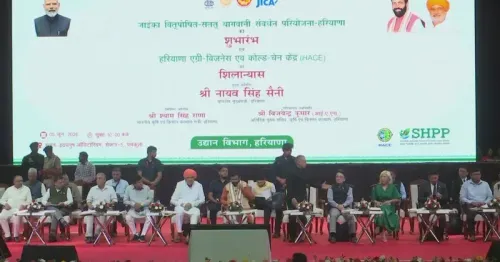
CM Saini launches ₹2,738 cr JICA horticulture project in Panchkula

Synopsis
Haryana Chief Minister Nayab Singh Saini launched the ₹2,738 crore Sustainable Horticulture Promotion Project and laid the foundation of the Haryana Agri Business and Cold Chain Centre in Panchkula on June 5, 2026, in partnership with Japan's JICA, targeting higher farmer incomes and reduced post-harvest losses.
Key Takeaways
Haryana CM Nayab Singh Saini launched the Sustainable Horticulture Promotion Project in Panchkula on June 5, 2026 .
The project is valued at ₹2,738 crore and is being implemented with support from the Japan International Cooperation Agency (JICA) .
The foundation stone of the Haryana Agri Business and Cold Chain Centre was also laid at the same event.
Key goals include raising farmer incomes , reducing post-harvest crop losses , and building modern agricultural infrastructure across the state.
The initiative aligns with central schemes including the Agricultural Infrastructure Fund (2020) and the National Horticulture Mission (2005) .
Primary beneficiaries are horticulture farmers and agri-entrepreneurs in Haryana.
Haryana Chief Minister Nayab Singh Saini on Friday, June 5, 2026, launched the Sustainable Horticulture Promotion Project and laid the foundation stone of the Haryana Agri Business and Cold Chain Centre at an event held in Panchkula. The ₹2,738 crore initiative is being implemented in partnership with the Japan International Cooperation Agency (JICA) and aims to raise farmer incomes, reduce post-harvest crop losses, and strengthen modern agricultural infrastructure across the state.
Context
Posting on X, CM Saini described the programme as a significant step toward building a self-reliant and prosperous farming ecosystem. In his words, 'यह पहल हरियाणा को बागवानी क्रांति की ओर अग्रसर करते हुए आत्मनिर्भर एवं समृद्ध कृषि व्यवस्था के निर्माण में अहम भूमिका निभाएगी' ('This initiative will play a key role in moving Haryana toward a horticulture revolution and building a self-reliant, prosperous agricultural system'). The event in Panchkula, the planned city adjacent to Chandigarh that regularly hosts state-level government functions, brought together officials, agri-entrepreneurs, and farming community representatives.
Policy Backdrop
JICA, Japan's principal bilateral development agency, has supported agriculture and infrastructure projects across Indian states since the early 2000s, with a focus on irrigation, value-chain development, and extension services. Haryana, whose agricultural base has traditionally centred on wheat and rice, has been actively pursuing horticulture diversification to improve farm incomes and reduce dependence on water-intensive staple crops. The project aligns with the central government's Agricultural Infrastructure Fund launched in 2020, which provides interest subvention for cold chains, warehousing, and primary processing units, as well as the older National Horticulture Mission initiated in 2005 to promote post-harvest management and market development.
India-Japan agricultural cooperation has grown steadily over the past two decades, with multiple states signing JICA-assisted projects that combine Japanese expertise in cold-chain and value-chain management with domestic infrastructure schemes. The Haryana Agri Business and Cold Chain Centre whose foundation stone was laid on Friday is expected to serve as a nodal facility for aggregation, processing, and onward movement of horticultural produce.
Stakeholders and Impact
The primary beneficiaries of the project are Haryana's horticulture farmers and agri-entrepreneurs who currently face significant post-harvest losses due to inadequate cold-chain infrastructure. Improved storage and logistics are expected to reduce spoilage, stabilise farm-gate prices, and open access to distant markets. Agri-business operators stand to gain from the modern processing and cold-chain facilities that the project promises to create across the state.
At a broader level, the initiative reflects a pattern seen in several Indian states where JICA funding has been leveraged to build climate-resilient infrastructure that supplements central government schemes. Successful implementation could position Haryana as a model for JICA-assisted horticulture development in the northern belt, potentially attracting further bilateral investment in allied sectors.
What's Next
Attention will now turn to the phased district-level rollout of project components and the pace at which cold-chain capacity is actually created on the ground. Observers will also watch for any convergence of the project with the central Mission for Integrated Development of Horticulture (MIDH) and whether supplementary allocations appear in upcoming state budget cycles. Progress reports on land acquisition, contractor appointments, and commissioning timelines for the Haryana Agri Business and Cold Chain Centre will be key early indicators of execution momentum.
Point of View
738 crore JICA-backed project represents one of the largest single bilateral agriculture investments in Haryana in recent memory, signalling a deliberate shift in the state's farm policy from staple-crop support toward horticulture value-chain building. For CM Saini, who took office in March 2024, the launch offers a tangible infrastructure milestone ahead of what will be a closely watched performance assessment by both the electorate and the BJP's central leadership. The cold-chain and agri-business focus also fits neatly into the broader national push to cut the roughly 15-18 per cent post-harvest losses that erode farmer earnings annually. Whether the project delivers on its promise will depend heavily on district-level execution and convergence with central horticulture funding, both of which have historically been uneven across Indian states.
NationPress
14 Sept 2026
Frequently Asked Questions
What is the Sustainable Horticulture Promotion Project in Haryana?
It is a ₹2,738 crore initiative launched by Haryana CM Nayab Singh Saini on June 5, 2026, in partnership with the Japan International Cooperation Agency (JICA). The project aims to raise farmer incomes, reduce post-harvest losses, and modernise agricultural infrastructure across the state, including through a new Agri Business and Cold Chain Centre in Panchkula.
What is JICA and why is it involved in Haryana agriculture?
JICA, the Japan International Cooperation Agency, is Japan's bilateral development agency. It has supported agriculture and infrastructure projects across Indian states since the early 2000s, focusing on irrigation, value-chain development, and extension services. Haryana has partnered with JICA to bring Japanese expertise in cold-chain management to its horticulture sector.
What is the Haryana Agri Business and Cold Chain Centre?
The Haryana Agri Business and Cold Chain Centre is a new facility whose foundation stone was laid by CM Saini in Panchkula on June 5, 2026. It is intended to serve as a nodal hub for aggregation, processing, and logistics of horticultural produce, helping reduce spoilage and connect farmers to wider markets.
How does this project help Haryana farmers?
The project is designed to reduce post-harvest crop losses by creating modern cold-chain infrastructure, stabilise farm-gate prices through better storage and logistics, and open access to distant markets. Horticulture farmers and agri-entrepreneurs are the primary intended beneficiaries.
Which central government schemes does the Haryana horticulture project align with?
The project aligns with the Agricultural Infrastructure Fund launched in 2020, which provides interest subvention for cold chains and warehousing, and the National Horticulture Mission initiated in 2005 for post-harvest management and market development. Convergence with the Mission for Integrated Development of Horticulture (MIDH) is also being watched.