CM Nayab Saini releases HSCW annual women's empowerment booklet
Synopsis
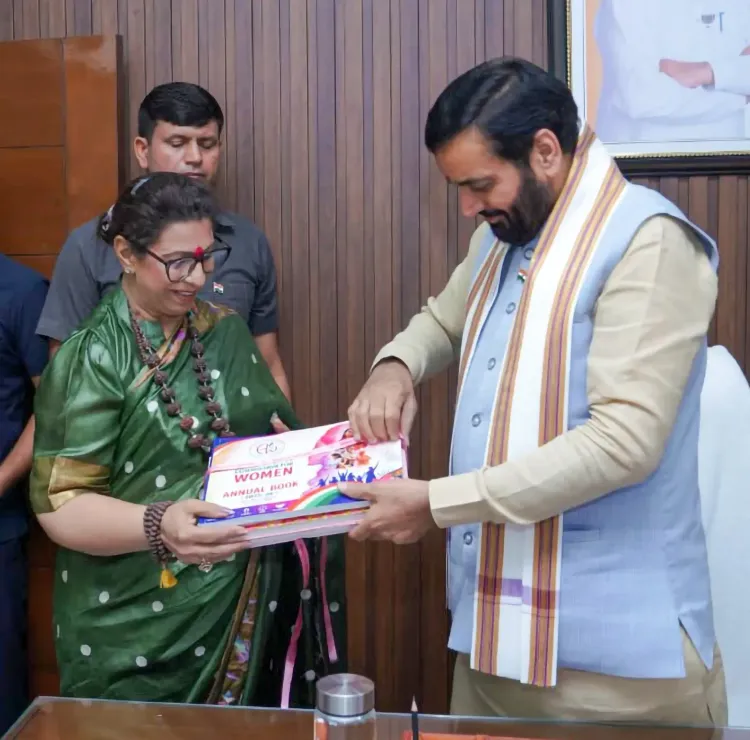
Chief Minister Nayab Singh Saini released the 'Sashakt Nari, Samriddh Haryana: Annual Booklet 2025-26' on 2 June 2026, during a courtesy visit by Haryana State Commission for Women Chairperson Renu Bhatia and her delegation, marking the state's annual accounting of women's welfare initiatives.
Key Takeaways
Chief Minister Nayab Singh Saini released the 'Sashakt Nari, Samriddh Haryana: Annual Booklet 2025–26' on 2 June 2026 .
Renu Bhatia , Chairperson of the Haryana State Commission for Women (HSCW) , led a delegation for a courtesy visit to the CM.
The HSCW is a statutory body under the Haryana State Commission for Women Act, mandated to protect and promote women's rights.
The annual booklet documents state initiatives on women's empowerment for the financial year 2025–26 .
Haryana was the launch state for the national Beti Bachao Beti Padhao scheme in 2015 , underlining its centrality to women's welfare policy.
Follow-up scheme guidelines or budget allocations referenced in the booklet are expected to surface in the next assembly session.
The Chief Minister's Office of Haryana announced on Tuesday, 2 June 2026 that Chief Minister Nayab Singh Saini received a courtesy call from Renu Bhatia, Chairperson of the Haryana State Commission for Women (HSCW), who led a delegation to his office. At the meeting, CM Saini released the annual publication 'Sashakt Nari, Samriddh Haryana: Annual Booklet 2025–26', a document cataloguing the state's initiatives on women's empowerment for the financial year.
Context
The post, shared from the official CMO Haryana handle, states: 'मुख्यमंत्री श्री @NayabSainiBJP से हरियाणा राज्य महिला आयोग (HSCW) की अध्यक्षा श्रीमती रेनू भाटिया ने प्रतिनिधिमंडल के साथ शिष्टाचार भेंट की' — ('Haryana State Commission for Women Chairperson Smt. Renu Bhatia, along with a delegation, paid a courtesy visit to Chief Minister Shri Nayab Saini'). It further notes that the booklet was released 'मुख्यमंत्री के करकमलों द्वारा' — 'by the hands of the Chief Minister.' The annual booklet is positioned as a record of progress on gender welfare schemes across the state.
Policy Backdrop
The Haryana State Commission for Women is a statutory body constituted under the Haryana State Commission for Women Act, mandated to investigate complaints, advise the government on policy, and monitor the implementation of laws relating to women. The commission's annual publications serve as an accountability mechanism, tracking gender indicators and scheme delivery across districts.
Haryana holds particular significance in the national women's welfare narrative: Panipat, Haryana was the launch site of the Beti Bachao Beti Padhao scheme in 2015, a flagship national programme aimed at improving the child sex ratio and promoting girls' education and survival. Successive state governments — and BJP administrations at the state level since 2014 — have maintained a consistent emphasis on women-centric policy as both a social and electoral priority.
Stakeholders and Impact
The primary beneficiaries of the policies documented in the 2025–26 booklet are women across Haryana's 22 districts, spanning rural and urban populations. The HSCW's mandate covers women facing workplace discrimination, domestic violence, and barriers to education and economic participation.
The publication of an annual booklet by the commission provides civil society organisations, district administrations, and policymakers a consolidated reference for assessing where gaps in delivery persist. It also signals the government's intent to maintain public accountability around gender welfare commitments made in the state budget and legislative assembly.
What's Next
Attention will now turn to whether the 2025–26 booklet references specific budget allocations or new scheme guidelines that could be taken up during the next Haryana Legislative Assembly session. Analysts will watch for any follow-up announcements from the HSCW on targeted interventions in districts where gender indicators have historically lagged. The release also sets the stage for the commission to present its findings and recommendations formally to the state cabinet in the months ahead.
Point of View
Samriddh Haryana' booklet is a routine but symbolically significant act of institutional accountability, reinforcing the BJP-led state government's positioning on women's welfare ahead of any future electoral cycle. CM Saini's personal association with the launch elevates it beyond bureaucratic process, signalling political ownership of the HSCW's agenda. The courtesy visit format — a statutory commission head calling on the Chief Minister — also reflects the commission's effort to maintain executive-level visibility for its mandate. Cumulatively, this pattern of annual publications and high-profile releases keeps Haryana's gender welfare record in the public domain, creating a benchmark against which future performance will be measured.
NationPress
19 Sept 2026
Frequently Asked Questions
What is the 'Sashakt Nari, Samriddh Haryana' booklet?
It is an annual publication by the Haryana State Commission for Women that documents the state government's initiatives and progress on women's empowerment schemes for a given financial year. The 2025–26 edition was released by Chief Minister Nayab Singh Saini on 2 June 2026.
What does the Haryana State Commission for Women do?
The HSCW is constituted under the Haryana State Commission for Women Act and is mandated to receive and investigate complaints from women, monitor the implementation of laws protecting women, and recommend policy measures to the state government.
What is the Beti Bachao Beti Padhao scheme and its connection to Haryana?
Beti Bachao Beti Padhao is a national scheme launched in 2015 to improve the child sex ratio and promote girls' education and survival. It was launched from Panipat, Haryana, reflecting the state's centrality to national women's welfare policy.
What should we expect after the release of the HSCW 2025-26 booklet?
The next step to watch is whether specific scheme guidelines or budget allocations mentioned in the booklet are taken up during the Haryana Legislative Assembly's upcoming session, and whether the HSCW presents formal recommendations to the state cabinet.