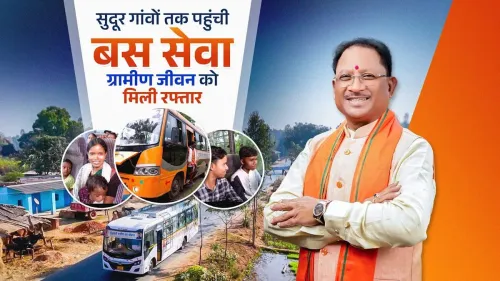
CM Sai's Material Bank-Dealer Didi Model wins national praise
Synopsis
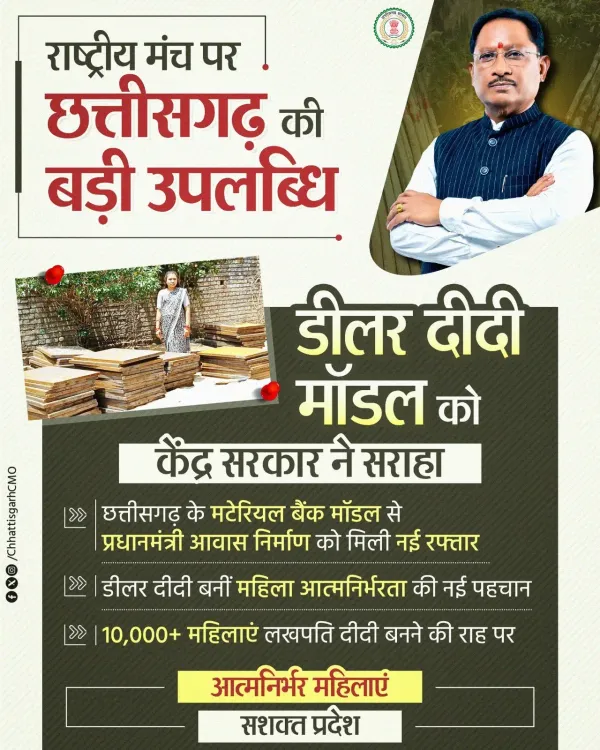
The Chief Minister's Office of Chhattisgarh announced on 1 July 2026 that the state's Material Bank–Dealer Didi Model under PMAY (Gramin) received appreciation from the Government of India at the National Rural Development Conference, with the model delivering construction materials to remote villages while empowering SHG women toward the Lakhpati Didi income target.
Key Takeaways
The Chhattisgarh CMO announced on 1 July 2026 that the Material Bank–Dealer Didi Model was appreciated by the Government of India at the National Rural Development Conference .
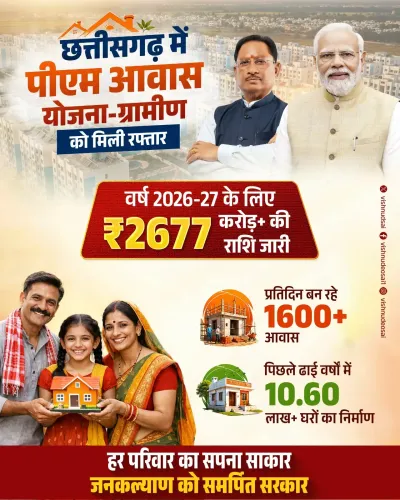
The model was developed under Pradhan Mantri Awas Yojana (Gramin) by the Vishnu Deo Sai government to supply construction materials from a single point in remote rural areas.
It aims to make rural housing construction faster, more accessible, and more affordable for PMAY-G beneficiaries in distant habitations.
Thousands of women from self-help groups serve as Dealer Didis , earning income through the model and progressing toward the Lakhpati Didi target of at least one lakh rupees annually.
The national recognition could pave the way for the model's replication in other states under central PMAY-G or DAY-NRLM frameworks.
The Chief Minister's Office of Chhattisgarh announced on 1 July 2026 that the state government's innovative 'Material Bank–Dealer Didi Model', developed under Pradhan Mantri Awas Yojana (Gramin), has been recognised and appreciated by the Government of India at the National Rural Development Conference. The model aims to deliver construction materials to housing beneficiaries in remote rural areas from a single point, while simultaneously empowering thousands of women from self-help groups.
Context
The Vishnu Deo Sai government developed the Material Bank–Dealer Didi Model as a last-mile supply-chain solution under PMAY (Gramin). As the CMO's post states, the model makes housing construction 'tez, sugam aur kifayati' — faster, easier, and more affordable — for beneficiaries in remote villages who previously struggled to source building materials. The central government's public appreciation at a national conference marks a significant endorsement of the state's approach.
Policy Backdrop
Pradhan Mantri Awas Yojana (Gramin) was launched in 2015 to provide pucca houses to eligible rural households, with convergence targets for basic amenities. A persistent challenge under the scheme has been ensuring that beneficiaries in geographically remote areas can access and afford construction materials without being exploited by middlemen or incurring high transportation costs. Chhattisgarh's Material Bank model addresses this by creating a centralised, accessible supply point linked to a local woman dealer — the 'Dealer Didi' — from a self-help group.
The model also converges with the Deendayal Antyodaya Yojana–National Rural Livelihoods Mission (DAY-NRLM), which was restructured in 2015 to scale self-help groups and integrate them with housing and livelihood programmes. The 'Lakhpati Didi' initiative — a national target to enable at least two crore women from self-help groups to earn a minimum of one lakh rupees annually — provides the income-generation framework within which Dealer Didis operate.
Stakeholders and Impact
The primary beneficiaries are rural housing recipients under PMAY-G in Chhattisgarh, particularly those in distant habitations with poor road or market connectivity. By providing construction materials at a single, locally accessible point, the model reduces delays and cost overruns that have historically slowed rural housing completion rates. Women self-help group members serving as Dealer Didis gain a structured, income-generating role, moving them toward the Lakhpati Didi income threshold.
The broader SHG ecosystem in Chhattisgarh stands to benefit as the model scales, with thousands of women positioned as micro-entrepreneurs embedded within the state's rural housing supply chain. Similar convergence innovations have been attempted in states such as Bihar and Odisha, and the national-level recognition signals that the Chhattisgarh model could inform guidelines for other states.
What's Next
The recognition at the National Rural Development Conference raises the prospect of the Material Bank–Dealer Didi Model being considered for replication or formal integration into central PMAY-G implementation guidelines. Watchers will track whether the Ministry of Rural Development issues advisories to other states drawing on Chhattisgarh's experience, and whether updated PMAY-G completion data from the state reflects the model's claimed acceleration of construction timelines. Progress on the Lakhpati Didi target — both nationally and within Chhattisgarh — will also be a key indicator of whether the SHG-linked dealer network delivers sustained income gains for women.
Point of View
The Vishnu Deo Sai government is demonstrating that state-level adaptation of central schemes can generate both housing outcomes and women's income gains simultaneously. This fits a broader BJP-governed-state pattern of showcasing convergence innovations — linking PMAY-G completion rates with the Lakhpati Didi count — as political and administrative proof-of-concept. If the model is formally adopted or cited in central guidelines, it would represent a significant policy win for Chhattisgarh and could accelerate similar experiments across tribal and forested states with comparable last-mile challenges.
NationPress
1 Jul 2026
Frequently Asked Questions
What is the Material Bank Dealer Didi Model in Chhattisgarh?
The Material Bank–Dealer Didi Model is an initiative by the Vishnu Deo Sai government in Chhattisgarh under PMAY (Gramin) that provides construction materials to rural housing beneficiaries from a single, locally accessible point. Women from self-help groups act as 'Dealer Didis,' running these material banks and earning income in the process.
Why did the Government of India praise Chhattisgarh's housing model?
The Government of India appreciated the Material Bank–Dealer Didi Model at the National Rural Development Conference because it addresses the persistent challenge of supplying construction materials to remote villages under PMAY-G while simultaneously empowering women self-help group members as micro-entrepreneurs.
What is the Lakhpati Didi scheme and how does it connect to this model?
Lakhpati Didi is a national initiative under DAY-NRLM targeting at least two crore women from self-help groups to earn a minimum of one lakh rupees annually through diversified livelihoods. The Dealer Didi role within the Material Bank model provides one such income pathway for SHG women in Chhattisgarh .
How does PMAY Gramin work in Chhattisgarh?
Pradhan Mantri Awas Yojana (Gramin) , launched in 2015 , provides financial assistance to eligible rural households to construct pucca houses. In Chhattisgarh , the state government has added the Material Bank–Dealer Didi layer to help beneficiaries in remote areas access construction materials more easily and affordably.
Can the Material Bank model be replicated in other states?
The national-level recognition at the National Rural Development Conference raises the possibility of the model being adapted by other states or incorporated into central PMAY-G guidelines. States with large remote or forested rural populations — similar to Chhattisgarh — are the most likely candidates for replication.