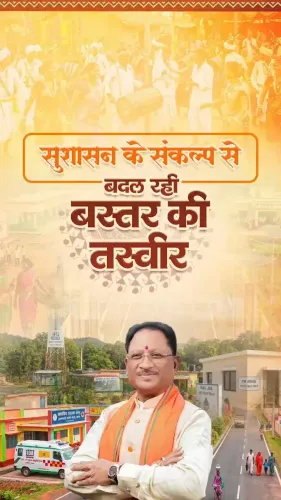
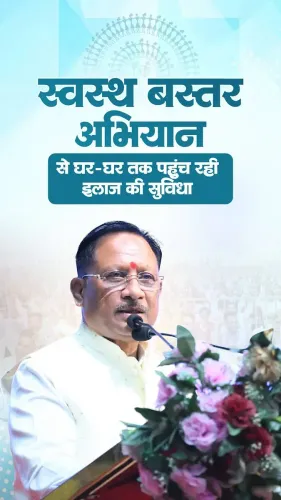
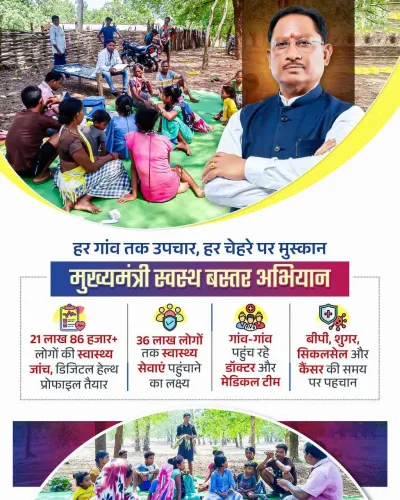
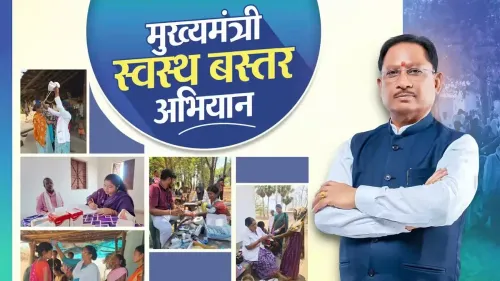
CM Sai's Swasth Bastar Abhiyan screens 34 lakh people
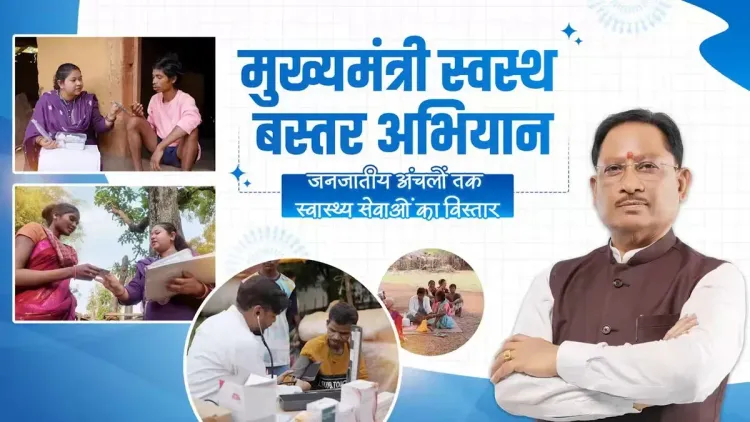
Synopsis
Chhattisgarh CM Vishnu Dev Sai's Mukhyamantri Swasth Bastar Abhiyan has screened 3.4 million people and treated over 40,000 in the tribal Bastar division, the CMO announced on the eve of Janjatiya Gaurav Diwas.
Key Takeaways
The Mukhyamantri Swasth Bastar Abhiyan , led by CM Vishnu Dev Sai , has conducted health check-ups for 34 lakh (3.4 million) people in the Bastar division.
More than 40,000 people have received treatment under the campaign so far.
The milestone was announced on 14 November 2026 , the eve of Janjatiya Gaurav Diwas (15 November), signalling a deliberate link to tribal welfare observance.
Bastar is Chhattisgarh's southern tribal division, historically marked by limited healthcare infrastructure and geographic access barriers.
The campaign uses mobile health units and community screenings as its core delivery model, consistent with outreach approaches across central India's tribal belts.
Analysts will watch for district-wise outcome data and any announcement extending the model to other tribal divisions in the state.
Thirty-four lakh health check-ups and over 40,000 treatments in one of India's most underserved tribal belts — the Chief Minister's Office of Chhattisgarh put those numbers on record on Saturday, 14 November 2026, the eve of Janjatiya Gaurav Diwas, as a measure of what the Mukhyamantri Swasth Bastar Abhiyan has delivered so far under Chief Minister Vishnu Dev Sai.
The post, shared in Hindi, reads: 'Mukhyamantri Shri Vishnu Dev Sai ke netritva mein Mukhyamantri Swasth Bastar Abhiyan ke tahat ab tak 34 lakh logon ki swasthya janch tatha 40 hazar se adhik logon ka upchar sunischit kiya gaya hai.' — 'Under the leadership of Chief Minister Vishnu Dev Sai, health check-ups of 3.4 million people and treatment of more than 40,000 people have been ensured so far under the Mukhyamantri Swasth Bastar Abhiyan.' The office added: 'Swasth Bastar, sashakt Chhattisgarh' — 'A healthy Bastar, an empowered Chhattisgarh.'
Why Bastar is the hardest place to run a health campaign
Bastar, the sprawling southern division of Chhattisgarh, carries one of the steepest healthcare deficits in central India. Its majority tribal population is spread across dense forests and remote hamlets where roads are sparse and permanent health facilities have historically been thin on the ground. Geography and, for years, security concerns compounded access barriers that generations of residents simply had to live with.
Chhattisgarh governments have run targeted outreach — malaria drives, nutrition camps — in Bastar since the early 2010s, but the current campaign frames those efforts under a single branded identity. Mobile health units, community screenings, and on-the-spot treatment are the operational core of the model, mirroring approaches used across tribal belts in Jharkhand and Odisha.
The Janjatiya Gaurav Diwas timing is deliberate
Janjatiya Gaurav Diwas, observed nationally on 15 November every year, marks tribal heritage and the contributions of tribal freedom fighters. Releasing the campaign's milestone figures on its eve is a pointed political signal — health delivery as a form of tribal welfare governance, not just an administrative update. The hashtag #JanjatiyaGauravDiwas in the official post makes that link explicit.
The BJP government under CM Sai, who took office in December 2023, has consistently positioned its Bastar agenda at the intersection of security normalisation and social delivery. Tribal health outreach, in that framing, doubles as a demonstration of restored governance reach in areas where state presence was once contested.
Where the numbers go next
The aggregate figures — 34 lakh screenings, 40,000-plus treatments — are government-reported. What analysts and health observers will watch for is district-wise outcome data: which blocks in Bastar saw the deepest penetration, what conditions were most commonly detected and treated, and whether the campaign model gets extended to other tribal divisions in the state. Ayushman Bharat provides a national insurance floor for Scheduled Tribe populations, but last-mile outreach remains a state-level execution challenge — and this campaign is precisely that last mile.
A 'sushaasan sarkar' — 'good governance government' — is how the CMO describes the Sai administration's self-identity. In Bastar, the scorecard is now tied to 34 lakh faces who showed up for a check-up.
Point of View
But its credibility will ultimately rest on verified outcome data that the administration has yet to release. For opposition parties in Chhattisgarh, the challenge is less to dispute the optics than to demand the disaggregated numbers that turn a headline figure into an accountable health record.
NationPress
14 Nov 2026
Frequently Asked Questions
What is the Mukhyamantri Swasth Bastar Abhiyan?
The Mukhyamantri Swasth Bastar Abhiyan is a state-government health outreach campaign in Chhattisgarh targeting medical screening and treatment for residents of the tribal Bastar division, run under Chief Minister Vishnu Dev Sai.
How many people have been screened under the Swasth Bastar Abhiyan?
According to the Chhattisgarh Chief Minister's Office, 34 lakh (3.4 million) people have been screened and more than 40,000 have received treatment under the campaign so far.
What is Janjatiya Gaurav Diwas and why is it relevant?
Janjatiya Gaurav Diwas is observed on 15 November every year as a national day honouring tribal heritage and freedom fighters. The Chhattisgarh CMO announced the campaign's health figures on its eve, explicitly linking tribal healthcare delivery to the observance.
Who is Vishnu Dev Sai and when did he become Chief Minister?
Vishnu Dev Sai is the Chief Minister of Chhattisgarh from the BJP, who took office in December 2023 . His government has prioritised outreach in tribal areas, particularly the Bastar division.
Why does Bastar face healthcare challenges?
Bastar is a largely forested, remote division in southern Chhattisgarh with a majority tribal population. Sparse roads, limited permanent health facilities, and years of security-related disruptions have historically made healthcare access difficult for residents.