CM Samrat Choudhary Hails 45% Export Surge Under PM Modi
Synopsis
Bihar Chief Minister Samrat Choudhary praised India's merchandise exports surging 45% year-on-year to $49.47 billion in October 2026, attributing the milestone to PM Narendra Modi's Make in India and PLI-driven manufacturing push under the Viksit Bharat vision.
Key Takeaways
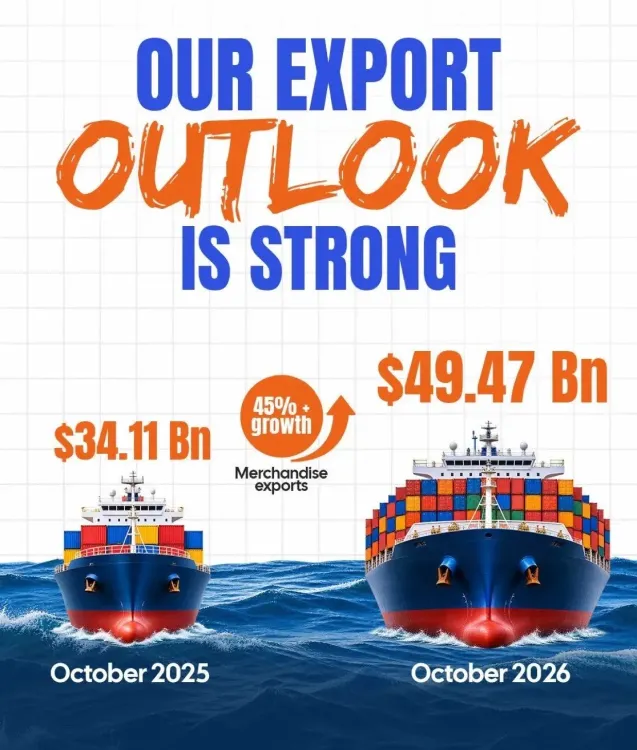
India's merchandise exports rose from $34.11 billion in October 2025 to $49.47 billion in October 2026, a 45% year-on-year increase .
Bihar CM Samrat Choudhary credited the surge to PM Modi's leadership and India's growing manufacturing capacity.
The Make in India initiative, launched in September 2014, and PLI schemes rolled out from 2020 form the policy backbone behind the export push.
The Viksit Bharat vision — a developed India by 2047 — provides the long-term framework within which each export record is positioned.
The Commerce Ministry's monthly export data and upcoming bilateral trade pact negotiations will be key indicators to watch for sustaining this momentum.
India's merchandise exports have posted a remarkable leap — from $34.11 billion in October 2025 to $49.47 billion in October 2026, a 45% year-on-year rise — and Bihar Chief Minister Samrat Choudhary has seized on the numbers as a defining proof-point of the country's growing manufacturing muscle and global standing.
Posting on Saturday, 14 November 2026, CM Choudhary wrote in Hindi: 'वैश्विक व्यापार में भारत की बढ़ती ताकत, दुनिया में भारत की मजबूत होती पहचान' — ['India's rising strength in global trade, India's strengthening identity in the world'] — crediting the leadership of Prime Minister Narendra Modi for steering exports to what he called 'new heights.' The post carried the hashtags #MakeInIndia and #ViksitBharat, twin pillars of the government's economic narrative.
From $34 Billion to $49 Billion — What the Numbers Signal
A single-month merchandise export figure crossing $49 billion would place India firmly in the conversation alongside major export economies. The 45% jump between the two Octobers is not merely a statistical blip — it reflects, if sustained, a structural shift in how much the world is buying 'Made in India.' CM Choudhary pointed to three drivers: rising manufacturing capacity, deeper self-reliance (Aatmanirbharta), and an increasingly credible presence in global markets.
The policy scaffolding behind such a trajectory has been years in the making. The Make in India initiative, launched in September 2014, set out to transform India from an import-dependent economy into a global production hub. It was followed, from 2020 onwards, by a wave of Production Linked Incentive (PLI) schemes spanning sectors from smartphones and pharmaceuticals to textiles and food processing — each designed to pull investment in and push exports out.
PLI Schemes and the Manufacturing Bet That Is Paying Off
The PLI architecture matters here. By tying government incentives directly to incremental output, the schemes gave exporters a reason to scale fast rather than consolidate slowly. Electronics, defence equipment, and specialty chemicals — sectors that barely registered in India's export basket a decade ago — have emerged as growth vectors. The Viksit Bharat vision, which sets the ambition of a fully developed India by 2047, provides the long-arc frame within which each monthly export record gets reported as a milestone, not a coincidence.
For BJP leaders like CM Choudhary — who governs Bihar, a state historically dependent on agriculture and remittances rather than manufacturing — amplifying national export data carries a pointed political message: the economic transformation is not confined to coastal industrial corridors but represents a rising tide for every state.
What Traders and Policymakers Will Watch Next
The Commerce Ministry's monthly merchandise export releases will now carry heightened attention. Analysts will track whether the October spike holds through the November–January quarter, whether it is concentrated in one or two high-value sectors, and whether the services export trajectory — already strong — reinforces the goods momentum. Any new bilateral or regional trade pacts under negotiation could add further runway.
India has consistently stated its goal of reaching $1 trillion in annual merchandise exports before the decade ends. At $49.47 billion in a single month, the arithmetic, for once, looks less aspirational and more arithmetic.
Point of View
The communication ties a monthly trade statistic to a 23-year civilisational ambition, making it harder to debate on pure policy terms. For a Chief Minister from Bihar — where industrial output has historically lagged coastal states — amplifying manufacturing-led export data also signals a party-wide stake in the narrative, not just a central government achievement. The question analysts will press: how much of the surge is concentrated in a handful of PLI sectors versus a broad-based rise across India's export basket.
NationPress
14 Nov 2026
Frequently Asked Questions
What was India's merchandise export figure in October 2026?
According to Bihar CM Samrat Choudhary's post, India's merchandise exports reached $49.47 billion in October 2026, up from $34.11 billion in October 2025 — a 45% year-on-year rise.
What is the Make in India scheme?
Make in India is a flagship government initiative launched in September 2014 by PM Narendra Modi to boost domestic manufacturing, attract foreign investment, and increase India's share of global exports.
What are PLI schemes and how do they affect exports?
Production Linked Incentive (PLI) schemes , rolled out from 2020 onwards across multiple sectors, tie government incentives to incremental production output, encouraging manufacturers to scale up and export more.
What is Viksit Bharat?
Viksit Bharat is the Indian government's vision for a fully developed India by 2047 , the centenary of independence, encompassing goals around economic self-reliance, manufacturing growth, and global integration.
Why did Bihar CM comment on India's export data?
Bihar CM Samrat Choudhary , a senior BJP leader, highlighted the export figures to celebrate PM Modi's economic leadership and underscore the party's narrative of India's rising global stature under the Make in India and Viksit Bharat programmes.