CM Samrat Choudhary hails ITBP all-women Everest team
Synopsis
Bihar Chief Minister Samrat Choudhary hailed the ITBP's historic first all-women expedition after all 11 members successfully summited Mount Everest on 22 May 2026, calling it a proud moment for every Indian and praising the team's courage and women's power.
Key Takeaways
Bihar CM Samrat Choudhary publicly congratulated the ITBP 's first all-women expedition team on 22 May 2026 .
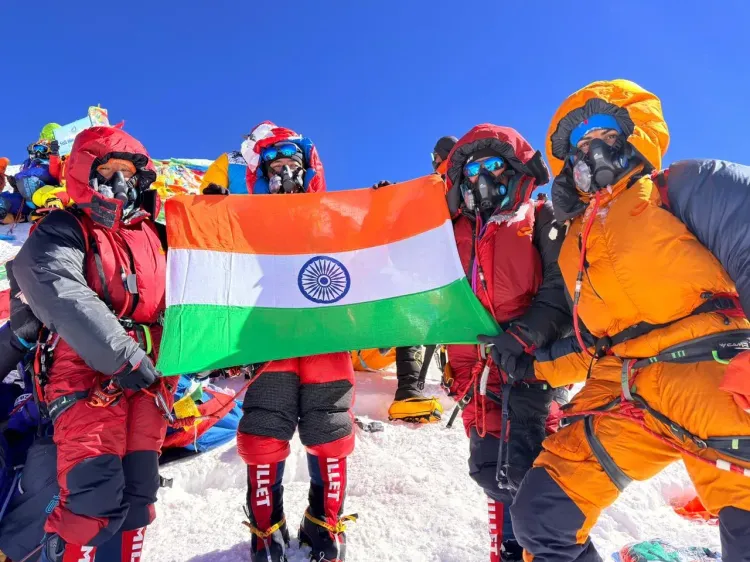
All 11 women in the team reached the summit of Mount Everest (8,848 m) and hoisted the Indian tricolour.
This is the first all-women expedition in the ITBP's mountaineering history.
The ITBP , established in 1962 , has long used high-altitude expeditions as operational training and a symbol of national capability.
The achievement reflects wider policy efforts to increase gender integration across India's Central Armed Police Forces.
Formal adventure or gallantry awards for the team and possible follow-on expeditions by other CAPFs are anticipated.
Bihar Chief Minister Samrat Choudhary on Friday, 22 May 2026, congratulated the Indo-Tibetan Border Police (ITBP)'s first all-women expedition team for successfully summiting Mount Everest, calling the feat a moment of pride for every Indian. All 11 members of the team planted the tricolour atop the world's highest peak, marking a historic milestone for women in India's paramilitary forces.
Context
Posting on X, CM Choudhary wrote: 'माउंट एवरेस्ट पर ITBP के प्रथम सर्व-महिला अभियान दल की ऐतिहासिक सफलता हर भारतीय के लिए गर्व का क्षण है' ['The historic success of ITBP's first all-women expedition team on Mount Everest is a moment of pride for every Indian']. He praised the team's 'courage, resolve, and extraordinary demonstration of women's power' (साहस, संकल्प और नारी शक्ति), extending heartfelt congratulations and best wishes to the entire squad.
The achievement represents the first time the ITBP has fielded an exclusively female mountaineering team to the summit of Mount Everest, which stands at 8,848 metres in the Himalayas. The expedition adds a landmark chapter to India's long record of high-altitude climbs by security forces.
Policy Backdrop
The ITBP, raised in 1962 under the Ministry of Home Affairs, has incorporated mountaineering into its operational training since inception. The force guards the India-China border across some of the world's most demanding high-altitude terrain, making summit expeditions both a practical fitness benchmark and a morale-building exercise.
India's relationship with Mount Everest and female climbers stretches back to 1984, when Bachendri Pal became the first Indian woman to reach the summit. Successive administrations have publicly celebrated such milestones to reinforce confidence in security institutions and to spotlight the growing role of women in forces historically dominated by men. The all-women format of this ITBP team aligns with broader policy directions promoting gender integration across Central Armed Police Forces (CAPFs).
Stakeholders and Impact
The 11 women of the ITBP expedition are the most immediate beneficiaries of the recognition now flowing from political leaders and the public alike. Their success is expected to encourage greater female enrolment and ambition within the CAPFs, where women have steadily expanded their presence in field and combat-adjacent roles over the past decade.
For the ITBP as an institution, the expedition reinforces its identity as a force capable of both border security and elite adventure operations. Political endorsement from figures such as CM Choudhary amplifies that image at the national level, lending the achievement visibility beyond defence circles.
What's Next
Attention will now turn to whether the central government formally recognises the team through gallantry or adventure awards at the next honours cycle. Other Central Armed Police Forces may also consider fielding all-women high-altitude teams in their annual training calendars, building on the precedent set by this ITBP expedition. The feat is likely to feature prominently in official communications around women's empowerment and national security in the months ahead.
Point of View
Reinforcing the party's consistent messaging around both military valour and women's empowerment. The all-women format gives the expedition unusual symbolic weight: it arrives at a time when the government is keen to demonstrate tangible progress on gender integration in uniformed services. By invoking Nari Shakti — a phrase closely associated with the current administration's flagship women-centric programmes — Choudhary aligns Bihar's political voice with the broader federal narrative. The post is unlikely to carry direct policy consequence but adds to a pattern of competitive political endorsement of security-force milestones that has become routine across party lines.
NationPress
19 Sept 2026
Frequently Asked Questions
What did ITBP's all-women team achieve on Mount Everest?
All 11 members of the ITBP's first all-women expedition team successfully summited Mount Everest and hoisted the Indian tricolour, marking a historic first for the force.
Who is Samrat Choudhary and why did he comment on the ITBP expedition?
Samrat Choudhary is the Chief Minister of Bihar and a senior BJP leader. He congratulated the team on X as part of a broader pattern of political leaders publicly celebrating security-force and national achievements.
What is the ITBP and what is its connection to mountaineering?
The Indo-Tibetan Border Police (ITBP) is a Central Armed Police Force under the Ministry of Home Affairs that guards the India-China border. It has included high-altitude mountaineering in its operational training since it was raised in 1962.
Who was the first Indian woman to climb Mount Everest?
Bachendri Pal became the first Indian woman to summit Mount Everest in 1984, paving the way for subsequent female expeditions by Indian armed and paramilitary forces.
Will the ITBP women Everest team receive any government awards?
No official announcement has been made yet, but attention is focused on whether the central government will formally recognise the team through gallantry or adventure awards at the next honours cycle.