CM Dhami Hails BSF All-Women Everest Team's Historic Climb

Synopsis
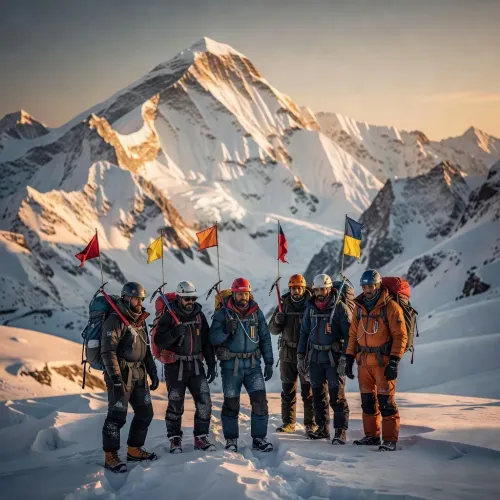
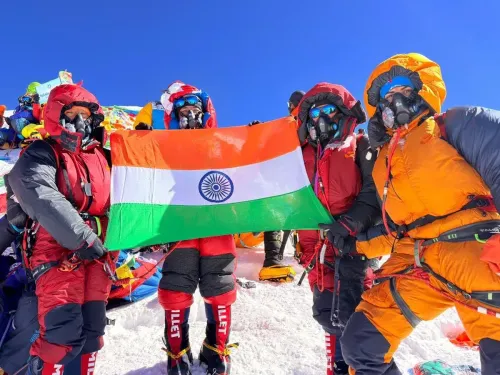
The BSF's first-ever all-women Mount Everest Expedition Team has scaled the world's highest peak under Mission Vande Mataram. Uttarakhand CM Pushkar Singh Dhami hailed the feat as a symbol of Nari Shakti and New India's unstoppable spirit, congratulating the entire team on 22 May 2026.
Key Takeaways
Uttarakhand Chief Minister Pushkar Singh Dhami congratulated the BSF's first-ever all-women Mount Everest Expedition Team on 22 May 2026 .
The expedition was conducted under Mission Vande Mataram , a BSF initiative linking the climb to national pride and patriotism.
The achievement is described as the first time the Border Security Force has fielded an exclusively women-led team on Mount Everest .
The feat is framed within India's Nari Shakti narrative, which successive governments have used to highlight women's achievements in national service.
Since 2015 , the Ministry of Home Affairs has been expanding induction and leadership roles for women across central armed police forces.
The milestone is expected to encourage other paramilitary forces to pursue similar all-women high-altitude expeditions.
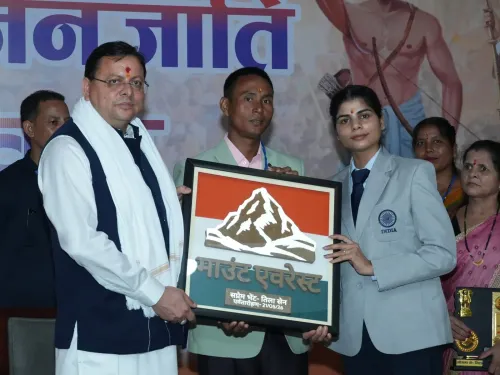
Uttarakhand Chief Minister Pushkar Singh Dhami on Friday, 22 May 2026 congratulated the Border Security Force's first-ever all-women Mount Everest Expedition Team for scripting history under Mission Vande Mataram, calling their feat a proud symbol of Nari Shakti and national pride.
Context
In his post, CM Dhami wrote that 'the daughters of India have once again proven that courage knows no limits,' extending heartiest congratulations to the entire team and signing off with 'Jai Hind.' The achievement marks the first time the BSF has fielded an exclusively women-led team on the world's highest peak, Mount Everest, framing it as a milestone for women in India's paramilitary forces.
The expedition was conducted under the banner of Mission Vande Mataram, a BSF initiative aimed at showcasing the capabilities and patriotic spirit of its personnel. The mission's name itself draws from India's national song, underscoring the symbolic weight the force has attached to this climb.
Policy Backdrop
The achievement sits within a deliberate, decade-long push by the Ministry of Home Affairs to expand induction and leadership roles for women across India's central armed police forces. Since 2015, the BSF and its sister organisations have progressively opened operational and adventure verticals to women personnel, moving well beyond administrative postings.
Indian security forces have a long tradition of high-altitude expeditions dating back to the 1960s, using such climbs to build institutional pride and demonstrate endurance. All-women or women-led expeditions have become an increasingly prominent strand of that tradition, each framed within the broader Nari Shakti narrative that successive central governments have championed to link women's achievements to national progress.
Stakeholders and Impact
The most direct beneficiaries of this milestone are the women personnel of the BSF and, by extension, women serving across India's paramilitary forces. A successful all-women Everest summit by a security force team carries institutional weight: it sets a precedent for future high-altitude deployments and strengthens the case for expanded operational roles for women in border-guarding duties.
For the broader public, the expedition reinforces a narrative that has gained traction across political and civil-society circles — that New India's women are equally capable of representing the nation in the most demanding arenas. Political leaders across the spectrum have historically celebrated such milestones, and CM Dhami's post is consistent with that pattern of amplifying institutional achievements to connect regional leadership with national pride.
What's Next
The BSF's trailblazing expedition is likely to prompt other central armed police forces to consider similar all-women high-altitude missions. Observers will watch whether Mission Vande Mataram expands its scope to include other major peaks or adventure challenges, and whether the Ministry of Home Affairs formalises policy updates on women's deployment in high-altitude and border-duty roles.
At the political level, the expedition is expected to feature in ongoing conversations about women's empowerment within India's security architecture — a theme that has gained prominence in both parliamentary debates and state-level governance agendas ahead of upcoming electoral cycles.
Point of View
Accelerated since 2015, to make women's participation in paramilitary adventure activities visible and politically legible. By amplifying the feat from Dehradun, Dhami signals Uttarakhand's proximity to the Himalayan theatre and its stake in high-altitude national achievements. The broader pattern suggests that all-women expeditions by security forces will continue to be used as soft-power moments, bridging the gap between defence policy and electoral messaging.
NationPress
16 Oct 2026
Frequently Asked Questions
What is the BSF all-women Mount Everest expedition?
It is the Border Security Force's first-ever expedition to the summit of Mount Everest composed entirely of women personnel, conducted under the BSF's Mission Vande Mataram initiative to showcase Nari Shakti and institutional capability.
What is Mission Vande Mataram BSF?
Mission Vande Mataram is a BSF initiative named after India's national song, designed to highlight the patriotism, courage, and capabilities of BSF personnel through landmark achievements such as high-altitude expeditions.
Why did CM Dhami congratulate the BSF women's team?
Uttarakhand Chief Minister Pushkar Singh Dhami congratulated the team on 22 May 2026 because their successful Everest climb under Mission Vande Mataram represents a historic first for the BSF and a milestone for women in India's paramilitary forces.
How has India expanded women's roles in paramilitary forces?
Since 2015, the Ministry of Home Affairs has progressively expanded induction and leadership roles for women across central armed police forces including the BSF, opening operational and adventure verticals beyond administrative positions.
Which other paramilitary forces have done women-led Everest expeditions?
Indian security forces have conducted all-women or women-led expeditions to major peaks for decades; the BSF's Mission Vande Mataram team is the first exclusively all-women Everest expedition specifically from the BSF, setting a precedent for other forces.