CM Sawant Backs Goa MSMEs on World MSME Day 2026
Synopsis
On World MSME Day 2026, Goa Chief Minister Pramod Sawant reaffirmed state support for micro, small and medium enterprises through financial assistance, interest rebates, skill development and market linkages, tying the effort to the Swayampurna Goa and Viksit Bharat frameworks.
Key Takeaways
Goa Chief Minister Pramod Sawant marked World MSME Day on 27 June 2026 with a public reaffirmation of state support for MSMEs.
The government has cited financial assistance, interest rebate schemes, skill development, ease-of-doing-business reforms and market linkage opportunities as its core MSME pillars.
Swayampurna Goa , the state's self-reliance initiative, and Viksit Bharat , the national 2047 vision, are the twin frameworks anchoring the policy direction.
Goa's MSME base covers tourism, pharmaceuticals, electronics and traditional crafts , sectors that stand to benefit from reduced credit costs and streamlined compliance.
India's Atmanirbhar Bharat package of 2020 and the MSME Development Act of 2006 provide the broader policy lineage within which Goa's state-level measures operate.
Upcoming Goa budget and industrial policy announcements will be watched for concrete allocations behind the commitments made on World MSME Day .
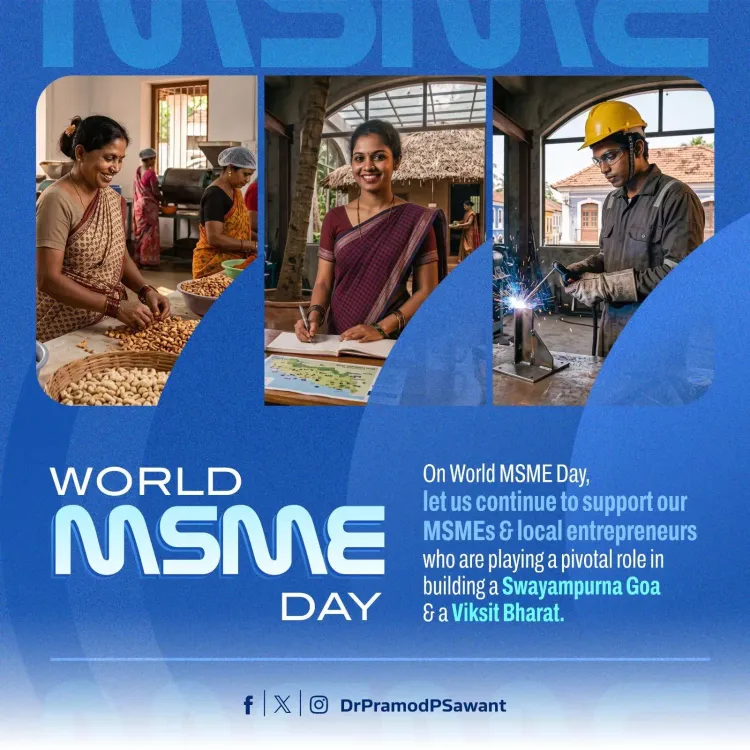
Goa Chief Minister Pramod Sawant on Saturday, 27 June 2026 marked World MSME Day by reaffirming his government's commitment to strengthening the state's micro, small and medium enterprise ecosystem through financial assistance, interest rebate schemes, skill development, ease-of-doing-business reforms and market linkage opportunities.
Context
World MSME Day, observed every year on 27 June, is a United Nations-recognised occasion that highlights the outsized contribution of micro, small and medium enterprises to employment, innovation and economic resilience. In India, the day has become an annual policy touchpoint for both central and state governments to announce or reiterate support measures for the sector.
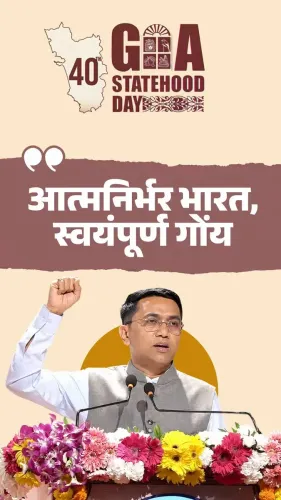
Chief Minister Sawant's post invoked two flagship frameworks — Swayampurna Goa, the state's own self-reliance initiative, and Viksit Bharat, the national vision for a developed India by 2047 — framing local entrepreneurship as integral to both goals. 'Let us continue to support our MSMEs and local entrepreneurs who are playing a pivotal role in building a self-reliant future,' he wrote.
Policy Backdrop
Goa's MSME base spans sectors including tourism, pharmaceuticals, electronics and traditional crafts. The state government's approach — combining financial assistance with interest rebate schemes and skill-building programmes — mirrors the broader direction set by India's Atmanirbhar Bharat package of 2020, which introduced dedicated credit guarantees, interest subvention and market linkage measures for MSMEs nationwide.
The legal scaffolding for these efforts traces back to the MSME Development Act of 2006, which established the classification, registration and support mechanisms that state-level policies continue to reference. Since the early 2020s, coastal and industrial states have increasingly aligned their MSME strategies with central government priorities around ease of doing business and credit access.
Swayampurna Goa, one of Chief Minister Sawant's signature programmes, promotes economic autonomy through local entrepreneurship and skill building. Its alignment with Viksit Bharat signals an intent to position Goa's small-business sector as a contributor to India's wider manufacturing and self-reliance targets ahead of the 2047 centenary goal.
Stakeholders and Impact
The primary beneficiaries of the policies highlighted by CM Sawant are Goa's MSME entrepreneurs and local businesses — from artisans and small manufacturers to service providers in the tourism corridor. Interest rebate schemes and skill development programmes, when effectively implemented, directly reduce the cost of capital and improve workforce readiness for smaller enterprises that typically lack access to formal credit.
Market linkage opportunities, another pillar cited in the post, are particularly relevant for Goa's traditional crafts and agro-processing units, which face distribution challenges despite strong product quality. Ease-of-doing-business reforms affect the entire MSME lifecycle — from registration and licensing to compliance — and have been a consistent demand from industry bodies across the state.
What's Next
Attention will now turn to Goa's next industrial policy review and budget cycle for concrete allocations on interest rebate outlays and skill programme targets. Any updates from the central MSME ministry on national credit schemes or revised classification thresholds — often timed around World MSME Day — will also shape the operating environment for the state's entrepreneurs. Whether the government translates the 27 June affirmations into measurable scheme expansions will determine how meaningfully Swayampurna Goa advances as an economic programme rather than an aspirational slogan.
Point of View
Though the absence of specific allocations or scheme targets leaves the commitment at the level of direction rather than delivery. Goa's MSME outreach fits a wider pattern among BJP-governed states of using symbolic occasions to reinforce the Atmanirbhar Bharat narrative at the grassroots. The real test will come at the next budget, where interest rebate outlays and skill programme enrolments can be measured against the aspirations articulated today.
NationPress
27 Jun 2026
Frequently Asked Questions
What did Goa CM Pramod Sawant say on World MSME Day 2026?
Chief Minister Pramod Sawant reaffirmed his government's commitment to supporting Goa's MSMEs through financial assistance, interest rebate schemes, skill development, ease-of-doing-business reforms and market linkage opportunities, linking the effort to Swayampurna Goa and Viksit Bharat goals.
What is Swayampurna Goa?
Swayampurna Goa is a state government initiative launched under Chief Minister Pramod Sawant that promotes self-reliance through local entrepreneurship, skill building and economic autonomy across Goa.
When is World MSME Day observed?
World MSME Day is observed every year on 27 June to highlight the role of micro, small and medium enterprises in employment, innovation and economic development globally and in India.
What sectors make up Goa's MSME base?
Goa's MSME sector spans tourism, pharmaceuticals, electronics and traditional crafts, with enterprises ranging from artisans and small manufacturers to service providers in the state's tourism corridor.
How does Goa's MSME policy connect to national schemes?
Goa's MSME support measures — including interest rebates and skill programmes — align with the central government's Atmanirbhar Bharat package of 2020 and the Viksit Bharat 2047 vision, following a pattern seen across coastal and industrial states since the early 2020s.