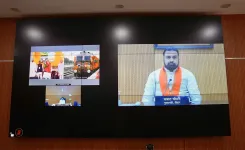
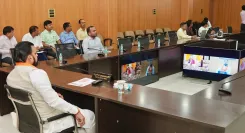
CM Sawant Hails India's First Hydrogen Train Launch

Synopsis
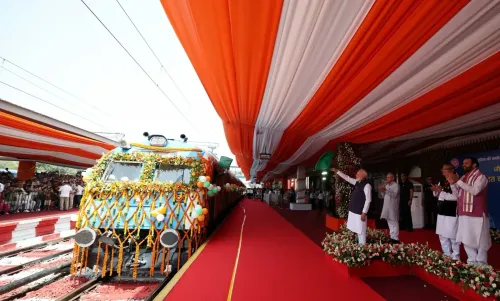
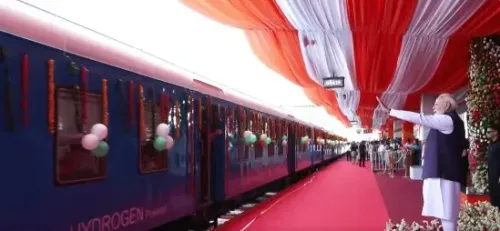
Goa Chief Minister Pramod Sawant hailed the inauguration of India's first indigenously developed Hydrogen Fuel Cell Train, flagged off by PM Narendra Modi on the Jind–Sonipat route in Haryana. The 1,200 kW zero-emission train marks a milestone under the National Green Hydrogen Mission and the Viksit Bharat vision.
Key Takeaways
India's first hydrogen fuel cell train was flagged off by PM Narendra Modi on 17 July 2026 .
The train operates on the Jind–Sonipat corridor in Haryana and is indigenously developed.
It runs on a 1,200 kW hydrogen fuel cell propulsion system and emits only water vapour.
The launch aligns with the National Green Hydrogen Mission approved in January 2023 .
Goa CM Pramod Sawant called it 'a new era in powering Indian Railways' and linked it to Atmanirbhar Bharat and Viksit Bharat .
India joins Germany , Japan , and other nations that have adopted hydrogen-powered rail technology.
Goa Chief Minister Pramod Sawant on Friday, 17 July 2026, welcomed the flagging off of India's first indigenously developed Hydrogen Fuel Cell Train, calling it the beginning of 'a new era in powering Indian Railways.' The train was inaugurated by Prime Minister Narendra Modi on the Jind–Sonipat route in Haryana, marking what the Chief Minister described as a historic milestone in the country's shift toward green mobility.
Context
CM Sawant's post on X stated that the train is 'powered by a 1,200 kW hydrogen fuel cell propulsion system and emitting only water vapour,' underlining its zero-emission credentials. He noted that the achievement 'places India among a select group of nations embracing hydrogen-powered rail technology,' referencing countries such as Germany and Japan that have run similar pilots. The post also linked the launch to the broader visions of Atmanirbhar Bharat and Viksit Bharat.
The train operates between Jind and Sonipat, two cities in Haryana, making this corridor India's first hydrogen-powered passenger rail route. The indigenous development of the trainset signals a step forward in domestic manufacturing of advanced propulsion equipment.
Policy Backdrop
The launch is rooted in a sequence of clean-energy policy commitments. At COP26 in 2021, India announced a net-zero emissions target by 2070, setting the frame for subsequent low-carbon transport policies. The National Green Hydrogen Mission, approved in January 2023, explicitly identified railways as a priority sector for hydrogen pilot projects, alongside steel, shipping, and fertilisers.
Indian Railways has been modernising its rolling stock under parallel tracks — electrification of the broad-gauge network and exploration of alternative fuels for routes where overhead electrification is less viable. Hydrogen fuel cell trains are seen as a candidate technology for such segments, offering zero direct emissions without requiring new electrical infrastructure.
Stakeholders and Impact
For railway passengers on the Jind–Sonipat corridor, the immediate change is operational — a cleaner, quieter ride with no diesel exhaust. For India's clean energy industry, the inauguration signals potential procurement pipelines: fuel cell manufacturers, electrolysers, and hydrogen storage system suppliers stand to benefit if the pilot scales up.
The indigenously developed tag is significant under the Atmanirbhar Bharat framework, as it suggests domestic engineering capability rather than import-dependent deployment. Globally, hydrogen rail has seen early adoption in Germany (Alstom's Coradia iLint) and pilot programmes in Japan and the United Kingdom, placing India's move within a recognised international trajectory.
What's Next
Attention will now turn to whether the National Green Hydrogen Mission allocates funds for additional hydrogen trainsets in upcoming railway budget cycles, and whether the Jind–Sonipat pilot will be extended to other routes with limited electrification. The government's ability to bring down the cost of green hydrogen — currently higher than diesel on a per-kilometre basis — will be the defining variable for large-scale rollout.
If the pilot demonstrates reliable performance and favourable economics, Indian Railways could integrate hydrogen propulsion into its long-term fleet strategy, potentially reducing the carbon footprint of one of the world's largest rail networks and reinforcing India's international climate commitments ahead of future COP negotiations.
Point of View
The National Green Hydrogen Mission, and the Atmanirbhar Bharat manufacturing narrative. For BJP-governed states like Goa, amplifying the event on social media reinforces alignment with the Centre's green-growth messaging ahead of electoral cycles. The real test, however, will be economic: green hydrogen remains costlier than diesel, and scaling beyond a single pilot route will require sustained policy support and price reduction in electrolysis. The Jind–Sonipat launch is a credible first step, but the gap between a flagship pilot and a system-wide transition for Indian Railways remains substantial.
NationPress
17 Jul 2026
Frequently Asked Questions
What is India's first hydrogen fuel cell train?
India's first hydrogen fuel cell train is an indigenously developed trainset powered by a 1,200 kW hydrogen fuel cell propulsion system that emits only water vapour. It was flagged off by PM Narendra Modi on the Jind–Sonipat route in Haryana on 17 July 2026.
Which route does India's hydrogen train run on?
The hydrogen train runs between Jind and Sonipat, two cities in Haryana, making this corridor India's first hydrogen-powered passenger rail route.
What is the National Green Hydrogen Mission?
The National Green Hydrogen Mission is a central government programme approved in January 2023 to scale up green hydrogen production and its application across sectors including railways, steel, and shipping.
How does a hydrogen fuel cell train work?
A hydrogen fuel cell train generates electricity through a chemical reaction between hydrogen and oxygen inside a fuel cell stack. The only byproduct is water vapour, making it a zero-direct-emission propulsion system compared to diesel trains.
Why did Goa CM Pramod Sawant comment on the hydrogen train launch?
Goa Chief Minister Pramod Sawant posted on X to welcome the launch as a national milestone, calling it the start of 'a new era in powering Indian Railways' and linking it to the Atmanirbhar Bharat and Viksit Bharat visions championed by the BJP-led central government.