CM Bhajan Lal Sharma Pushes Gram Chaupals for Last-Mile Delivery
Synopsis
Rajasthan Chief Minister Bhajan Lal Sharma on 28 May 2026 invoked PM Modi's public-service philosophy and highlighted Gram Chaupals — village-level open forums — as his government's tool for on-the-spot grievance redressal and last-mile delivery of welfare schemes across the state.
Key Takeaways
CM Bhajan Lal Sharma posted on 28 May 2026 reaffirming that political power is a means of public service, not personal comfort.
He credited Prime Minister Narendra Modi's philosophy as the guiding principle of the Rajasthan government's approach to governance.
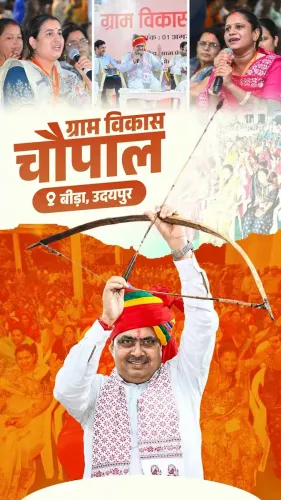
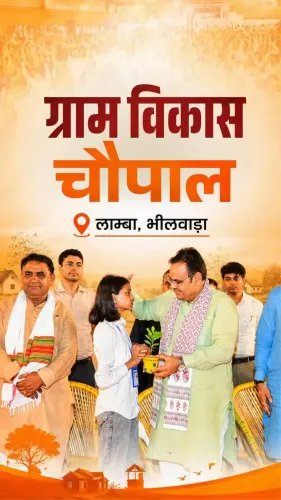
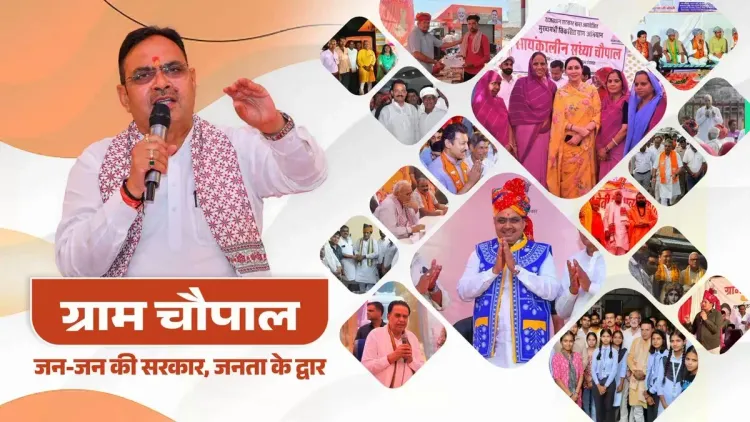
The Gram Chaupal programme deploys village-level public forums across Rajasthan for on-the-spot grievance redressal.
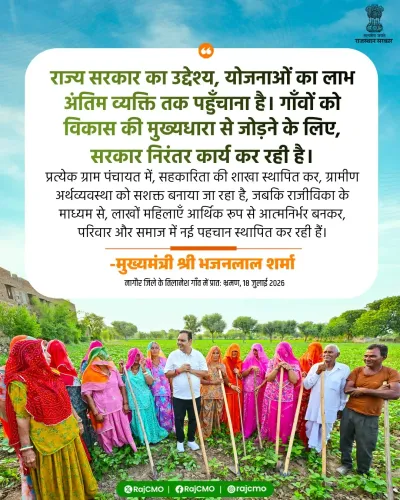
The initiative aims to ensure welfare schemes reach the last person in society, aligned with the national Antyodaya principle.
Similar grassroots outreach formats have been used in Gujarat and Madhya Pradesh under BJP governments.
Formal integration of Gram Chaupals into the Rajasthan Panchayati Raj department's framework remains a key indicator to watch.
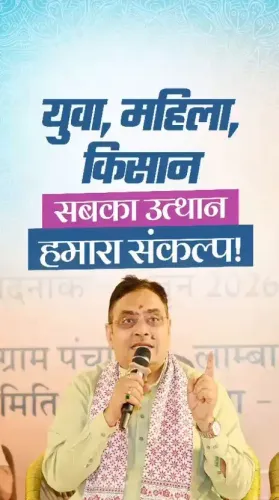
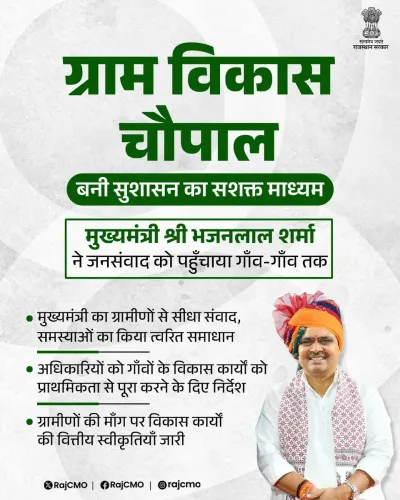
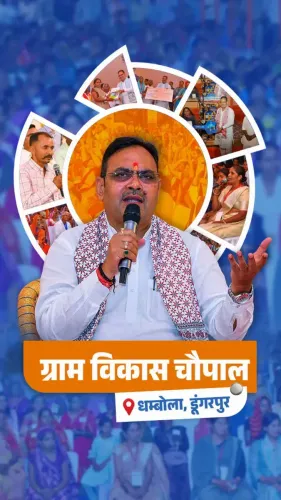
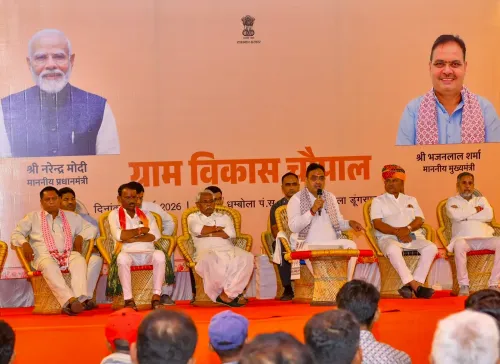
Rajasthan Chief Minister Bhajan Lal Sharma on Thursday, 28 May 2026, reaffirmed his government's commitment to grassroots governance, saying political power is a means of public service and not personal comfort. Invoking the philosophy of Prime Minister Narendra Modi, Sharma highlighted the Rajasthan government's use of Gram Chaupals — village-level public forums — to carry welfare schemes directly to the last beneficiary.
Context
Posting in Hindi, CM Sharma wrote: 'सत्ता हमारे लिए सुख का साधन नहीं, बल्कि जनता-जनार्दन की सेवा का माध्यम है' — 'Power is not a means of comfort for us, but a medium for serving the people.' He attributed this guiding principle directly to Prime Minister Modi, framing it as the philosophical foundation of his administration's approach to governance.
The Chief Minister also stated that his government believes in living among the people and sharing their joys and sorrows — a rhetorical posture consistent with BJP's grassroots outreach messaging across states it governs.
Policy Backdrop
The Gram Chaupal model — open village assemblies where officials hear grievances and resolve them on the spot — has precedent in several BJP-governed states. Gujarat and Madhya Pradesh have used similar formats to accelerate scheme implementation and strengthen political communication at the village level.
At the national level, the Antyodaya principle — reaching the poorest of the poor — has underpinned central schemes since 2014, operationalised through mechanisms such as Jan Dhan accounts and Direct Benefit Transfer. The Rajasthan government's Gram Chaupal initiative appears designed to complement these central delivery channels with a state-level, face-to-face engagement layer.
Following the December 2023 assembly elections that brought the BJP back to power in Rajasthan, the Sharma administration announced a shift toward direct public engagement models to supplement the existing Panchayati Raj structures already embedded in rural governance.
Stakeholders and Impact
Rural citizens and village panchayats are the primary stakeholders of the Gram Chaupal programme. The stated objective is on-the-spot grievance redressal, ensuring that citizens in remote villages do not have to travel to district headquarters to access government services or register complaints.
For the Rajasthan government, the forums also serve as a political listening exercise — allowing ruling party representatives and officials to gauge ground-level sentiment on scheme delivery. The Chief Minister's post underscores the dual function: administrative efficiency and direct democratic engagement.
What's Next
Observers will watch for state-level data on the number of Gram Chaupals conducted across Rajasthan's districts, the volume of grievances registered and resolved, and whether the programme is formally integrated into the Rajasthan Panchayati Raj department's budget and guidelines. A structured rollout with measurable targets would signal the initiative's transition from a political communication tool to an institutionalised governance mechanism.
The broader implication is that the Sharma government is positioning last-mile outreach as a defining feature of its tenure — one that aligns Rajasthan's state model with the public-service rhetoric championed by the BJP at the national level under Prime Minister Modi.
Point of View
But its explicit framing as a last-mile delivery mechanism signals an attempt to institutionalise what has often remained an ad-hoc political outreach exercise. The real test will be whether the programme generates verifiable data on grievances resolved and schemes delivered, or remains primarily a communication strategy. If the Sharma government can attach measurable outcomes to Gram Chaupals, it could set a replicable template for BJP-governed states heading into the next electoral cycle.
NationPress
11 Oct 2026
Frequently Asked Questions
What is a Gram Chaupal in Rajasthan?
A Gram Chaupal is a village-level open forum organised by the Rajasthan government where officials meet residents directly to hear grievances and resolve problems on the spot, ensuring welfare schemes reach the last beneficiary.
What did CM Bhajan Lal Sharma say about Gram Chaupals?
On 28 May 2026, CM Bhajan Lal Sharma said the Rajasthan government is reaching every village through Gram Chaupals to resolve problems immediately and deliver development schemes to the last person in society.
What is Bhajan Lal Sharma's governance philosophy?
CM Sharma has stated that political power is not a means of personal comfort but a medium for public service, a principle he attributes to Prime Minister Narendra Modi's guiding philosophy.
How does the Gram Chaupal relate to the Antyodaya principle?
The Gram Chaupal initiative aligns with the Antyodaya principle promoted by the central government since 2014, which focuses on reaching the poorest and most marginalised citizens through direct, last-mile delivery of welfare schemes.
Which other states have used similar village outreach programmes?
Gujarat and Madhya Pradesh, both BJP-governed states, have used similar village-level meeting formats to accelerate scheme implementation and maintain grassroots political engagement.