CM Shivakumar Announces AI Education from Class VI in Karnataka
Synopsis
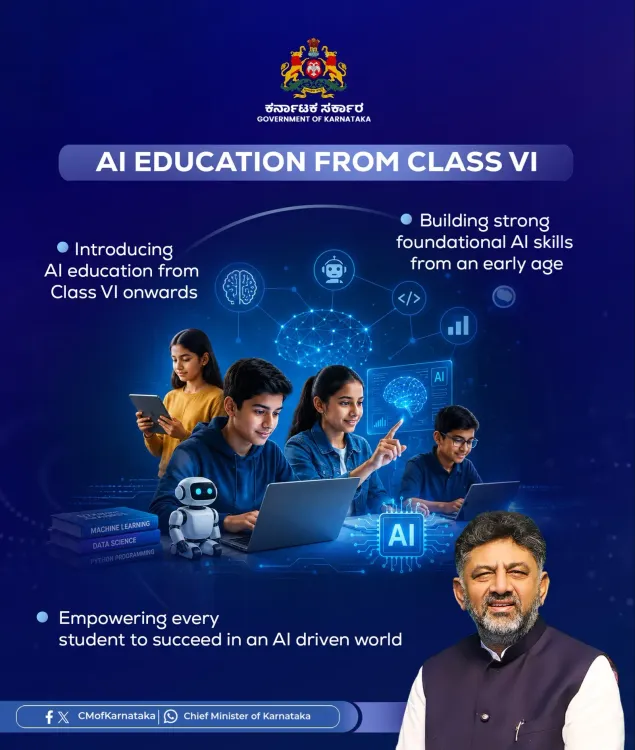
Karnataka Chief Minister D.K. Shivakumar has announced the introduction of AI education from Class VI onwards in state schools. The initiative aims to build foundational artificial intelligence skills in students, aligning with the National Education Policy 2020 and India's broader push to embed emerging technology learning in school curricula.
Key Takeaways
Shivakumar announced the introduction of AI education starting from Class VI in state schools.
The initiative aims to equip students with foundational AI skills and develop future innovators.
The move aligns with the National Education Policy 2020 , which recommended AI and coding integration from middle school onwards.
Karnataka joins several Indian states that have piloted AI or coding modules following India's National AI Strategy of 2018 .
Teachers and curriculum framework development will be central to successful implementation.
Detailed implementation timelines and budget allocations are yet to be made public.
The Chief Minister's Office of Karnataka announced on Tuesday, 14 July 2026, that Chief Minister D.K. Shivakumar has ordered the introduction of artificial intelligence education starting from Class VI across state schools, positioning Karnataka as one of the early movers among Indian states to embed foundational AI skills into middle-school curricula.
Context
The official announcement states that the initiative is aimed at 'preparing the next generation for an AI-driven future' and will 'equip young minds with foundational AI skills and nurture future innovators.' The move signals a deliberate push by the Government of Karnataka to align school education with the demands of an increasingly technology-driven economy.
The decision brings AI instruction into the curriculum at the point where students — typically aged 11 to 12 — begin transitional middle-school learning, a stage educators consider critical for building analytical thinking and problem-solving habits.
Policy Backdrop
The Karnataka announcement sits within a well-established national policy direction. The National Education Policy (NEP) 2020 explicitly recommended integrating artificial intelligence, coding, and experiential learning from middle school onwards, providing a framework that states have been progressively adopting.
India's National AI Strategy of 2018 further encouraged sub-national governments to pilot AI and coding modules in school curricula. Several Indian states have since launched such programmes, and Karnataka's initiative continues this pattern of translating central technology priorities into state-level action.
The broader trend reflects a recognition, shared across government and industry, that workforce readiness for an AI-integrated economy must begin well before higher education — making early school-level exposure increasingly seen as foundational rather than optional.
Stakeholders and Impact
School students from Class VI upwards across Karnataka's government and state-aided schools stand to be the primary beneficiaries, gaining early exposure to concepts that have until now largely been confined to higher secondary or undergraduate levels in most Indian states.
Teachers represent the most critical link in implementation. Curriculum reform at this scale requires substantial teacher training, and the Karnataka Department of School Education will need to develop or procure content frameworks, assessment tools, and professional development programmes before classroom rollout can begin in earnest.
The initiative also opens the door to potential partnerships with national ed-tech bodies and private industry players who have existing AI literacy content and assessment infrastructure suited to the middle-school level.
What's Next
The immediate priority will be the finalisation of a curriculum framework that defines what 'foundational AI skills' means in practice for students at the Class VI level — a scope that can range from basic computational thinking and data literacy to introductory machine learning concepts.
Teacher training timelines and any industry or institutional partnerships the Karnataka government may announce will be closely watched as indicators of how quickly the programme can move from policy declaration to classroom reality. Budget allocation details have not yet been made public.
If Karnataka executes the rollout effectively, the state could serve as a replicable model for other Indian states still deliberating on how to operationalise the NEP 2020 technology-education mandate at the middle-school level.
Point of View
Moving the policy from aspiration to a named curriculum intervention. The announcement carries political weight for CM Shivakumar, allowing the state government to project a technology-forward identity at a time when AI literacy is a visible national priority. However, the real test lies in teacher readiness and curriculum quality — the two areas where similar state-level digital education initiatives have historically stalled. The move also signals that the competitive race among Indian states to position themselves as technology-education leaders is intensifying.
NationPress
14 Jul 2026
Frequently Asked Questions
What is Karnataka's AI education initiative for schools?
Karnataka has announced the introduction of artificial intelligence education from Class VI onwards in state schools, aimed at building foundational AI skills among students and preparing them for a technology-driven future.
From which class will AI be taught in Karnataka schools?
AI education will be introduced from Class VI onwards in Karnataka schools, as announced by Chief Minister D.K. Shivakumar.
How does Karnataka's AI curriculum relate to NEP 2020?
The National Education Policy 2020 recommended integrating AI, coding, and experiential learning from middle school onwards. Karnataka's initiative directly operationalises this recommendation at the state level.
Who announced AI education in Karnataka schools?
Chief Minister D.K. Shivakumar announced the initiative, as communicated by the official Chief Minister's Office of Karnataka on 14 July 2026.
What are the challenges in implementing AI education in Karnataka schools?
The key challenges include finalising a suitable curriculum framework for middle-school students, training teachers at scale, and securing budget allocations — details of which have not yet been made public.