CM Shivakumar Grants One-Time OC Waiver for Power Links
Synopsis
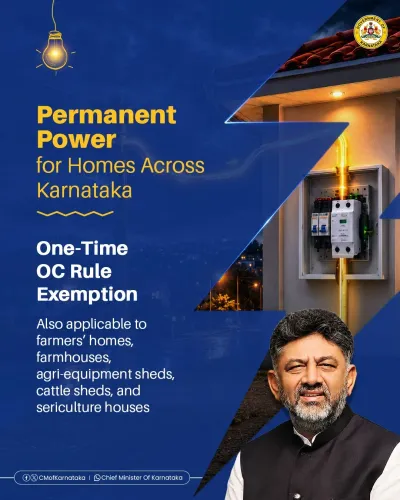
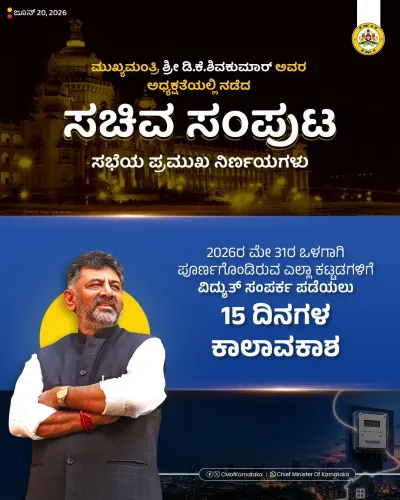
The Karnataka government has issued a one-time, 15-day exemption from the OC requirement for permanent electricity connections to eligible residential buildings — including urban, peri-urban, and rural structures — following a cabinet decision chaired by CM D.K. Shivakumar on June 20, 2026.
Key Takeaways
The Karnataka cabinet, chaired by CM D.K.
Shivakumar on June 20, 2026 , approved a one-time OC exemption for permanent electricity connections to residential buildings.
Applications can be submitted only within a 15-day window starting June 22, 2026 .
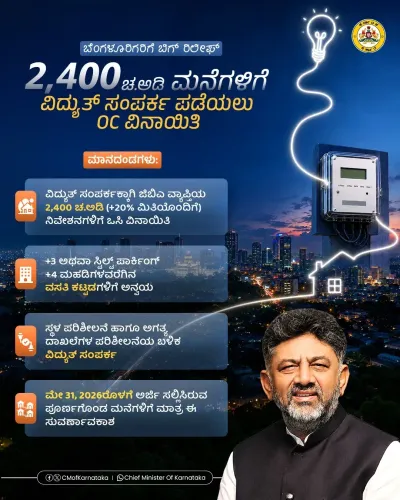
Eligible buildings include those on plots up to 2,400 sq ft (with 20% relaxation) , up to G+3 floors , or stilt parking plus 4 floors .
The exemption covers the entire state — Greater Bengaluru Authority limits, city corporations, urban local bodies, and gram panchayats .
Farmers' homes, farm houses, agricultural storage, cattle sheds, and sericulture cocoon houses are also eligible.
The measure is a one-time relief and does not alter Karnataka's core building bye-laws or planning regulations.
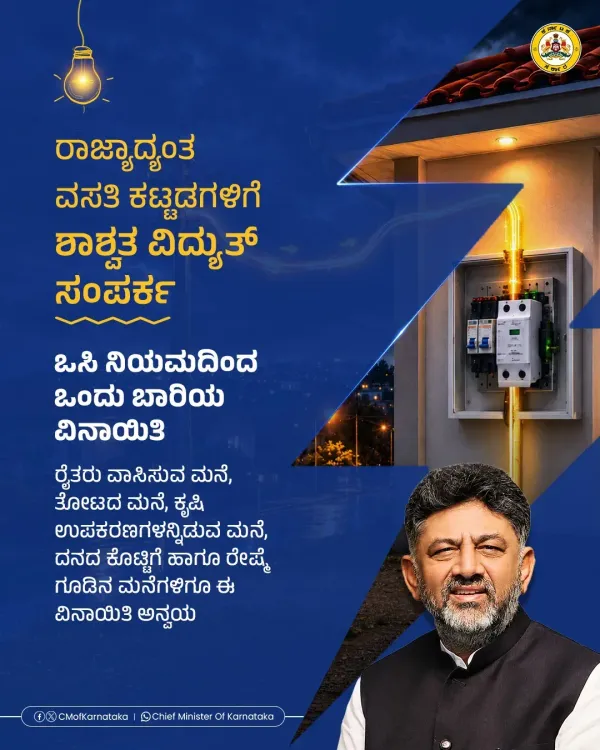
The Chief Minister's Office of Karnataka announced on Tuesday, June 23, 2026 that the state government has issued a one-time exemption from the Occupancy Certificate (OC) requirement for residential buildings seeking permanent electricity connections — a decision taken at a cabinet meeting chaired by Chief Minister D.K. Shivakumar on June 20, 2026.
The order, effective from June 22, 2026, opens a 15-day window during which eligible applicants may apply for new permanent power connections without producing an OC. The policy covers the entire state — from the jurisdiction of the Greater Bengaluru Authority and city municipal corporations to urban local bodies and gram panchayats.
Context
Karnataka's building regulations, rooted in the Town and Country Planning Act, have long required an Occupancy Certificate before a permanent electricity connection can be granted to a residential structure. For thousands of homeowners — particularly those in rapidly urbanising areas where building approvals lag behind construction — this rule has meant living without a legal power supply for years.
The cabinet's decision directly addresses this bottleneck, offering a limited, time-bound relief rather than a permanent rollback of planning norms. The government's post stated the move was aimed at resolving a 'major problem' (ಪ್ರಮುಖ ಸಮಸ್ಯೆ) faced by residents across the state.
Policy Backdrop
Karnataka governments have periodically issued time-bound relaxations to reduce bureaucratic friction for basic utility access without dismantling core planning regulations. This order follows that pattern, framing the exemption as a one-off measure rather than a structural change to building bye-laws.
The eligibility criteria are specific: residential buildings on plots up to 2,400 sq ft (with a 20% area relaxation), constructed up to G+3 floors, or buildings with stilt parking plus 4 floors, qualify for the OC waiver. Additionally, the exemption extends to farmers' residences, farm houses, agricultural equipment storage structures, cattle sheds, and sericulture cocoon houses — a notable inclusion that signals the policy's rural as well as urban reach.
Stakeholders and Impact
Urban homeowners stuck in approval limbo stand to benefit most immediately, particularly in peri-urban zones under the Greater Bengaluru Authority where rapid housing growth has outpaced formal building clearances. The inclusion of gram panchayat areas broadens the relief to rural Karnataka, covering farmers and agricultural households who have historically had limited access to formal utility connections.
Electricity distribution companies will need to process a potentially large volume of applications within and shortly after the 15-day period ending around July 7, 2026. The load impact on the grid and the administrative capacity of DISCOMs to handle the surge will be closely watched.
What's Next
Applicants have until the close of the 15-day window from June 22, 2026 to submit fresh applications for permanent connections under this exemption. Whether the government extends the window, introduces a follow-up regularisation scheme for OC compliance, or allows the measure to lapse as a one-time relief will determine its long-term significance. The policy's success in clearing the backlog could set a precedent for similar time-bound interventions in other utility sectors.
Point of View
Politically astute move that acknowledges the state's longstanding gap between rapid housing construction and slow building-approval machinery. By capping the window at 15 days and restricting eligibility by plot size and floor count, the government avoids the optics of a blanket amnesty while still delivering relief to a large constituency of urban and rural homeowners. The inclusion of agricultural structures — cattle sheds, sericulture houses — signals a deliberate outreach to Karnataka's farming communities ahead of what remains a competitive political environment. The real test will be whether distribution companies can absorb the application surge and whether the government follows up with a structural fix to the OC bottleneck, or lets the pressure rebuild until the next time-bound exemption.
NationPress
23 Jun 2026
Frequently Asked Questions
What is the OC exemption for electricity connection in Karnataka 2026?
The Karnataka government has issued a one-time order allowing eligible residential buildings to apply for permanent electricity connections without an Occupancy Certificate (OC). The exemption is valid only for applications submitted within 15 days from June 22, 2026.
Which buildings are eligible for the Karnataka OC waiver for power connections?
Residential buildings on plots up to 2,400 sq ft (with a 20% area relaxation), built up to G+3 floors or stilt parking plus 4 floors, are eligible. Farmers' homes, farm houses, agricultural storage structures, cattle sheds, and sericulture cocoon houses are also covered.
How long is the Karnataka electricity OC exemption window open?
The window is open for 15 days starting June 22, 2026 — the date of the government order. Applications submitted after this period will not be covered by the exemption.
Does the Karnataka OC exemption apply to rural areas and gram panchayats?
Yes. The order applies statewide, covering the Greater Bengaluru Authority limits, city municipal corporations, urban local bodies, and gram panchayats across Karnataka.
Will the Karnataka government extend the OC waiver for electricity connections beyond 15 days?
No extension has been announced. The current order is explicitly a one-time, time-bound measure. Any extension or follow-up regularisation scheme would require a separate government decision.