CM Shivakumar Launches 'Namma Shale Namma Javabdari' in Bengaluru
Synopsis
Chief Minister D.K. Shivakumar launched 'Namma Shale Namma Javabdari' at Vidhana Soudha on 4 November 2026, mobilising Institutional CSR funding to upgrade Karnataka government schools and improve learning quality.
Key Takeaways
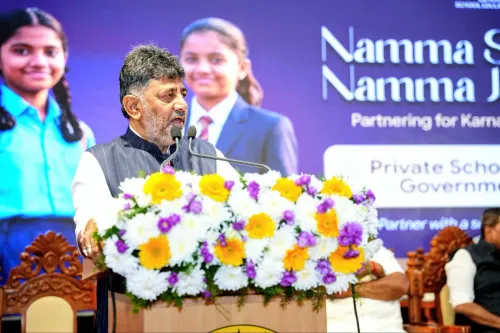
Shivakumar inaugurated the 'Namma Shale Namma Javabdari' (Our School, Our Responsibility) programme on 4 November 2026 .
The launch was held at the Banquet Hall, Vidhana Soudha , Bengaluru, at an Institutional CSR representatives' meeting.
The programme aims to channel corporate CSR funds into government school infrastructure and education quality under the Companies Act, 2013 framework.
School Education Minister Madhu Bangarappa and Chief Secretary Dr.
Shalini Rajneesh were among senior officials present.
Karnataka's state budgets for 2023–24 and 2024–25 had already allocated funds for government school upgrades, with this programme adding a corporate-funding layer.
District-level rollout and actual CSR commitments from companies will determine the programme's real-world impact.
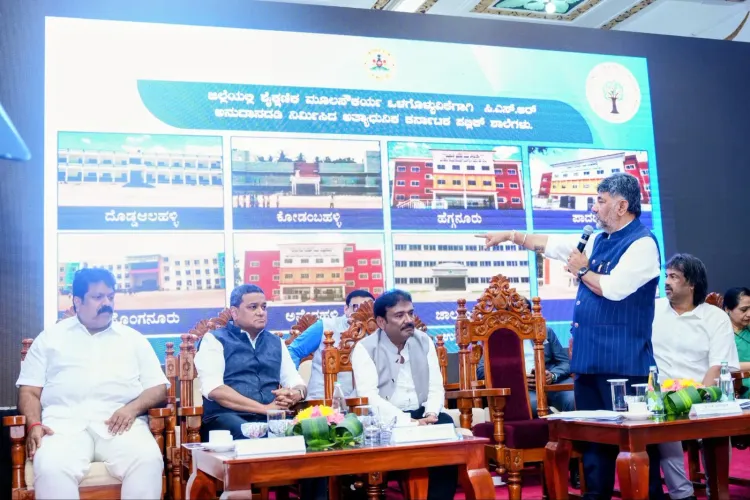
Karnataka's classrooms are getting a corporate lifeline. Chief Minister D.K. Shivakumar on Wednesday, 4 November 2026, inaugurated the 'Namma Shale Namma Javabdari' (Our School, Our Responsibility) programme at a high-level Institutional CSR representatives' meeting held at the Banquet Hall of Vidhana Soudha, Bengaluru — signalling Karnataka's formal push to mobilise corporate India behind its government school network.
'Namma Shale Namma Javabdari': What the programme promises
The initiative is designed to channel Corporate Social Responsibility funds directly into the development of government school infrastructure and the improvement of learning quality. By anchoring the effort within the Institutional CSR framework — rooted in India's Companies Act, 2013, which lists education as a priority sector for corporate giving — the state is effectively turning a legal obligation into a classroom transformation engine.
School Education Minister Madhu Bangarappa was present at the launch, underscoring the department's direct stake in the programme's execution. The sheer weight of officials assembled — from Chief Secretary Dr. Shalini Rajneesh to School Education Commissioner K. Vidyakumari — signals that this is not a ceremonial gesture but an administrative commitment with real delivery machinery behind it.
The officials in the room — and why that matters
The gathering at Vidhana Soudha brought together a rare convergence of political and bureaucratic leadership. Deputy Speaker Mankal Vaidya, Rajya Sabha MP Mansoor Ali Khan, CM's Principal Adviser G.C. Chandrashekar, CM's Additional Chief Secretary Tushar Girinath, Additional Chief Secretary for School Education Rashmi Mahesh, and Principal Secretary for Commerce and Industries Dr. S. Selvakumar were all present alongside corporate representatives.
The presence of the Commerce and Industries principal secretary alongside school education officials is telling: it places the programme squarely at the intersection of business accountability and public-service delivery — the precise sweet spot where CSR mandates can move fastest.
Karnataka's track record on school funding — and the gaps CSR must fill
Karnataka's state budgets for 2023–24 and 2024–25 both allocated funds for government school upgrades and teacher training. Yet the gap between budgetary intention and on-the-ground classroom reality across the state's roughly 46,000 government schools has persisted. Successive administrations have experimented with public-private school adoption models; 'Namma Shale Namma Javabdari' represents the most structured attempt yet to institutionalise that partnership rather than leave it to ad-hoc corporate goodwill.
The critical test will come at the district level — whether CSR commitments made in Bengaluru's Banquet Hall translate into repaired roofs, stocked libraries, and functional toilets in taluk schools. That rollout, and the quantum of funds actually committed by participating companies, will define the programme's legacy.
Point of View
Karnataka is attempting to convert a regulatory obligation into a scalable public-education dividend — a model other large states will watch closely. The programme also signals Chief Minister Shivakumar's intent to use Vidhana Soudha as a convening platform for private capital, reinforcing his dual identity as a development administrator and business-friendly politician. The real political test, however, is execution at the taluk level: CSR-funded flagship launches have historically struggled to survive the journey from Bengaluru boardrooms to rural classrooms. If 'Namma Shale Namma Javabdari' delivers verifiable infrastructure outcomes before the next state budget cycle, it could become a template; if not, it risks joining Karnataka's long list of well-announced but under-delivered education initiatives.
NationPress
4 Nov 2026
Frequently Asked Questions
What is 'Namma Shale Namma Javabdari'?
'Namma Shale Namma Javabdari' — meaning 'Our School, Our Responsibility' in Kannada — is a Karnataka government programme launched on 4 November 2026 to mobilise Institutional CSR funds for the development and quality improvement of government schools across the state.
Who launched the Namma Shale Namma Javabdari programme?
Chief Minister D.K. Shivakumar inaugurated the programme at a meeting of Institutional CSR representatives held at the Banquet Hall of Vidhana Soudha, Bengaluru.
What is the role of CSR in Karnataka's government school programme?
The programme draws on the Companies Act, 2013 framework that designates education as a priority sector for Corporate Social Responsibility spending. Companies are invited to direct CSR funds toward government school infrastructure upgrades and learning-quality improvements.
Which Karnataka minister handles school education?
Madhu Bangarappa holds the school education portfolio in the Karnataka cabinet and was present at the launch of the programme.
What will determine the success of 'Namma Shale Namma Javabdari'?
The programme's success will depend on the quantum of CSR funds committed by participating companies and the district-level rollout — specifically whether infrastructure improvements and quality upgrades actually reach government schools across Karnataka's taluks.