CM Siddaramaiah links 'Jolarajana Kathe' to equality agenda
Synopsis
Karnataka CM Siddaramaiah launched 'Jolarajana Kathe' at Seshadripuram, Bengaluru, connecting the book's sorghum allegory to Anna Bhagya, Article 371(J), and his vision of ending social and regional inequality across Karnataka.
Key Takeaways
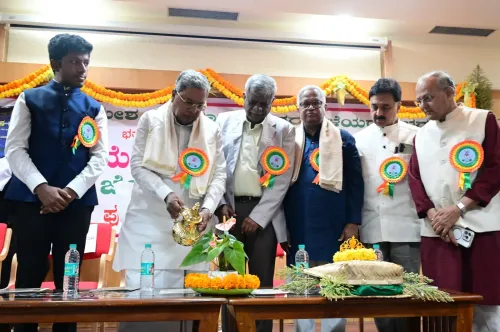
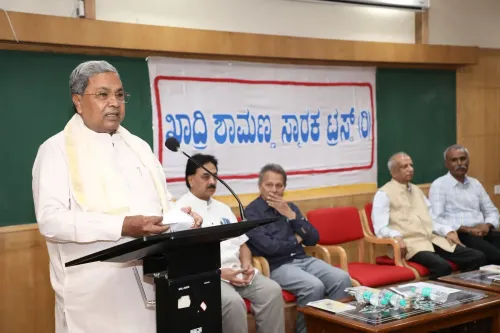
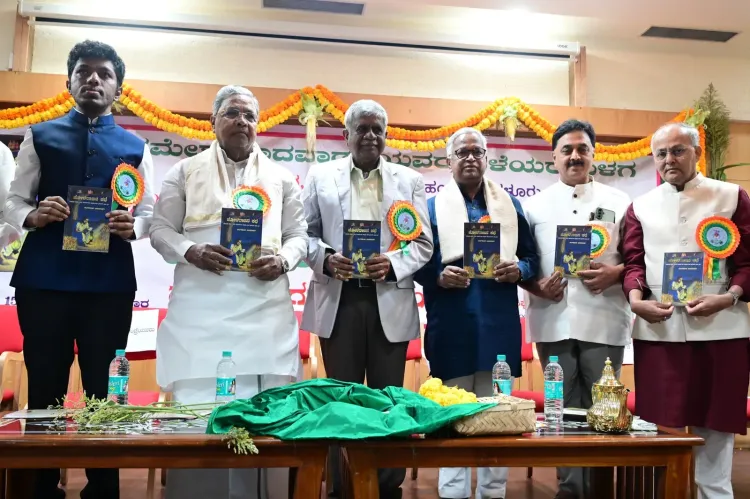
Karnataka Chief Minister Siddaramaiah released Kannada book 'Jolarajana Kathe' by Sangamesh Badawadagi at Seshadripuram Educational Institutions in Bengaluru on 15 November 2026 .
He drew a literary parallel between the book and Kanakadasa's 16th-century 'Ramadhanya Charite' , both using grains as metaphors for social equality.
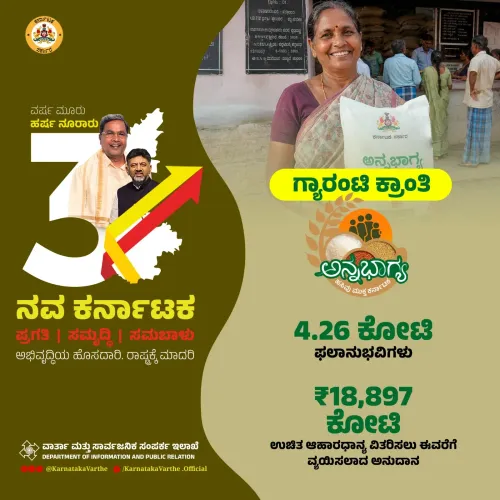
Anna Bhagya Yojane , launched in 2013-14 , was cited as a direct policy response to food inequality between poor and wealthy households.
Article 371(J) , enacted via the 98th Constitutional Amendment in 2012 , was highlighted as a milestone for education and employment access in Kalyana Karnataka .
Siddaramaiah invoked Basavanna, Dr Ambedkar, and Gandhi as shared visionaries of a caste- and class-free society.
The Chief Minister called casteism and superstition among the educated 'alarming' and urged a rational, scientific temperament.
A 16th-century poet's grain allegory met 21st-century welfare politics in Bengaluru on Sunday, 15 November 2026, when Karnataka Chief Minister Siddaramaiah launched a Kannada literary work and used it to trace an unbroken line from medieval social reform to his government's food-security guarantees.
Speaking at the Seshadripuram Educational Institutions auditorium, the Chief Minister released 'Jolarajana Kathe' ('The Story of the Sorghum King'), a new Kannada work by author Sangamesh Badawadagi. Siddaramaiah drew a direct literary parallel: just as the 16th-century poet-saint Kanakadasa championed the humble ragi grain over rice in his celebrated 'Ramadhanya Charite', Badawadagi uses sorghum — jowar — as a metaphor to surface questions of social and regional inequality that persist in modern Karnataka.
From childhood mudde to Anna Bhagya
The Chief Minister turned personal to make his policy case. 'In my childhood, ragi and jowar mudde was the staple food of poor families,' he said. 'Rice was cooked only on festival occasions.' That lived memory, he argued, was the seed of the Anna Bhagya Yojane, the food-security scheme he introduced during his first term as Chief Minister. Launched in 2013-14, Anna Bhagya guarantees free or subsidised rice to below-poverty-line households across Karnataka. 'Food security is every person's right,' he said. 'There should be no inequality in food between the poor and the wealthy.'Kalyana Karnataka's long wait and the 371(J) lifeline
Siddaramaiah extended the equality argument from the dinner table to the development map. The northern Kalyana Karnataka region — formerly Hyderabad Karnataka — has carried a historical lag in education, employment, and infrastructure. He cited the Nanjundappa Committee report of 2002, which documented regional disparities and recommended targeted investment, and the Govindarao Committee, as the evidence base for corrective measures. The decisive constitutional instrument, he said, was Article 371(J), enacted through the 98th Constitutional Amendment in 2012, which provides reservations in education and public employment for the region's youth. 'Dreams of becoming doctors, engineers, teachers, and professors are being realised because of 371(J),' he said.Basavanna's vachana and the unfinished reform
The Chief Minister grounded his politics in a longer moral tradition. He invoked Basavanna, the 12th-century reformer whose vachanas argued against caste discrimination — including the verse 'Ivanaarava, ivanaarava endeniside ayyaa; iva nammava, iva nammava endenisuyyaa' ('Do not ask who he is, whose is he; say he is ours, he is ours') — alongside Dr B.R. Ambedkar and Mahatma Gandhi as architects of an egalitarian vision India has yet to fully achieve. 'Even among the educated, casteism, superstition, and blind orthodoxy continue — that is alarming,' he said, calling for a scientific and rational temperament to replace them. 'Coexistence, not hatred, must be our value.' Siddaramaiah closed by congratulating Badawadagi for carrying forward the spirit of Kanakadasa's allegory and expressing hope that such literary works would 'spread the light of equality, humanity, and rational thinking across society.' When grain becomes metaphor and metaphor becomes policy, the distance between a medieval poem and a welfare scheme turns out to be very short.Point of View
Welfare policy, and constitutional law, he frames the Congress government's social-justice agenda as culturally rooted rather than merely electoral. The invocation of Kanakadasa and Basavanna alongside Anna Bhagya and Article 371(J) signals an attempt to consolidate backward-class and Dalit constituencies in the Kalyana Karnataka belt, a region of persistent electoral significance. Citing the Nanjundappa and Govindarao committees keeps the regional-development discourse tethered to technocratic legitimacy rather than populism. The sharp critique of educated casteism also reads as a signal to liberal urban voters, widening the coalition the CM is addressing from a single platform.
NationPress
15 Nov 2026
Frequently Asked Questions
What is 'Jolarajana Kathe' and who wrote it?
'Jolarajana Kathe' ('The Story of the Sorghum King') is a Kannada literary work by Sangamesh Badawadagi that uses sorghum as a metaphor to explore social and regional inequality in Karnataka. CM Siddaramaiah launched the book at Seshadripuram in Bengaluru on 15 November 2026.
What is the Anna Bhagya Yojane scheme?
Anna Bhagya Yojane is a Karnataka food-security scheme launched by Siddaramaiah during his first term as Chief Minister in 2013-14 , guaranteeing free or subsidised rice to below-poverty-line families across the state.
What is Article 371(J) and how does it help Kalyana Karnataka?
Article 371(J), inserted by the 98th Constitutional Amendment in 2012 , grants special status to the Kalyana Karnataka (formerly Hyderabad Karnataka) region, providing reservations in education and public employment for local youth and directing development funds to historically backward districts.
Who was Kanakadasa and what is 'Ramadhanya Charite'?
Kanakadasa was a 16th-century Kannada poet-saint. His 'Ramadhanya Charite' uses a contest between grains — with ragi prevailing over rice — as an allegory arguing for the dignity and worth of the common person's food and culture.
What did Siddaramaiah say about casteism at the event?
Siddaramaiah called the persistence of casteism, superstition, and orthodoxy even among educated people 'alarming,' citing the 12th-century reformer Basavanna's vachanas alongside Ambedkar and Gandhi to argue that a scientific and rational mindset is needed to build a truly equal society.