CM Siddaramaiah pushes for Karnataka state flag, Kannada jobs
Synopsis
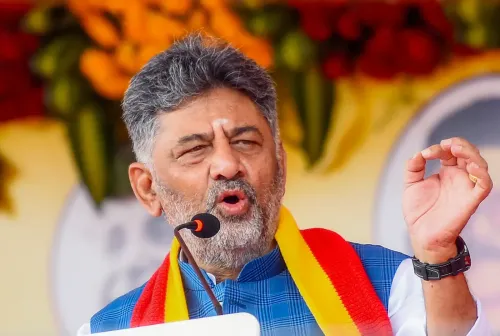
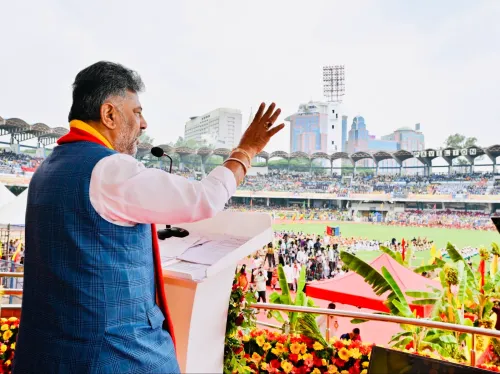
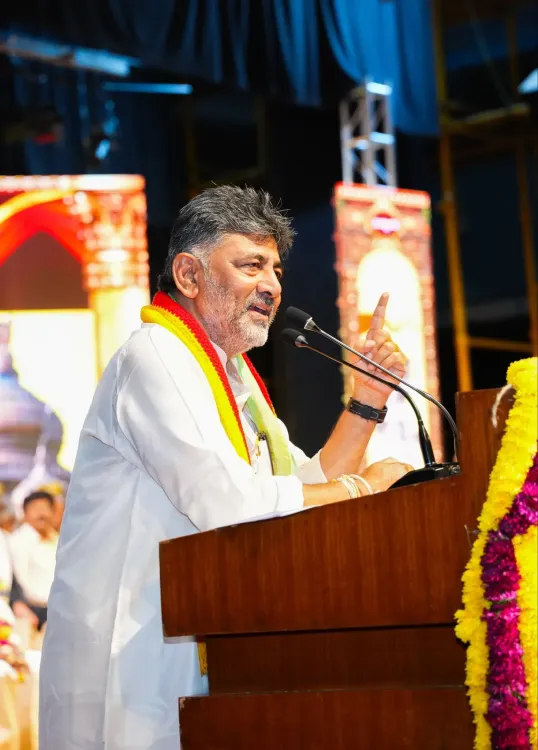
At the 71st Kannada Rajyotsava ceremony in Bengaluru, CM DK Shivakumar demanded Centre's recognition of a Karnataka state flag, cited a sharp decline in Kannada speakers in Bengaluru, and warned private employers and IT firms to prioritise Kannada workers in hiring.
Key Takeaways
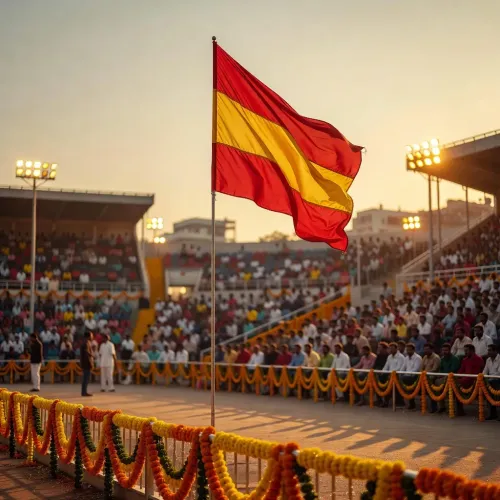
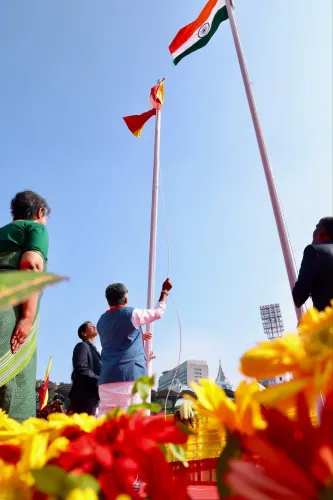
CM DK Shivakumar called on the entire state to send a unified message to the Centre seeking official recognition of a Karnataka naadadhwaja (state flag) alongside the national flag.
Karnataka holds roughly 5.5% of India's population but contributes approximately 9.19% of the national economy, the CM argued in support of the state's aspirations.
The 2011 Census found only 44.5% of Bengaluru residents speak Kannada as their mother tongue, down from a historical figure of around 90%.
Shivakumar reiterated last week's directive to all private institutions, IT-BT companies and factories in Karnataka to give hiring preference to Kannadigas .
The CM called for Kannada to grow as a language of AI, startups and the digital era , and praised youth-led social media efforts to document regional dialects.
71 awardees received the Kannada Rajyotsava Prashasti at the ceremony held at Ravindra Kalakshetra, Bengaluru .
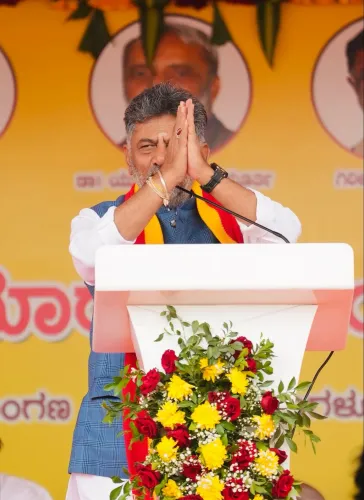
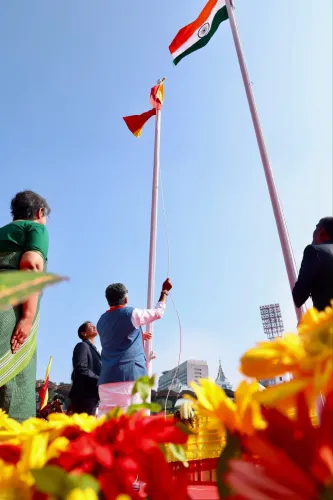
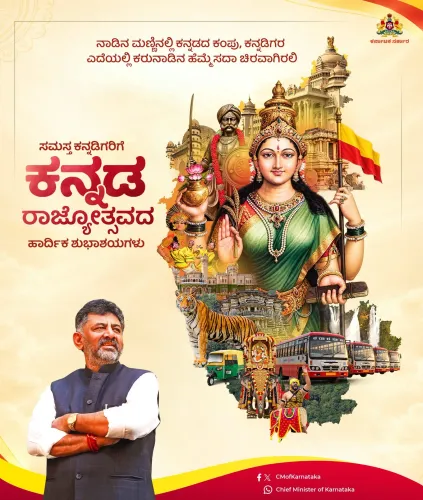
Seventy-one years after Karnataka's unification, the state's highest cultural stage — the Kannada Rajyotsava awards ceremony at Ravindra Kalakshetra, Bengaluru — became a platform for something far larger: a formal call to fly a Karnataka naadadhwaja (state flag) alongside the national tricolour, and a blunt warning to every IT-BT company and private employer in the state to prioritise Kannada-speaking workers. Chief Minister DK Shivakumar delivered the address on Sunday, 1 November 2026, at the event where 71 awardees were recognised for distinguished service to the Kannada language and culture.
The state-flag demand: a constitutional argument
Shivakumar framed the naadadhwaja push as neither symbolic defiance nor separatism, but a straightforward constitutional reading. 'The Constitution nowhere says a state cannot have its own flag,' he said, calling on the entire state to send a unified message to the Centre seeking official recognition. His vision — articulated as 'Bharatada bala Karnataka' ('Karnataka, the strength of India') — positions the state not as demanding special treatment but as asserting earned stature: Karnataka accounts for roughly 5.5% of India's population yet contributes approximately 9.19% of the national economy. The ask, he argued, is proportionate.
Bengaluru's linguistic slide — and why it alarms the government
The Chief Minister placed a stark statistic at the centre of his cultural argument. The 2011 Census recorded 107 languages spoken in Bengaluru, with only 44.5% of residents declaring Kannada as their mother tongue — down from a figure that once stood near 90%. The 2018 linguistic survey ranked Kannada eighth among India's most-spoken languages. Shivakumar did not treat these numbers as curiosities; he treated them as a slow emergency. 'If the language survives, the land survives. If the land survives, the language survives,' he said.
He invoked poet D.R. Bendre's line — 'Jagada ellige aguvaude Kannadaadinda' ('The world's progress happens through Kannada') — and recalled that literary giants who adopted Kannada were not born into it: Masti's mother tongue was Tamil, Bendre's was Marathi, Kuvempu wrote his first poems in English, and recent Booker Prize winner Banu Mushtaq's home language is Urdu. All of them, he said, breathed and found glory in Kannada — proof that the language can be chosen, not just inherited.
Jobs, signboards, and a direct warning to industry
Shivakumar reminded the audience that his earlier directive — issued just the previous week — had explicitly warned all private institutions, IT-BT companies and factories operating in Karnataka to give hiring preference to Kannadigas. He pointed to a rule he had introduced as Deputy Chief Minister mandating that all signboards in Bengaluru carry 60% Kannada and 40% English, and reiterated that all private schools, colleges and offices in the city must mandatorily observe Kannada Rajyotsava celebrations. 'Kannada must be sovereign in Karnataka,' he said. 'Other languages are guests here.'
Kannada as the language of AI and the startup age
The speech was not only backward-looking. Shivakumar called on the younger generation to make Kannada 'a language of artificial intelligence, startups and the digital era.' He praised young content creators on social media who are documenting regional dialects — Chamarajanagar Kannada, Hassan Kannada, Kundapur Kannada, Davangere Kannada, Tumkur Kannada — celebrating linguistic diversity within the Kannada world itself. 'We have a crore languages to learn,' he said. 'But to speak, we have only one — Kannada.'
Quoting Mahatma Gandhi — 'Love other cultures, live in your own' — he closed by addressing the 71 Rajyotsava awardees directly: their recognition, he said, is the blessing of the Kannada people, and Kannada's glory is the inspiration for all. The 71st Kannada Rajyotsava is not just a celebration; it is, as he put it, 'Kannadammana goodu kattida habba' — the festival that built the home of Mother Kannada.
Whether the Centre responds to the state-flag demand will now be the real measure of how far this anniversary speech travels beyond Ravindra Kalakshetra.
Point of View
Anchoring the flag demand to Karnataka's outsized GDP contribution, is designed to pre-empt any charge of parochialism by recasting it as proportionate federal assertion. Bengaluru's declining share of native Kannada speakers gives the government a genuine demographic anxiety to mobilise; the question is whether legislative teeth will follow the rhetoric, particularly on private-sector hiring quotas, which have historically attracted constitutional challenges.
NationPress
2 Nov 2026
Frequently Asked Questions
What is the Karnataka naadadhwaja or state flag demand?
The Karnataka government wants the Centre to officially recognise a distinct state flag — the naadadhwaja — that can fly alongside the national tricolour. CM Shivakumar argued that the Constitution does not prohibit states from having their own flags, citing Jammu and Kashmir's pre-2019 precedent as the only historical Indian case.
Why are Kannada speakers declining in Bengaluru?
Bengaluru's rapid growth as a global technology hub has drawn millions of migrants from across India and abroad. The 2011 Census found that only 44.5% of Bengaluru residents declared Kannada as their mother tongue, compared to roughly 90% in earlier decades, a shift the state government attributes to the pace and scale of in-migration.
What did CM Shivakumar say about Kannada employment in private companies?
Shivakumar said he had warned all private institutions, IT-BT companies and factories in Karnataka the previous week to give hiring preference to Kannadigas. He also reiterated rules requiring all Bengaluru signboards to carry 60% Kannada text and mandating Kannada Rajyotsava celebrations in all private establishments.
Who are some of the literary figures CM Shivakumar cited in his speech?
He cited poet D.R. Bendre (whose mother tongue was Marathi), litterateur Masti (mother tongue Tamil), Jnanpith laureate Kuvempu (who first wrote poetry in English), and recent Booker Prize winner Banu Mushtaq (whose home language is Urdu) — all of whom built their greatest work in Kannada.
How many people received the Kannada Rajyotsava Prashasti in 2026?
71 people were honoured with the Kannada Rajyotsava Prashasti at the ceremony held at Ravindra Kalakshetra, Bengaluru on 1 November 2026, the 71st Karnataka Rajyotsava.