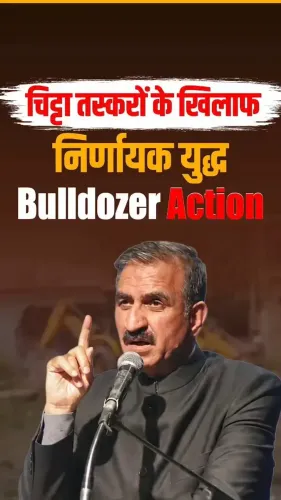
CM Sukhu vows relentless crackdown on chitta traffickers in HP
Synopsis
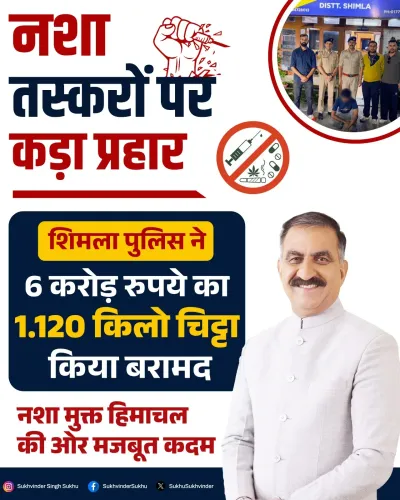
Chief Minister Sukhvinder Singh Sukhu on 9 June 2026 declared that Himachal Pradesh will sustain its campaign to jail chitta traffickers while simultaneously working to rehabilitate addicts and bring them back into the mainstream — underscoring a twin-track approach to the state's opioid crisis.
Key Takeaways
CM Sukhvinder Singh Sukhu reaffirmed on 9 June 2026 that the campaign against chitta traffickers in Himachal Pradesh will continue 'with full resolve and commitment.' The statement explicitly pairs enforcement — putting traffickers 'behind bars' — with rehabilitation of those trapped in addiction.
Chitta, a colloquial term for heroin or white synthetic opioids, is a significant drug-abuse concern across Himachal Pradesh , particularly among youth.
Legal action is anchored in the Narcotic Drugs and Psychotropic Substances (NDPS) Act, 1985 , which allows stringent prosecution and bail restrictions.
Himachal Pradesh aligns its demand-reduction efforts with the central Nasha Mukt Bharat Abhiyaan launched after 2020 .
Follow-up metrics to watch include arrest statistics, new rehabilitation centre announcements, and inter-state coordination with Punjab and central agencies.
The Chief Minister's Office of Himachal Pradesh shared a statement on Tuesday, 9 June 2026 from Chief Minister Thakur Sukhvinder Singh Sukhu reaffirming a two-pronged state strategy against the chitta crisis: rehabilitating addicts and prosecuting traffickers with uncompromising force.
Context
In the post, CM Sukhu stated — 'Chitta ki lat mein phanse logon ko mukhyadhara se jodna jitna aavashyak hai, utna hi taskaron ke viruddh kathor karyavahi karna bhi' — 'Bringing those trapped in chitta addiction back into the mainstream is as necessary as taking strict action against traffickers.' He added that the campaign to put chitta traffickers 'behind bars will continue with full resolve and commitment.'
'Chitta' is a colloquial term for heroin or white synthetic opioids widely used in Himachal Pradesh, Punjab, and Haryana. The drug has become a significant public-health and law-enforcement concern across the northern hill state, particularly among youth.
Policy Backdrop
Drug enforcement in Himachal Pradesh is anchored in the Narcotic Drugs and Psychotropic Substances (NDPS) Act, 1985, which empowers state police to arrest, prosecute, and seek stringent bail restrictions against traffickers. The Act has been invoked repeatedly in the state for cases involving heroin and synthetic opioid supply chains.
On the demand-reduction side, Himachal Pradesh aligned its district-level de-addiction and rehabilitation drives with the central government's Nasha Mukt Bharat Abhiyaan after 2020. The dual-track approach — enforcement plus rehabilitation — mirrors the framework adopted by neighbouring Punjab and Haryana, which have similarly grappled with opioid networks fed by cross-border trafficking routes.
Stakeholders and Impact
The statement directly addresses two distinct groups: individuals caught in addiction, who the government says must be reintegrated into mainstream society, and the traffickers who supply the drug, who face the full force of the law. State police remain the primary operational arm of the crackdown, with coordination expected alongside central agencies for cross-border cases.
Families of addicts, youth welfare organisations, and district health departments are among the civilian stakeholders who stand to be affected by the balance the state strikes between punitive and rehabilitative measures. The emphasis on rehabilitation signals that the government is seeking to avoid criminalising users while maximising deterrence against suppliers.
What's Next
Observers will watch for follow-up arrest figures, announcements of new rehabilitation or de-addiction centres, and any inter-state coordination meetings between Himachal Pradesh, Punjab, and central narcotics agencies on trafficking networks. CM Sukhu's explicit use of the word 'campaign' suggests a structured, ongoing operation rather than a one-off enforcement drive — meaning further updates on arrests and seizures are likely in the weeks ahead. The statement sets a political benchmark against which the administration's actual enforcement record will increasingly be measured.
Point of View
The administration seeks to avoid the optics of criminalising vulnerable youth while still projecting law-and-order credibility. The framing mirrors a broader pattern across northern states where opioid crises have become politically loaded issues, and where governments are judged as much on visible arrests and seizures as on longer-term recovery outcomes. Whether the rhetoric translates into measurable enforcement outcomes will determine how durable this political positioning proves to be.
NationPress
23 Oct 2026
Frequently Asked Questions
What is chitta and why is it a problem in Himachal Pradesh?
Chitta is a colloquial term for heroin or white synthetic opioids that has become a major drug-abuse concern in Himachal Pradesh, particularly among youth, owing to trafficking routes from neighbouring states and across international borders.
What did CM Sukhu say about the chitta crackdown on 9 June 2026?
CM Sukhvinder Singh Sukhu stated that the campaign to put chitta traffickers behind bars will continue with full resolve and commitment, while also emphasising the need to rehabilitate addicts and bring them back into the mainstream.
What law does Himachal Pradesh use to prosecute drug traffickers?
The state invokes the Narcotic Drugs and Psychotropic Substances (NDPS) Act, 1985, which allows for stringent prosecution, arrest, and bail restrictions against drug traffickers.
What is the Nasha Mukt Bharat Abhiyaan and how does HP fit in?
Nasha Mukt Bharat Abhiyaan is a central government initiative for drug-free India launched after 2020; Himachal Pradesh aligned its district-level de-addiction and rehabilitation drives with this programme as part of its demand-reduction strategy.
Is Himachal Pradesh coordinating with other states on drug trafficking?
Himachal Pradesh is expected to coordinate with Punjab and central narcotics agencies on cross-border trafficking networks, given that opioid supply chains span multiple northern Indian states.