CM Sukhu Flags Police Role in HP's Anti-Chitta Drive

Synopsis
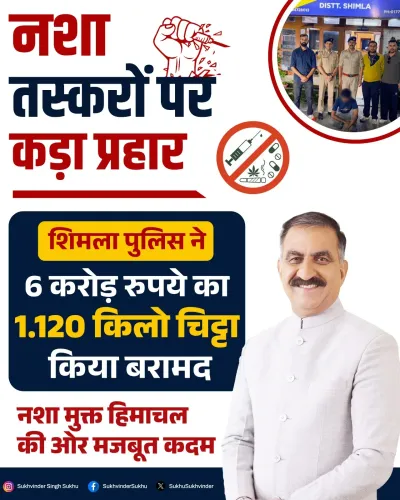
Chief Minister Sukhvinder Singh Sukhu of Himachal Pradesh has reaffirmed a strict, wide-ranging state campaign against 'chitta' and drug abuse, with police playing a central role. DGP Ashok Tiwari and Sainik Welfare Minister Dr. Dhani Ram Shandil were present at the occasion on 2 June 2026.
Key Takeaways
CM Sukhvinder Singh Sukhu publicly reaffirmed the Himachal Pradesh government's strict and comprehensive campaign against drugs, especially 'chitta'.
The state government has assigned a critical role to the police in executing the anti-narcotics drive.
Sainik Welfare Minister Dr. (Col.) Dhani Ram Shandil and DGP Ashok Tiwari were present at the event, signalling high-level coordination.
Himachal Pradesh's proximity to Punjab's drug-trafficking routes makes the chitta problem a persistent cross-border challenge.
The campaign operates under the NDPS Act, 1985 , the primary legal framework for narcotics enforcement in India.
Upcoming quarterly crime statistics and state budget allocations for anti-narcotics cells will be key benchmarks for the campaign's progress.
The Chief Minister's Office of Himachal Pradesh shared remarks by Chief Minister Thakur Sukhvinder Singh Sukhu on Tuesday, 2 June 2026, reaffirming the state government's commitment to a strict and wide-ranging campaign against drug abuse, with a particular focus on 'chitta', the synthetic opioid that has become a growing menace across the state.
Context
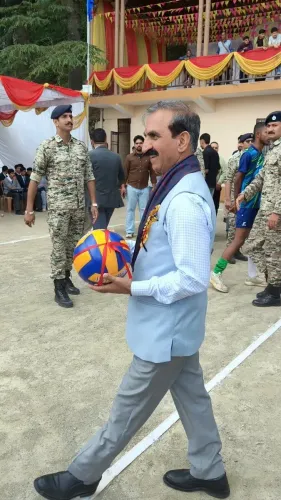
Speaking at the occasion, CM Sukhu stated that the state government is running a 'sakht aur vyapak abhiyan' (strict and comprehensive campaign) against drugs, especially 'chitta', and underscored the critical role of the police in driving this effort. Present at the event were Sainik Welfare Minister Dr. (Col.) Dhani Ram Shandil and Director General of Police Ashok Tiwari, along with other senior officials.
'Chitta' is a street name for heroin-based synthetic opioid powder that has spread rapidly through Himachal Pradesh, particularly among the youth in districts bordering Punjab. The substance has been at the centre of multiple enforcement drives by the state police in recent years.
Policy Backdrop
Himachal Pradesh's anti-narcotics enforcement operates primarily under the Narcotic Drugs and Psychotropic Substances (NDPS) Act, 1985, which empowers state police to arrest, seize, and prosecute those involved in drug trafficking and possession. Successive state governments have treated drug trafficking as a law-and-order priority, given the state's geographic proximity to Punjab's drug-affected belt and cross-border smuggling routes.
The Sukhu-led Congress government, which came to power in December 2022, has periodically flagged the chitta menace as a top governance concern, combining enforcement crackdowns with announcements around rehabilitation. The current statement signals a continuation and intensification of that posture, with the Chief Minister personally attributing a central role to the police machinery.
Stakeholders and Impact
Himachal Pradesh's youth are the most directly affected demographic, with chitta addiction reported across urban and semi-urban pockets of the state. Border communities near Punjab face heightened exposure to trafficking networks, making localised enforcement coordination essential.
The presence of DGP Ashok Tiwari at the event alongside a cabinet minister signals a coordinated civil-police approach at the highest level. For families and communities grappling with addiction, the government's public reiteration of its campaign offers both a policy signal and an accountability marker.
What's Next
Observers will watch for the release of quarterly crime and narcotics statistics by the Himachal Pradesh Police, which would offer measurable evidence of the campaign's impact. Any fresh budgetary allocations for dedicated anti-narcotics cells in the upcoming state budget will be a key indicator of how deeply the government intends to institutionalise this drive.
With senior officials visibly aligned behind the Chief Minister's stated priority, the pressure on the police force to deliver verifiable results — in seizures, arrests, and prosecution rates — is likely to intensify in the months ahead.
Point of View
The government is acknowledging a granular, street-level problem rather than speaking in generalities, which raises public accountability. This fits a broader pattern of Congress-governed hill states using visible law-and-order postures to counter opposition narratives around governance failures. The real test will come when seizure data and conviction rates are placed in the public domain.
NationPress
20 Sept 2026
Frequently Asked Questions
What is 'chitta' and why is it a problem in Himachal Pradesh?
'Chitta' is a street name for a heroin-based synthetic opioid powder that has spread rapidly in Himachal Pradesh, particularly among youth in districts bordering Punjab. Its low cost and high addictive potential have made it a major public health and law-and-order concern for the state.
What action is the Himachal Pradesh government taking against drugs?
The Himachal Pradesh government under CM Sukhvinder Singh Sukhu is running a strict and comprehensive anti-drug campaign, with the state police playing a central role in enforcement under the NDPS Act, 1985.
Who attended the anti-drug campaign event with CM Sukhu?
Sainik Welfare Minister Dr. (Col.) Dhani Ram Shandil and Director General of Police Ashok Tiwari, along with other senior officials, were present at the occasion alongside CM Sukhu.
Who is Sukhvinder Singh Sukhu?
Sukhvinder Singh Sukhu is the Chief Minister of Himachal Pradesh, leading the Congress government in the state since December 2022.
What law governs anti-narcotics operations in Himachal Pradesh?
Anti-narcotics operations in Himachal Pradesh are primarily governed by the Narcotic Drugs and Psychotropic Substances (NDPS) Act, 1985, which empowers state police to arrest, seize, and prosecute those involved in drug-related offences.