CM Sukhu on Himachal livelihood revival for disaster-hit families
Synopsis
Chief Minister Sukhvinder Singh Sukhu stated that government relief measures have helped disaster-affected families in Himachal Pradesh get their livelihoods back on track, reinforcing the state's post-flood rehabilitation push ahead of another monsoon season.
Key Takeaways
CM Thakur Sukhvinder Singh Sukhu confirmed that state-led measures enabled disaster-affected residents to restore their livelihoods.
The statement was shared by the Chief Minister's Office of Himachal Pradesh on 5 July 2026 as part of a thread on the official CMO account.
Himachal Pradesh has been implementing targeted rehabilitation measures for households hit by monsoon floods and landslides since the severe 2023 floods .
Key affected groups include farmers, orchard owners, and daily-wage labourers in districts such as Mandi, Kullu, Shimla, and Kangra .
Disbursement progress and scheme coverage are expected to be reviewed in the upcoming state budget session .
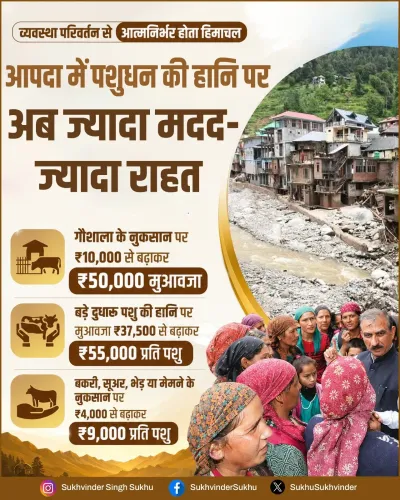
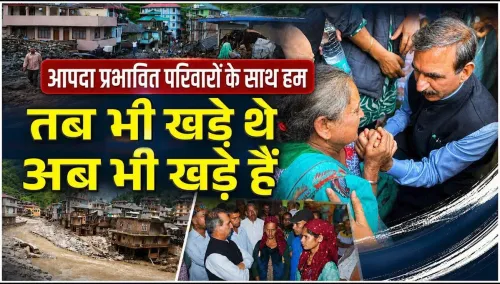
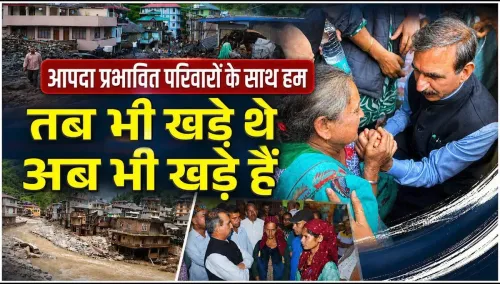
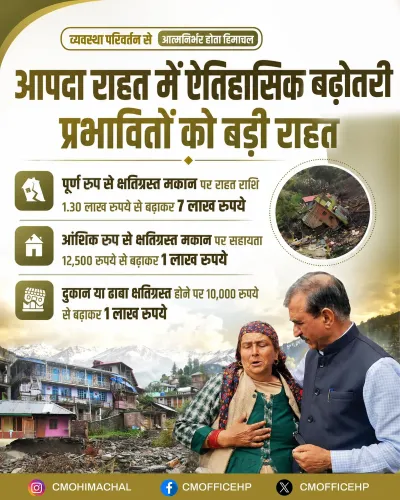
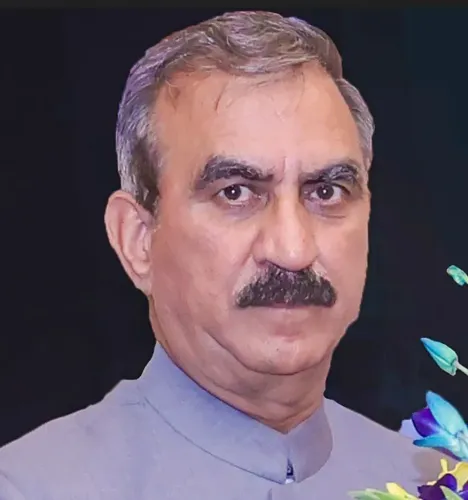
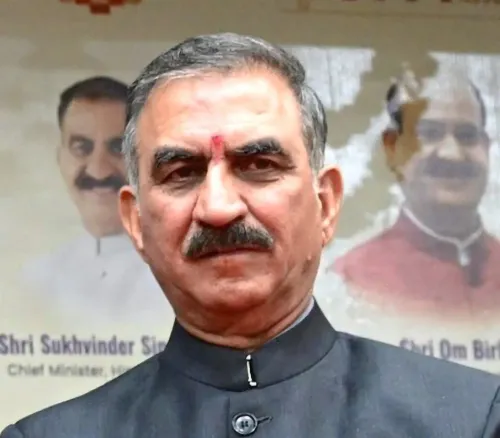
The Chief Minister's Office of Himachal Pradesh shared a statement from Chief Minister Thakur Sukhvinder Singh Sukhu on Sunday, 5 July 2026, highlighting the state government's efforts to help disaster-affected residents restore their livelihoods. The post, part of a thread on the official CMO account, quoted the Chief Minister affirming that beneficiaries were enabled to 'apni aajivika ko phir se patri par lane mein saksham' ('get their livelihoods back on track').
Context
Himachal Pradesh is among the most climate-vulnerable states in northern India, routinely battered by monsoon floods and landslides that damage homes, agricultural plots, and small businesses. The disruption to household incomes in the aftermath of such events is acute, particularly for farming families and daily-wage workers in hill districts. CM Sukhu's remark directly addresses the state's responsibility to bridge that income gap for affected residents.
The statement appears to be part of a longer thread documenting outcomes of a relief or rehabilitation initiative. The specific scheme or event referenced in the thread could not be independently verified from available records at the time of publication.
Policy Backdrop
Following the severe 2023 monsoon floods, the Himachal Pradesh government launched targeted rehabilitation measures for households whose primary income sources were damaged. These included compensation packages, skill-linked support, and restoration of agricultural assets. The current statement by CM Sukhu appears to reference the outcomes of such interventions, pointing to livelihood recovery as a measurable result.
Indian state governments operating in the Himalayan belt have increasingly moved from one-time cash transfers toward sustained livelihood-restoration frameworks, in line with the national disaster management architecture. Himachal Pradesh's approach fits within this broader shift, prioritising the revival of household earning capacity over purely infrastructural repair.
Stakeholders and Impact
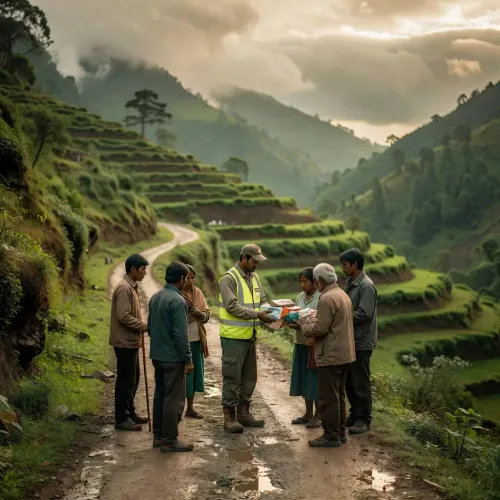
The primary beneficiaries of the measures cited by CM Sukhu are families in Himachal Pradesh whose livelihoods were disrupted by extreme weather events. This group typically includes small and marginal farmers, orchard owners, labourers, and artisans concentrated in flood- and landslide-prone districts such as Mandi, Kullu, Shimla, and Kangra. For these households, the ability to resume income-generating activity is directly tied to food security and debt sustainability.
Local economies in hill regions are deeply interlinked, meaning that a recovery in household earnings also stimulates demand for local goods and services, creating a multiplier effect across affected communities.
What's Next
Attention will now turn to the disbursement timelines and coverage of ongoing livelihood schemes, with the state's upcoming budget session expected to shed light on allocations for disaster relief and rural employment support. Advocacy groups and opposition legislators are likely to seek detailed progress reports on the number of beneficiaries reached and funds utilised. Sustained monitoring of these schemes will be critical as Himachal Pradesh heads into another monsoon cycle, during which fresh disruptions could reverse recent recovery gains.
Point of View
A framing that resonates with rural voters who bore the brunt of the 2023 floods. By foregrounding beneficiary outcomes, the Congress-led government in Shimla is building a welfare narrative ahead of future electoral cycles in a state where agrarian distress and climate vulnerability are persistent concerns. The statement also implicitly benchmarks the administration's performance against the scale of destruction seen in recent monsoon seasons, inviting scrutiny of actual disbursement data. Whether the relief has reached the most marginalised households at the required scale remains the critical question that opposition and civil society are likely to press.
NationPress
5 Jul 2026
Frequently Asked Questions
What did CM Sukhu say about livelihood restoration in Himachal Pradesh?
CM Sukhvinder Singh Sukhu stated that government relief measures enabled disaster-affected families in Himachal Pradesh to get their livelihoods back on track, as quoted by the Chief Minister's Office on 5 July 2026.
Which families benefit from Himachal Pradesh's livelihood restoration schemes?
The primary beneficiaries are small and marginal farmers, orchard owners, agricultural labourers, and artisans in flood- and landslide-prone districts such as Mandi, Kullu, Shimla, and Kangra.
What relief measures did Himachal Pradesh launch after the 2023 floods?
After the 2023 monsoon floods, the Himachal Pradesh government launched targeted rehabilitation measures including compensation packages, skill-linked support, and restoration of agricultural assets for affected households.
Who is the Chief Minister of Himachal Pradesh in 2026?
Thakur Sukhvinder Singh Sukhu has been the Chief Minister of Himachal Pradesh since December 2022 and continues to head the state government.
What is next for Himachal Pradesh disaster relief schemes?
The state's upcoming budget session is expected to detail allocations and progress on livelihood schemes, with scrutiny on beneficiary coverage and fund disbursement as another monsoon season approaches.