CM Vijay's Office Highlights Youth and Women in Tamil Nadu Governance
Synopsis
The Chief Minister's Office of Tamil Nadu invoked #CMJosephVijay on 23 June 2026 to frame the state's governance as a direct answer to those who doubt what youth and women can achieve, echoing Tamil Nadu's long tradition of welfare-centred political messaging.
Key Takeaways
The Chief Minister's Office of Tamil Nadu posted on X on 23 June 2026 under the hashtag #CMJosephVijay .
The Tamil-language post translates to: 'This magnificent people's rule is the answer for those who ask what youth and women can do.' Joseph Vijay , the Tamil film actor who entered politics in 2024 , is referenced as the Chief Minister of Tamil Nadu.
Tamil Nadu has a documented history of youth and women welfare schemes, including free bus travel for women introduced in 2021 .
The post frames governance delivery — rather than symbolic representation — as the measure of inclusive rule for youth and women.
Analysts will watch for new scheme announcements or legislative action targeting these groups as substantive follow-through.
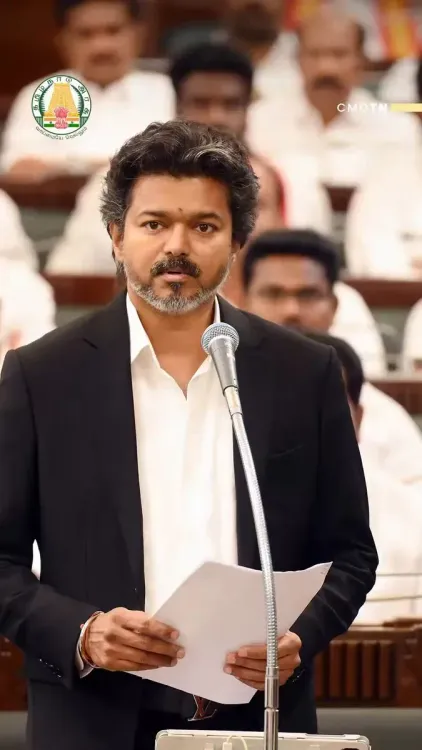
The Chief Minister's Office of Tamil Nadu posted on X on Tuesday, 23 June 2026, invoking the hashtag #CMJosephVijay to frame the state's governance record as a direct answer to those who question what young people and women can achieve in public life.
The post, written in Tamil, translates to: 'This magnificent people's rule is the answer for those who ask what youth and women can do.' The message positions the current administration's governance model as proof of the capabilities of these two groups, rather than as a conventional policy announcement.
Context
Joseph Vijay, widely known as Thalapathy Vijay, is one of Tamil cinema's most prominent actors. He announced his entry into politics in 2024, and the hashtag #CMJosephVijay signals his elevation to the Chief Minister's role in Tamil Nadu. The post reflects how celebrity-linked political figures in the state have historically used welfare messaging to communicate administrative intent directly to constituents.
Tamil Nadu has a long tradition of film personalities crossing into electoral politics. The use of a social media post — rather than a press conference or policy document — to make this kind of governance statement is consistent with how newer political entrants communicate with younger, digitally active voter bases.
Policy Backdrop
Tamil Nadu governments have maintained a consistent focus on youth and women through targeted welfare schemes. A notable example is the free bus travel scheme for women, introduced in 2021, which became a widely cited model of gender-inclusive governance in the state. Such measures have repeatedly been used to demonstrate that administrative decisions can directly expand participation by groups historically underrepresented in public life.
The framing in the post — answering doubters about what youth and women 'can do' — echoes a rhetorical pattern common in Tamil Nadu politics, where welfare records are presented as rebuttals to scepticism about inclusive governance rather than simply as policy achievements.
Stakeholders and Impact
The primary audiences for this messaging are Tamil Nadu's youth and women voters, both of whom represent significant demographic blocs in the state's electorate. By framing governance itself as a demonstration of their capabilities, the Chief Minister's Office signals that policy delivery — rather than symbolic representation alone — is the measure of inclusive rule.
Political observers note that such statements also serve to consolidate support among first-time voters and women who have benefited from state welfare programmes. The invocation of 'people's rule' (மக்கள் ஆட்சி) carries weight in Tamil political culture, where the idea of governance as a public mandate is deeply embedded in party rhetoric across the spectrum.
What's Next
Attention will now turn to whether this messaging precedes a formal announcement of new youth- or women-focused schemes by the Tamil Nadu government. Legislative debates and budget allocations targeting these groups will be closely watched as indicators of whether the post signals a policy direction or a broader communications strategy. Any rollout of programmes under the #CMJosephVijay administration specifically aimed at employment, education, or welfare for youth and women will be seen as the substantive follow-through to this public framing.
Point of View
Anchoring credibility in welfare outcomes rather than ideological positioning is a smart consolidation play with Tamil Nadu's large youth and women voter blocs. This mirrors a broader pattern in Tamil Nadu politics where successive administrations have competed on welfare delivery as the primary metric of legitimacy. Whether the messaging is backed by measurable new policy action will determine if it sustains beyond a social media moment.
NationPress
23 Jun 2026
Frequently Asked Questions
Who is CM Joseph Vijay of Tamil Nadu?
Joseph Vijay , popularly known as Thalapathy Vijay , is a prominent Tamil film actor who announced his entry into politics in 2024 and subsequently became Chief Minister of Tamil Nadu.
What did the Tamil Nadu CMO post on X on 23 June 2026?
The Chief Minister's Office of Tamil Nadu posted in Tamil on 23 June 2026 , stating that 'this magnificent people's rule is the answer for those who ask what youth and women can do,' using the hashtag #CMJosephVijay .
What welfare schemes for women has Tamil Nadu introduced?
Tamil Nadu introduced free bus travel for women in 2021 , which became a widely cited model of gender-inclusive governance in the state. The current administration has continued a tradition of targeted welfare for women and youth.
What does 'makkal aatchi' or people's rule mean in Tamil Nadu politics?
The phrase மக்கள் ஆட்சி ('people's rule') is a deeply embedded concept in Tamil political culture, used by successive administrations to frame governance as a direct mandate from and service to the public, particularly welfare-focused policies.
What should we watch for next from the Tamil Nadu government on youth and women policies?
Policy observers are watching for formal announcements of new youth- or women-focused schemes, budget allocations, and legislative debates that would give substantive follow-through to the Chief Minister's Office 's governance messaging.