CM Mohan Yadav Hails 12 Years of Modi's Infra Revolution
Synopsis
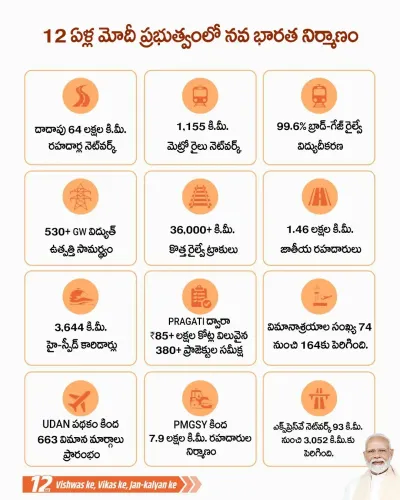
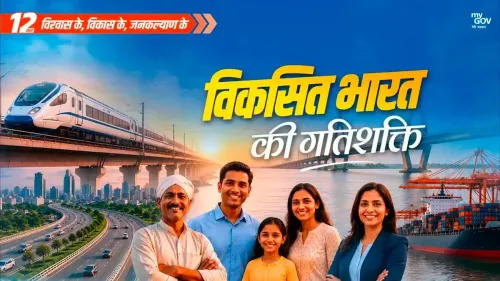
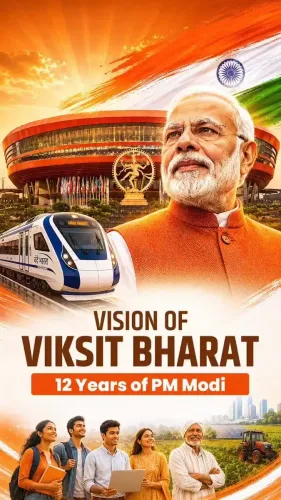
MP Chief Minister Dr. Mohan Yadav credited PM Modi's 12-year tenure with transforming India's infrastructure landscape — citing Vande Bharat and Namo Bharat trains, a 64-lakh-km road network ranked second globally, and a 1,155-km metro grid ranked third — as the foundation for the Viksit Bharat @2047 goal.
Key Takeaways
Mohan Yadav posted on 16 June 2026 crediting PM Modi's 12 years in office with an infrastructure transformation under the hashtag #12YearsOfNayaBharatNirman .
The post cites a road network of 64 lakh kilometres , described as the world's second largest, built up under the Bharatmala Pariyojana and allied programmes.
India's metro network, stated at 1,155 km , is described as the world's third largest, driven by a revised Metro Rail Policy from 2017 and rising urban transit investment.
Vande Bharat Express (launched 2019 ) and Namo Bharat rapid transit are highlighted as symbols of railway modernisation under the current government.
The messaging aligns with the Viksit Bharat @2047 framework, positioning infrastructure as the foundation for India's goal of becoming a developed economy by independence's centenary.
The National Infrastructure Pipeline , announced in 2019 , targeted over Rs 100 lakh crore in multi-sector investments, underpinning the scale of the build-out referenced in the post.
Madhya Pradesh Chief Minister Dr. Mohan Yadav on Tuesday, 16 June 2026, credited Prime Minister Narendra Modi's decade-plus tenure with delivering an unprecedented infrastructure transformation, citing modern rail services, a world-class road network, and a rapidly expanding metro grid as cornerstones of the Viksit Bharat @2047 vision.
Context
Posting under the hashtag #12YearsOfNayaBharatNirman ('12 years of building a new India'), Dr. Yadav wrote that over the past 12 years, an 'infrastructure revolution' under Modi's 'visionary leadership' has given the country 'unprecedented speed, direction and confidence' in constructing a 'new India.' The post references Vande Bharat and Namo Bharat rail services, a road network of 64 lakh kilometres described as the world's second largest, and a metro network of 1,155 kilometres described as the world's third largest.
The statement arrives as the BJP marks what it frames as a twelve-year milestone of governance under Prime Minister Modi, who assumed office in May 2014. State chief ministers across BJP-governed states have been amplifying a coordinated messaging campaign around infrastructure achievements.
Policy Backdrop
The infrastructure push Dr. Yadav references draws from several flagship central programmes. The Bharatmala Pariyojana, launched in 2015, set out to construct and upgrade national highways and expressways, forming the backbone of the road network expansion. The National Infrastructure Pipeline, announced in 2019, targeted over Rs 100 lakh crore in multi-sector investments through 2025.
On the railways front, the first Vande Bharat Express — a semi-high-speed train — was inaugurated in 2019 between New Delhi and Varanasi. Namo Bharat, a regional rapid transit system in the National Capital Region, extended high-frequency commuter rail to urban and peri-urban corridors. A revised Metro Rail Policy issued in 2017 encouraged public-private partnerships and accelerated metro expansion beyond the largest cities.
Successive Union Budgets have allocated rising capital expenditure to roads, railways, and urban transit, with state governments — including Madhya Pradesh — aligning their own programmes to central schemes for funding and project execution.
Stakeholders and Impact
The beneficiaries of the infrastructure build-out span a wide cross-section: railway passengers gain from faster, more frequent intercity services; urban commuters in metro cities benefit from reduced road congestion; and the logistics industry sees lower freight costs and shorter transit times as highway quality improves. For a landlocked state like Madhya Pradesh, better road and rail connectivity directly affects agricultural supply chains, industrial investment, and tourism.
State governments play a dual role — as implementers of centrally sponsored projects and as advocates who shape public perception of those projects. Dr. Yadav's post is consistent with that pattern, reinforcing the central government's narrative while associating Madhya Pradesh with the broader national progress story.
What's Next
Attention will now turn to progress on sanctioned high-speed rail corridors and metro extensions in Tier-2 cities, as well as any infrastructure allocations in Madhya Pradesh's forthcoming state budget or the Union Budget 2027-28. The Viksit Bharat @2047 framework — India's official vision to become a developed economy by the centenary of independence — will increasingly serve as the benchmark against which infrastructure milestones are measured and communicated.
Point of View
Timed to mark twelve years since the Modi government took office. By invoking globally ranked statistics on roads and metro networks alongside flagship rail brands, Dr. Yadav anchors the party's electoral identity firmly in physical infrastructure — a domain that polls consistently show resonates with voters across income groups. The framing around Viksit Bharat @2047 is also significant: it transforms a retrospective achievement list into a forward-looking promise, extending the political contract well beyond the current election cycle. Whether the specific figures cited withstand independent audit will determine how durable this messaging proves to be.
NationPress
17 Sept 2026
Frequently Asked Questions
What did MP CM Mohan Yadav say about Modi's infrastructure record?
Dr. Mohan Yadav said that over the past 12 years, PM Modi's leadership has driven an 'infrastructure revolution' giving India modern rail services like Vande Bharat and Namo Bharat, the world's second-largest road network at 64 lakh km, and the world's third-largest metro network at 1,155 km.
What is the Viksit Bharat @2047 vision?
Viksit Bharat @2047 is the Indian government's official target to transform India into a developed economy by 2047, the centenary of independence, with infrastructure expansion cited as a core pillar of that ambition.
What is the Namo Bharat train service?
Namo Bharat is a regional rapid transit system launched in the National Capital Region to provide high-frequency commuter rail services connecting urban and peri-urban areas.
When was the first Vande Bharat Express launched?
The first Vande Bharat Express was inaugurated in 2019, running between New Delhi and Varanasi as part of Indian Railways' modernisation drive.
What is the Bharatmala Pariyojana scheme?
Bharatmala Pariyojana is a national highway development programme launched in 2015 to construct and upgrade highways and expressways across India, forming a key part of the road network expansion highlighted in Dr. Yadav's post.