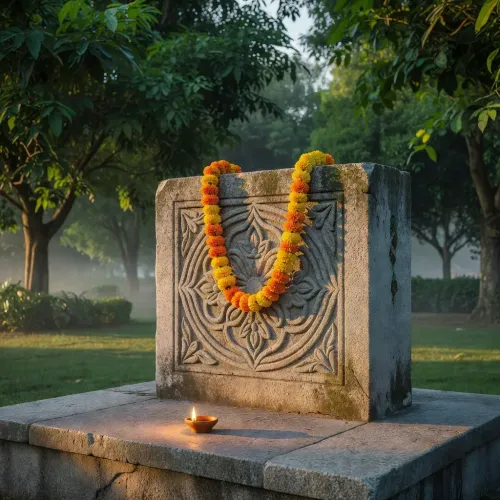
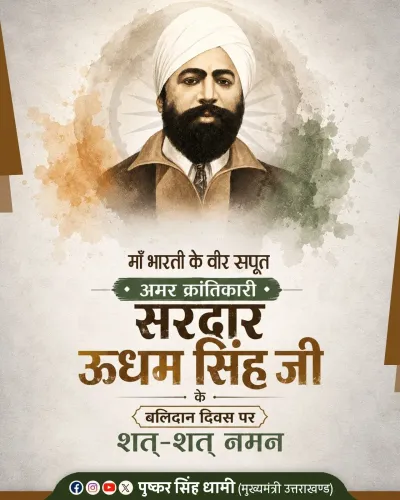
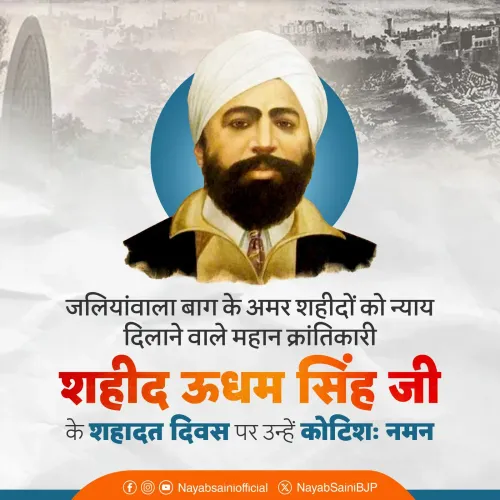
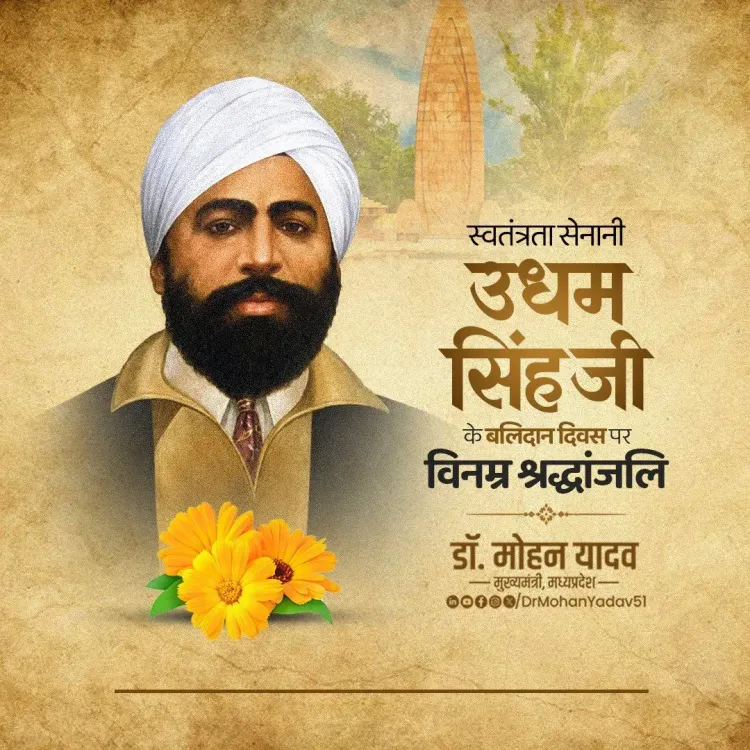
CM Mohan Yadav Pays Tribute to Shaheed Udham Singh
Synopsis
Madhya Pradesh Chief Minister Dr. Mohan Yadav paid solemn tribute to Shaheed Udham Singh on his martyrdom anniversary, July 31, honouring the revolutionary who gave his life to seek justice for the victims of the 1919 Jallianwala Bagh massacre.
Key Takeaways
Mohan Yadav posted a tribute to Shaheed Udham Singh on his martyrdom day, July 31, 2026 .
Udham Singh was executed by British authorities on July 31, 1940 in London after assassinating Michael O'Dwyer to avenge the Jallianwala Bagh massacre .
The Jallianwala Bagh massacre took place on April 13, 1919 in Amritsar, when British troops fired on an unarmed crowd, killing hundreds.
Udham Singh spent over two decades in exile across multiple countries before carrying out his act of defiance in London in 1940 .
Tributes to Udham Singh on his martyrdom anniversary are observed across party lines as part of India's national remembrance of its freedom struggle.
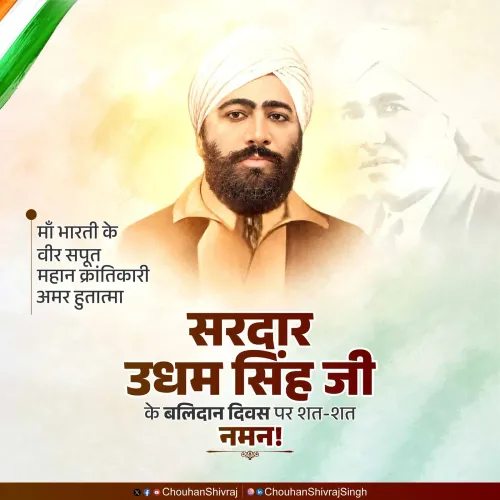
A revolutionary who waited 21 years to deliver justice for the dead of Jallianwala Bagh — Madhya Pradesh Chief Minister Dr. Mohan Yadav on Friday, July 31, 2026, paid solemn homage to Shaheed Udham Singh on his martyrdom anniversary, honouring a man whose unflinching resolve became one of the most defining acts of defiance in India's freedom struggle.
In his tribute posted on X, CM Dr. Mohan Yadav wrote: 'Shaheed Udham Singh ji ke balidaan diwas par vinamra shraddhanjali arpit karta hoon' — 'I humbly offer my tribute on the martyrdom day of Shaheed Udham Singh.' He noted that Udham Singh demonstrated 'indomitable courage, patience, and patriotism' in his mission to secure justice for the innocent victims of the Jallianwala Bagh massacre, ultimately dedicating everything he had to the nation.
The wound that never healed: Jallianwala Bagh, April 1919
On April 13, 1919, British troops opened fire on an unarmed crowd gathered at Jallianwala Bagh in Amritsar, killing hundreds of men, women, and children in one of colonial India's darkest hours. The order was carried out under the authority of officials including Michael O'Dwyer, then Lieutenant Governor of Punjab. For a young Udham Singh, who was present that day, the massacre became a wound he carried across continents and decades.
One act, two decades in the making
Udham Singh spent years in exile, travelling through East Africa, the United States, and Europe, all while keeping his purpose alive. On March 13, 1940, at Caxton Hall in London, he shot and killed Michael O'Dwyer — making clear, in his own words at trial, that he acted to avenge the innocent dead of Amritsar. He was tried, convicted, and executed on July 31, 1940 at Pentonville Prison, London. That date — July 31 — is observed as his martyrdom day.
A remembrance that crosses party lines
Tributes to Udham Singh on his martyrdom anniversary have become a fixture of Indian political life, observed across party lines as part of the broader national remembrance of colonial-era sacrifice. Dr. Mohan Yadav's post reflects that tradition — a moment to pause on the cost at which India's freedom was won, and on the individuals who paid it in full.
Udham Singh was posthumously celebrated as a national hero. The Jallianwala Bagh National Memorial in Amritsar stands today as a permanent reminder of the massacre, drawing visitors and official commemorations each year. His story remains a cornerstone of how India remembers the human price of its independence.
Some debts, history insists, are never forgotten — only honoured, year after year, in the names we refuse to let fade.
Point of View
Simultaneously, moments that reinforce a party's claim to the legacy of the freedom struggle. For the BJP, invoking revolutionary martyrs who acted outside the Gandhian mainstream — Udham Singh, Bhagat Singh — has long been part of a deliberate effort to broaden the party's historical narrative. CM Yadav's post fits that pattern without departing from it. What it does not do, and what such tributes rarely do, is translate historical sacrifice into any specific contemporary policy commitment — the remembrance remains symbolic, powerful in its own right, but deliberately unanchored to the present.
NationPress
14 Sept 2026
Frequently Asked Questions
Why is July 31 observed as Udham Singh's martyrdom day?
Udham Singh was hanged by British authorities on July 31, 1940 at Pentonville Prison in London after being convicted for the assassination of Michael O'Dwyer. July 31 is therefore observed annually as his martyrdom day across India.
Who was Udham Singh and what did he do?
Udham Singh was an Indian revolutionary who assassinated Michael O'Dwyer in London on March 13, 1940, to avenge the Jallianwala Bagh massacre of April 1919 in Amritsar, in which British troops killed hundreds of unarmed civilians.
What was the Jallianwala Bagh massacre?
The Jallianwala Bagh massacre occurred on April 13, 1919 in Amritsar, Punjab, when British troops under orders fired on a large unarmed crowd gathered at the walled garden, killing hundreds and wounding many more in one of the worst atrocities of British colonial rule in India.
What did CM Mohan Yadav say about Udham Singh?
CM Dr. Mohan Yadav said he humbly offers tribute on Udham Singh's martyrdom day, praising his 'indomitable courage, patience, and patriotism' in seeking justice for the innocent victims of Jallianwala Bagh and dedicating his life entirely to the nation.
Is Udham Singh officially recognised as a national hero in India?
Yes. Udham Singh is celebrated as a national martyr and freedom fighter in India. The government has recognised his sacrifice, and his memory is honoured through memorials, official tributes, and annual commemorations on his martyrdom day, July 31 .