CM Yogi Announces ₹4 Lakh Ex-Gratia, Relief for Disaster Victims

Synopsis
Chief Minister Yogi Adityanath has announced ₹4 lakh immediate ex-gratia for families who lost lives in an ongoing disaster in Uttar Pradesh, with relief material distribution already begun. The payment is rooted in SDRF norms set in 2015 under the National Disaster Management Act framework.
Key Takeaways
CM Yogi Adityanath announced immediate disaster relief measures via the Chief Minister's Office of Uttar Pradesh on 29 September 2026 .
Families that suffered loss of life will receive ₹4 lakh in ex-gratia assistance, consistent with SDRF norms revised in 2015 .
Relief material distribution to every affected family has already commenced, per the CM's statement.
The National Disaster Management Act, 2005 provides the legal framework for the state's structured compensation mechanism.
The 'double engine government' framing signals coordination between the Uttar Pradesh state administration and the central government for faster aid delivery.
The specific disaster's scale, location, and casualty figures have not been independently confirmed.
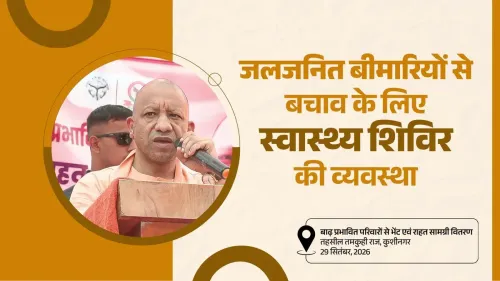
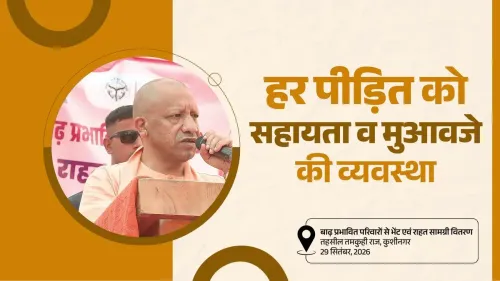
When disaster strikes Uttar Pradesh, the state's response is measured in rupees delivered and relief material moved — and on Tuesday, 29 September 2026, Chief Minister Yogi Adityanath's office made clear that both were already in motion. The Chief Minister's Office of Uttar Pradesh posted a direct statement from CM Yogi Adityanath, announcing that relief distribution had begun for every affected family and that families who lost a member would receive an immediate ex-gratia payment of ₹4 lakh.
What CM Yogi Said — Word for Word
The statement, attributed directly to Chief Minister @myogiadityanath, read: 'Aapda ki is ghadi mein double engine sarkar sabhi peediton ke saath hai' — 'In this hour of disaster, the double engine government stands with all victims.' The CM confirmed that relief material distribution to every affected family had already commenced, and that instructions had been issued to make ₹4 lakh available immediately to any family that suffered a loss of life.
The ₹4 Lakh Figure and Where It Comes From
The ₹4 lakh ex-gratia figure is not arbitrary. It is anchored in the State Disaster Response Fund (SDRF) norms revised in 2015, which fixed this amount as the standard compensation for loss of life in a declared disaster. The legal architecture behind it traces back further — to the National Disaster Management Act of 2005, which established the framework for state-level disaster response and mandated structured compensation. In practice, this means affected families in Uttar Pradesh are entitled to this payment as a matter of policy, not discretion.
'Double Engine Government' — What the Phrase Signals
The BJP's signature phrase 'double engine government' — referring to coordinated action between the Uttar Pradesh state administration and the central government — carries a specific operational claim: that having the same party in power at both levels accelerates aid delivery. Uttar Pradesh, India's most populous state, is routinely hit by monsoon-season floods and other seasonal calamities, making this coordination argument a recurring feature of the state's disaster-response communication. The phrase signals political alignment as an administrative advantage.
The exact nature and scale of the disaster referenced in the post — its location within the state, the number of districts affected, and the casualty count — have not been independently confirmed. What is confirmed is that the state machinery, by the CM's own account, has been activated: relief material is moving, and compensation orders have been issued.
The real test now is not the announcement — it is how fast the ₹4 lakh reaches grieving families, and whether relief material clears the last mile to the most remote households.
Point of View
Who has consistently positioned UP's administration as responsive and muscular, rapid-relief optics during calamities are a core part of his governance brand. The real policy question, however, is institutional: whether the ₹4 lakh actually reaches families within days or gets mired in district-level bureaucracy, as has historically been a bottleneck in UP's disaster compensation pipeline. Analysts watching UP governance will track claim-processing timelines as the sharper indicator of administrative capacity than the announcement itself.
NationPress
29 Sept 2026
Frequently Asked Questions
How much ex-gratia will UP give to families who lost a member in the disaster?
The Uttar Pradesh government, under CM Yogi Adityanath's orders, will provide ₹4 lakh immediately to each family that suffered a loss of life in the disaster. This amount is fixed under State Disaster Response Fund norms revised in 2015.
What is the 'double engine government' that CM Yogi referred to?
'Double engine government' is a BJP phrase describing the coordination between the Uttar Pradesh state administration and the central government — both led by the BJP — which the party argues enables faster disaster relief and aid delivery.
What is the legal basis for the ₹4 lakh disaster compensation in Uttar Pradesh?
The ₹4 lakh ex-gratia for loss of life is mandated under SDRF (State Disaster Response Fund) norms revised in 2015, which operate within the framework of the National Disaster Management Act enacted in 2005.
Has relief distribution started in Uttar Pradesh after the disaster?
Yes. CM Yogi Adityanath confirmed on 29 September 2026 that relief material distribution to every affected family had already begun, alongside the order for ₹4 lakh compensation to families that lost a member.
Is Uttar Pradesh frequently affected by natural disasters?
Yes. Uttar Pradesh, India's most populous state, is regularly hit by monsoon floods and seasonal calamities, making state-level disaster response and compensation announcements a recurring feature of its governance.