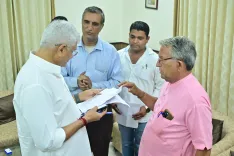
CM Yogi Approves 10-Township Plan for Greater Agra

Synopsis
Chief Minister Yogi Adityanath has approved a ₹5,200-crore-plus programme to build 10 townships under the Greater Agra expansion plan, the UP CM's Office confirmed on 25 July 2026, marking a major state push to ease urban pressure on the heritage city.
Key Takeaways
CM Yogi Adityanath has formally approved the 10-township construction programme for Greater Agra .
The total project cost exceeds ₹5,200 crore .
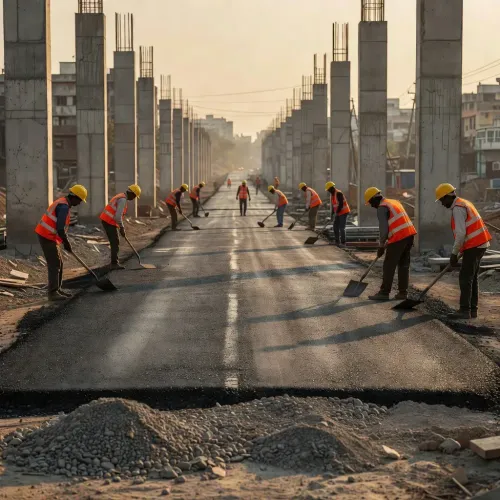
The programme aims to ease urban pressure on Agra's historic core by developing planned peripheral zones.
Agra has previously been part of the Central government's Smart Cities Mission (launched 2015 ), providing a policy foundation for this expansion.
Key next steps include tender processes, land acquisition, and phased rollout timelines for all 10 townships .
Real estate developers and residents of Agra are among the primary stakeholders set to be affected.
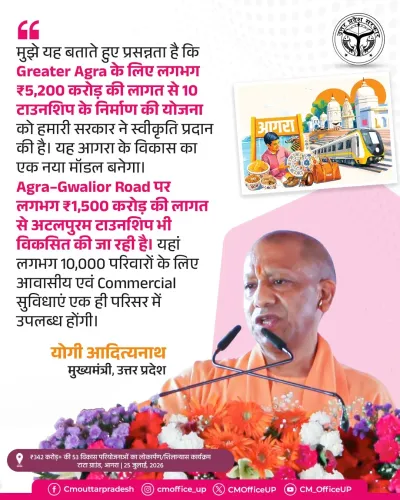
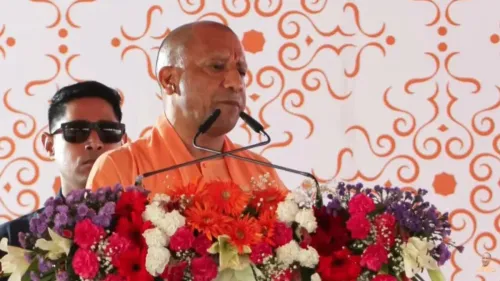
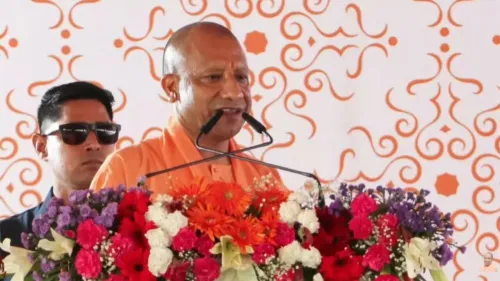
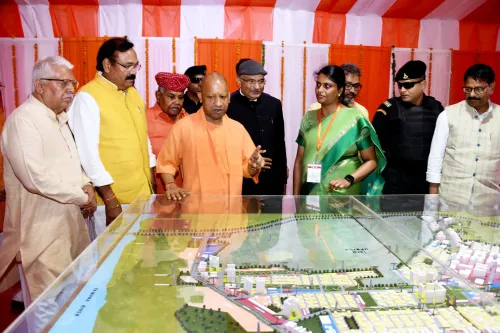
The Chief Minister's Office of Uttar Pradesh announced on Saturday, 25 July 2026 that Chief Minister Yogi Adityanath has approved a programme to construct 10 townships under the Greater Agra expansion plan, at a combined cost of more than ₹5,200 crore.
Speaking on the development, CM Yogi Adityanath stated: 'Greater Agra ke liye hamne ₹5,200 crore se adhik lagat ki ek 10 township ke nirman karyakram ko apni sahmat pradan kar di hai' — ('We have given our approval to a programme for the construction of 10 townships at a cost of more than ₹5,200 crore for Greater Agra.')
Context
Agra, home to the Taj Mahal and one of Uttar Pradesh's most visited cities, has long faced pressure on its urban core from a growing population and expanding tourism footprint. The approval signals a structured push to redistribute residential and commercial activity to planned peripheral zones rather than allowing unregulated sprawl around the heritage city. The 10-township programme is framed as part of the Greater Agra vision — a broader administrative and planning concept aimed at extending the city's functional boundaries while preserving the character of its historic centre.Policy Backdrop
Agra was among the cities selected under the Central government's Smart Cities Mission, launched in 2015, which prioritised integrated urban renewal and infrastructure modernisation. The current township approval builds on that legacy, shifting the emphasis from retrofitting the old city to creating new, planned habitation zones. Uttar Pradesh under CM Yogi Adityanath — in office since 2017 — has consistently pursued large-scale urban infrastructure projects across the state, including satellite townships and housing corridors in cities such as Lucknow, Kanpur, and Varanasi. The Greater Agra plan fits squarely within this pattern of state-led urban expansion. An outlay of more than ₹5,200 crore for a single city's township programme represents a significant capital commitment, underlining the state government's prioritisation of Agra as an economic and tourism hub requiring urgent infrastructure scaling.Stakeholders and Impact
Agra's residents — particularly those in overcrowded localities — stand to benefit from planned housing supply that could ease pressure on existing civic infrastructure. Real estate developers are expected to watch the tender process closely, as a project of this scale typically opens multiple contracting and investment opportunities. The township programme could also generate construction-phase employment across Agra district, with downstream demand for building materials, logistics, and ancillary services. Heritage conservation stakeholders will likely monitor how the expansion is zoned relative to protected monuments and the Taj Trapezium Zone.What's Next
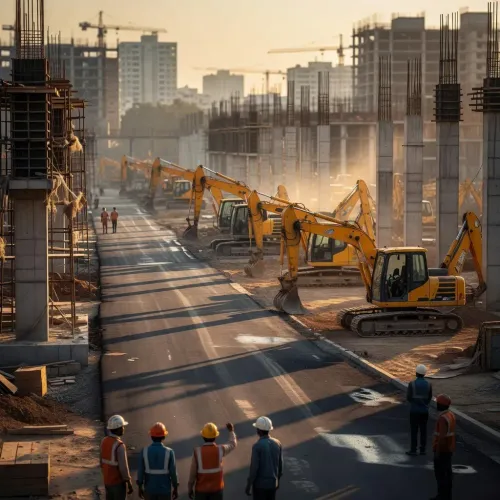
With the approval now in place, attention will turn to the tender processes, land acquisition steps, and phased rollout timelines for each of the 10 townships. The Uttar Pradesh government is expected to outline implementation milestones, including agency appointments and financing arrangements, in the weeks ahead. If executed on schedule, the Greater Agra township programme could reshape the city's urban geography over the next decade, positioning it as a model for heritage-city expansion elsewhere in the state.Point of View
200-crore township programme for Greater Agra is among the more consequential urban infrastructure decisions the Yogi Adityanath government has announced for a single city, and it signals that the state sees planned peripheral expansion — rather than inner-city densification — as the preferred model for heritage cities. Agra's dual identity as a global tourism destination and a rapidly growing secondary city makes it a politically and economically high-visibility test case. If the programme proceeds on schedule, it could reinforce the UP government's broader narrative of infrastructure-led growth ahead of future electoral cycles. The real measure of intent, however, will come at the tender and land-acquisition stage, where large township projects in India have historically faced delays.
NationPress
25 Jul 2026
Frequently Asked Questions
What is the Greater Agra township project approved by CM Yogi?
Chief Minister Yogi Adityanath has approved a programme to construct 10 townships in the Greater Agra area at a total cost exceeding ₹5,200 crore , announced on 25 July 2026 . The project aims to expand Agra's urban footprint in a planned manner and reduce pressure on the city's historic core.
How much money has been approved for the Agra township project?
The approved outlay for the Greater Agra 10-township programme is more than ₹5,200 crore , as stated by CM Yogi Adityanath in a post shared by the Chief Minister's Office of Uttar Pradesh on 25 July 2026 .
How many townships will be built under the Greater Agra plan?
A total of 10 townships are planned under the Greater Agra expansion programme approved by CM Yogi Adityanath .
Why is Agra being expanded with new townships?
Agra faces growing urban pressure due to its expanding population and tourism activity around the Taj Mahal . Planned townships on the city's periphery are intended to provide organised housing and infrastructure while protecting the heritage city's core.
What is the Smart Cities Mission and how does it relate to Agra?
The Smart Cities Mission is a Central government programme launched in 2015 to promote sustainable urban development. Agra was selected under this mission, laying the policy groundwork for subsequent urban expansion initiatives including the current township programme.