CM Yogi Hails Lucknow as Key IMD Regional Hub
Synopsis
Chief Minister Yogi Adityanath has highlighted Lucknow's emergence as a major India Meteorological Department regional centre, framing the development as a scientific stride toward the Viksit Bharat vision of a developed India by 2047.
Key Takeaways
CM Yogi Adityanath on 8 June 2026 declared Lucknow is establishing itself as a prominent IMD regional centre.
The development is framed as advancing the Viksit Bharat national vision through a scientific approach.
IMD has been modernising its regional network since the early 2000s , including Doppler radar installations.
Farmers and disaster management authorities in Uttar Pradesh are among the primary beneficiaries of enhanced regional forecasting.
Further details on staffing, radar installations, and data-sharing agreements with the state disaster authority are awaited.
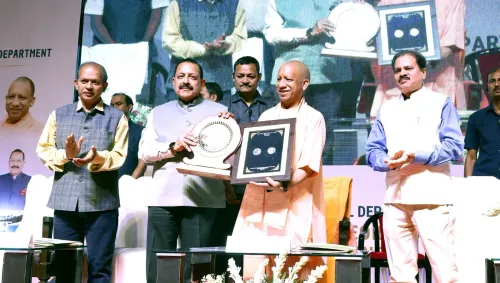
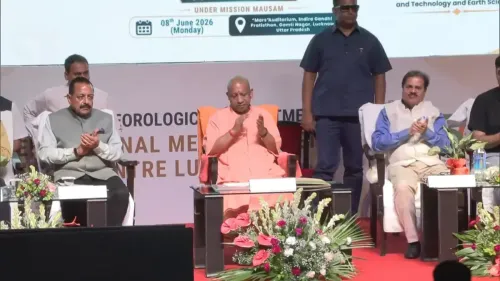
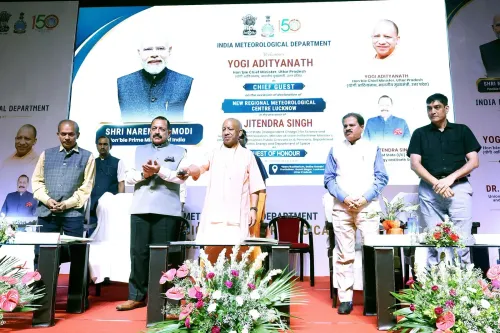
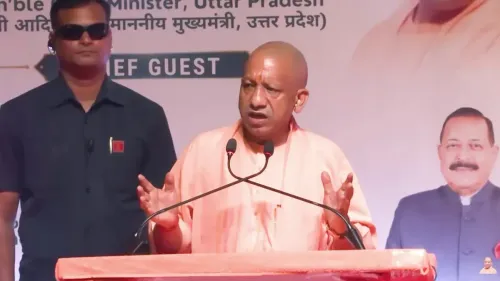
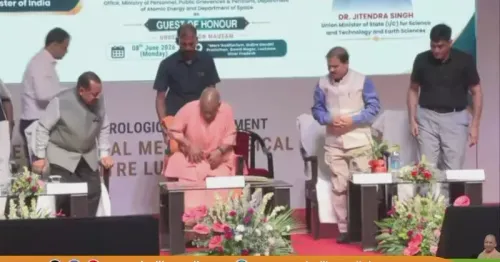
The Chief Minister's Office of Uttar Pradesh on Monday, 8 June 2026, shared a statement from Chief Minister Yogi Adityanath marking Lucknow's emergence as a major regional centre of the India Meteorological Department (IMD), calling it a significant step toward advancing the Viksit Bharat vision through a scientific approach.
Context
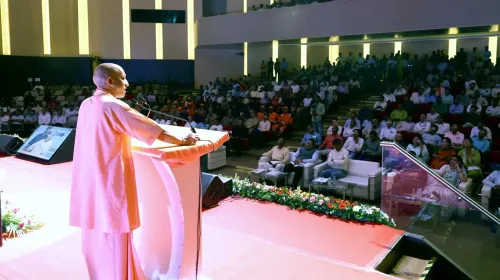
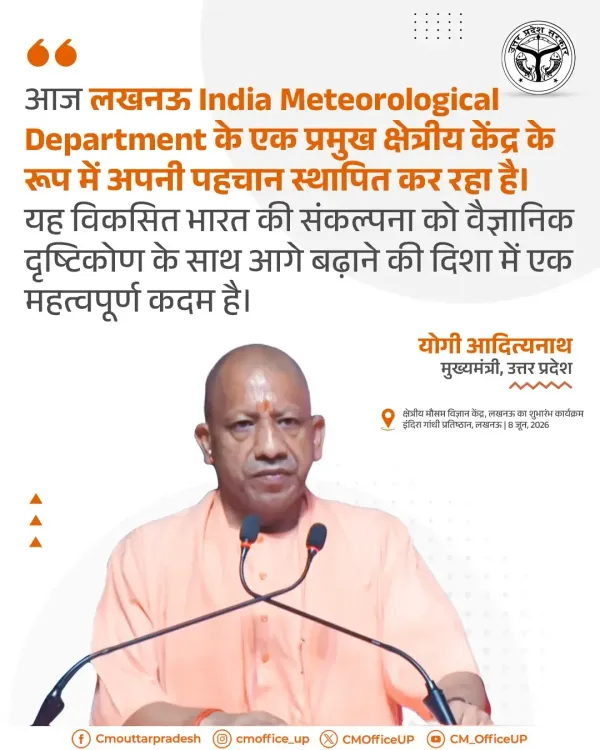
In his statement, CM Yogi Adityanath said: 'Today, Lucknow is establishing its identity as a prominent regional centre of the India Meteorological Department. This is an important step in the direction of advancing the concept of Viksit Bharat [Developed India] with a scientific outlook.' The remarks signal the state government's intent to position Uttar Pradesh's capital as a hub for national meteorological infrastructure.
The IMD, operating under the Ministry of Earth Sciences, is India's nodal agency for weather forecasting, monsoon monitoring, and climate services. Its regional centres serve as critical nodes that translate national-level data into localised forecasts used by farmers, aviation authorities, and disaster management agencies.
Policy Backdrop
IMD has been expanding and modernising its observational network since the early 2000s, an effort that included the installation of Doppler weather radars and the strengthening of regional forecasting infrastructure across the country. This expansion was designed to improve the granularity and timeliness of weather warnings, particularly for agriculture-heavy states like Uttar Pradesh.
The Viksit Bharat framework, a national vision articulated by the Government of India targeting developed-economy status by 2047, explicitly emphasises technology and infrastructure upgrades as pillars of transformation. Anchoring a key IMD regional centre in Lucknow aligns state-level ambitions with this broader national programme.
Stakeholders and Impact
Uttar Pradesh is one of India's most agriculturally significant states, with tens of millions of farmers dependent on timely and accurate weather data for sowing, irrigation, and harvest decisions. A stronger IMD presence in Lucknow could improve the speed and precision of forecasts reaching district-level agricultural and disaster management offices.
State disaster management authorities stand to benefit directly, as enhanced regional forecasting capacity supports earlier flood and storm warnings — critical for a state that faces recurring monsoon-related flooding along the Ganga and Ghaghra river systems. Aviation and urban planning departments in the state are also among the key beneficiaries of improved meteorological data access.
What's Next
Observers will watch for follow-up announcements detailing the operational mandate, staffing, and technical equipment — including potential new radar installations — at the Lucknow IMD regional centre. Data-sharing agreements between the centre and the Uttar Pradesh State Disaster Management Authority will be a key indicator of how quickly the facility translates into on-ground early-warning capability.
As the Viksit Bharat agenda continues to drive central investment in scientific infrastructure, Lucknow's positioning as a regional meteorological hub may set a template for other state capitals seeking to host upgraded IMD facilities in the run-up to 2047.
Point of View
The statement ties a state-level infrastructure development to the ruling dispensation's overarching national narrative ahead of 2047. For a state as large and agriculturally dependent as Uttar Pradesh, improved meteorological infrastructure carries genuine policy weight beyond symbolism. The announcement's real significance, however, will depend on operational details that are yet to be made public.
NationPress
26 Oct 2026
Frequently Asked Questions
What is the new IMD regional centre in Lucknow?
Lucknow is being established as a major regional centre of the India Meteorological Department, as highlighted by CM Yogi Adityanath on 8 June 2026, to improve weather forecasting and climate services for Uttar Pradesh.
What is Viksit Bharat and how does this relate to it?
Viksit Bharat is the Government of India's vision to achieve developed-economy status by 2047 through technology and infrastructure upgrades. CM Yogi linked the Lucknow IMD centre to this vision as an example of scientific-approach development.
How does an IMD regional centre benefit farmers in UP?
An IMD regional centre in Lucknow can deliver more localised and timely weather forecasts, helping farmers in Uttar Pradesh make better decisions on sowing, irrigation, and harvesting, and giving disaster authorities earlier flood warnings.
What is the India Meteorological Department?
The India Meteorological Department is the national agency under the Ministry of Earth Sciences responsible for weather forecasting, monsoon monitoring, and climate services across India.
What further developments are expected from the Lucknow IMD centre?
Observers are watching for announcements on the centre's operational mandate, staffing, radar installations, and data-sharing agreements with the Uttar Pradesh State Disaster Management Authority.