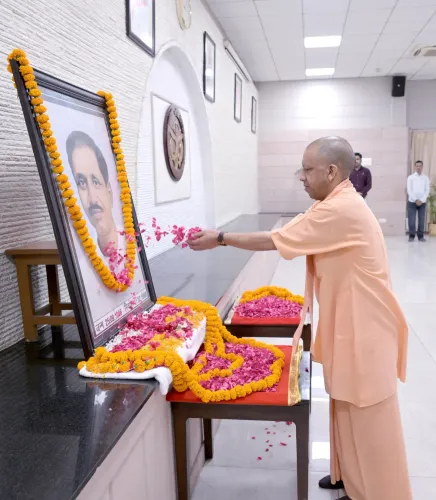
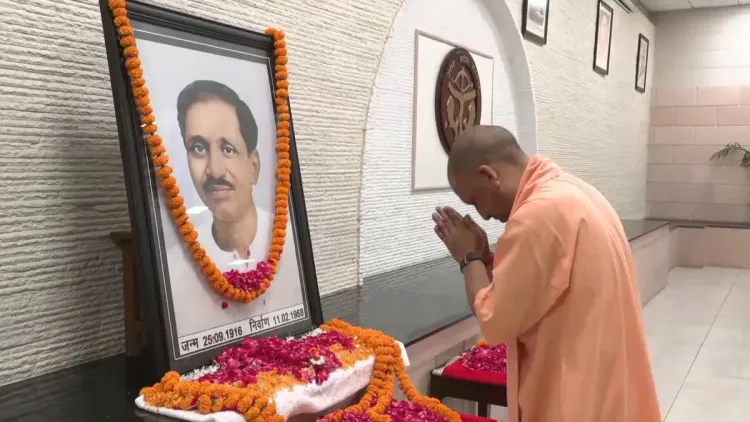
CM Yogi pays tribute to Deendayal Upadhyay in Lucknow
Synopsis
Uttar Pradesh Chief Minister Yogi Adityanath paid floral tribute to Pandit Deendayal Upadhyay in Lucknow on his birth anniversary, invoking the Bharatiya Jana Sangh founder's Antyodaya philosophy and linking it to the BJP's ongoing welfare agenda under PM Modi.
Key Takeaways
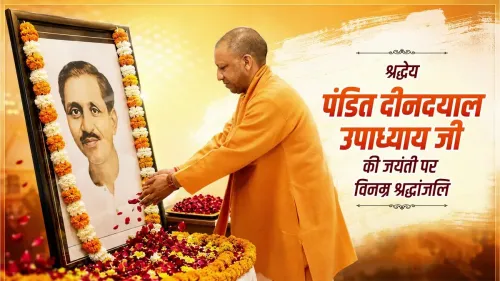
CM Yogi Adityanath offered floral tributes at Pandit Deendayal Upadhyay's portrait in Lucknow on 25 September 2026 .
Upadhyay was a founding member of the Bharatiya Jana Sangh , established in 1951 , which later became the BJP.
His doctrine of Antyodaya and Ekatma Manav Darshan , articulated in the 1960s , focused on self-reliance for the most marginalised in society.
CM Yogi linked Upadhyay's philosophy to the BJP's 'Double Engine Government' welfare model under PM Narendra Modi .
BJP-led governments routinely cite Antyodaya to provide ideological grounding for contemporary welfare and empowerment schemes.
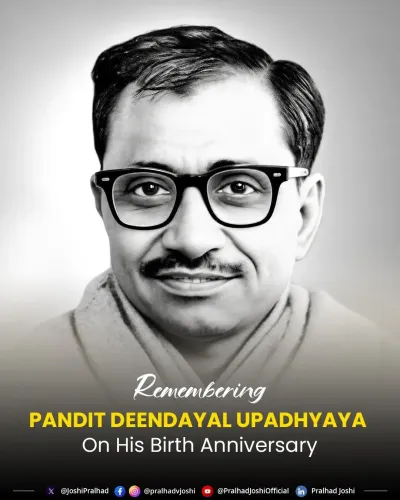
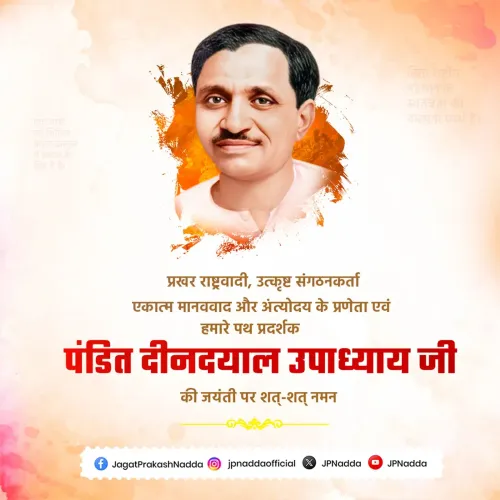
On the birth anniversary of one of independent India's most consequential political philosophers, Uttar Pradesh Chief Minister Yogi Adityanath offered floral tributes at the portrait of Pandit Deendayal Upadhyay in Lucknow on Friday, 25 September 2026, honouring the ideologue whose doctrine of Antyodaya — placing the last person in the line at the centre of governance — continues to shape BJP's welfare vocabulary seven decades on.
The philosopher who put the 'last man' first
Pandit Deendayal Upadhyay was a founding member of the Bharatiya Jana Sangh, established in 1951, the party that later became the Bharatiya Janata Party. In the 1960s, he articulated the doctrine of Ekatma Manav Darshan — Integral Humanism — a framework that placed the self-reliance and dignity of society's most marginalised at its core. His concept of Antyodaya (upliftment of the last person) was not merely rhetorical; it proposed a structured departure from both Western capitalism and Soviet-style socialism, arguing for an indigenous model rooted in Indian civilisational values.
CM Yogi, in his tribute post, described Upadhyay as one who 'dedicated his entire life to India and Indianness' and whose philosophy of empowering the person 'standing on the last rung of society' remains an 'unparalleled source of inspiration.' That framing is deliberate — and politically loaded.
Double Engine, single philosophy
CM Yogi explicitly linked Upadhyay's legacy to the present governance model, stating that under the 'able guidance of Prime Minister Narendra Modi,' the 'Double Engine Government' — the BJP's term for aligned BJP administrations at the Centre and in Lucknow — is 'continuously working for the welfare and empowerment of the poor, deprived and needy.' The 'Double Engine' framing has been a consistent shorthand for the BJP's pitch to voters in state elections: that having the same party at both levels accelerates welfare delivery.
The invocation of Antyodaya on this occasion is part of a broader, well-established BJP practice of grounding contemporary scheme launches and welfare narratives in Upadhyay's philosophy — from housing programmes to direct-benefit transfers — giving them an ideological lineage that predates the party's current form.
Why this anniversary carries political weight
Deendayal Upadhyay's birth anniversary is observed as a significant marker within the BJP's internal calendar. The Bharatiya Jana Sangh, of which he was a founding pillar, was the direct organisational predecessor of the BJP — making tributes on this date as much about ideological identity as about historical remembrance. For Yogi Adityanath, who heads both the state government and the Gorakhnath Math, the tribute also reinforces his positioning as a custodian of Hindu nationalist thought with deep ideological roots.
The philosophy lives on not just in speeches but in scheme branding — several central welfare programmes have been christened with Upadhyay's name over the years, making his anniversary a recurring touchstone for governance communication.
A thinker who never held elected office himself now anchors the political vocabulary of India's ruling party. That may be the sharpest measure of Deendayal Upadhyay's lasting influence.
Point of View
Yogi simultaneously shores up his ideological credentials and reframes routine welfare spending as a civilisational mission. The timing also matters: birth anniversaries of BJP foundational figures function as low-frequency but high-visibility moments to reinforce party identity ahead of any electoral cycle. The line from Jana Sangh to BJP to current state governance is presented as an unbroken continuum — a deliberate narrative choice.
NationPress
25 Sept 2026
Frequently Asked Questions
Who was Pandit Deendayal Upadhyay?
Pandit Deendayal Upadhyay was a founding member of the Bharatiya Jana Sangh, established in 1951, and the principal thinker behind Antyodaya and Ekatma Manav Darshan (Integral Humanism) — philosophies centred on the dignity and self-reliance of society's most marginalised. The Jana Sangh later evolved into the Bharatiya Janata Party.
What is Antyodaya philosophy?
Antyodaya, meaning 'rise of the last person,' is a governance principle articulated by Deendayal Upadhyay in the 1960s. It holds that true social progress must be measured by the empowerment of the weakest member of society, not aggregate growth. BJP governments frequently invoke this doctrine to frame welfare and poverty-alleviation programmes.
What did CM Yogi do on Deendayal Upadhyay's birth anniversary in 2026?
On 25 September 2026, Uttar Pradesh Chief Minister Yogi Adityanath offered floral tributes at Pandit Deendayal Upadhyay's portrait in Lucknow, paying homage on his birth anniversary and linking Upadhyay's philosophy to the current BJP government's welfare agenda.
What is the 'Double Engine Government' referred to by CM Yogi?
'Double Engine Government' is the BJP's political shorthand for having the same party in power at both the central and state levels simultaneously. The term is used to argue that coordinated BJP governance accelerates delivery of welfare and development schemes — a key electoral pitch in state elections.
What was the Bharatiya Jana Sangh?
The Bharatiya Jana Sangh was an Indian political party founded in 1951, with Deendayal Upadhyay as a key founding member. It served as a precursor to the Bharatiya Janata Party, which was formed in 1980, making its ideological lineage central to BJP's self-identity.