CM Yogi Invokes Sanskrit Wisdom on True Purpose of Education
Synopsis
Chief Minister Yogi Adityanath's office quoted the classical Sanskrit aphorism 'Sa vidya ya vimuktaye' — true knowledge leads to liberation — on 1 June 2026, reinforcing Uttar Pradesh's value-based education agenda aligned with the National Education Policy 2020.
Key Takeaways
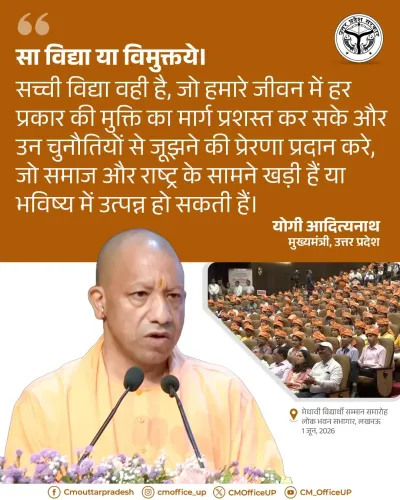
The Chief Minister's Office of Uttar Pradesh posted the Sanskrit maxim 'Sa vidya ya vimuktaye' ('True knowledge is that which leads to liberation') on 1 June 2026 .
Chief Minister Yogi Adityanath is directly attributed as the source of the quote in the official post.
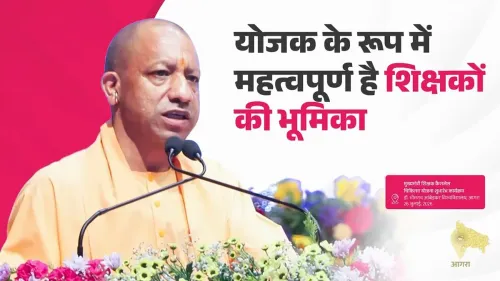
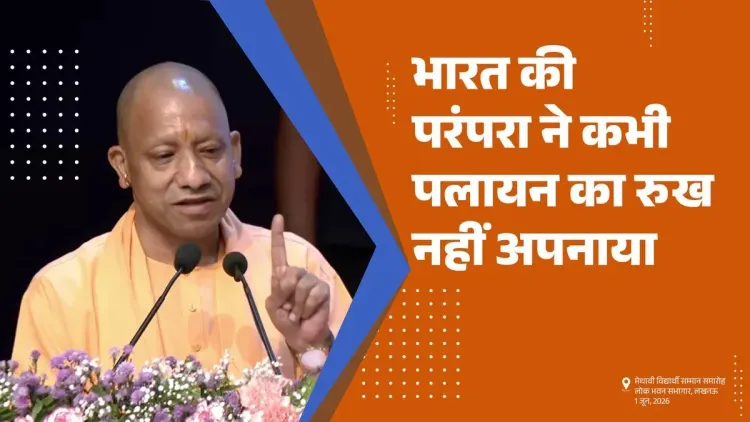
The message was accompanied by a video, indicating it may be drawn from a public address or official event.
Uttar Pradesh has aligned state education programmes with the National Education Policy 2020 , which emphasises Indian knowledge systems and holistic development.
The state expanded digital education infrastructure and free textbook schemes for government school students after 2017 .
Budget allocations for school and higher education in the next assembly session will indicate how this philosophy translates into policy action.
The Chief Minister's Office of Uttar Pradesh, on behalf of Chief Minister Yogi Adityanath, shared a classical Sanskrit maxim on Monday, 1 June 2026, underscoring the state government's view that genuine education must serve as a path to liberation in every dimension of human life.
Context
The post quotes the Sanskrit aphorism 'Sa vidya ya vimuktaye' — meaning 'That alone is true knowledge which leads to liberation' — attributing it directly to Chief Minister Yogi Adityanath. The phrase originates in classical Indian philosophical tradition and has long been invoked in discourse on the higher purpose of learning. The Chief Minister's Office framed it with the Hindi elaboration that 'true knowledge is that which can pave the way for every kind of liberation in our lives.'
The statement was accompanied by a video, suggesting it may be drawn from a public address or official event, though the specific occasion was not identified in the post.
Policy Backdrop
The invocation fits squarely within the broader educational philosophy that the Uttar Pradesh government has championed since 2017, when the BJP-led administration took office. The state has aligned its education agenda with the National Education Policy 2020, the central framework that replaced the 1986 policy and explicitly calls for learning rooted in Indian knowledge systems while equipping students for contemporary challenges.
Uttar Pradesh expanded digital education infrastructure and free textbook distribution for government school students in the years following 2017. These programmatic steps have been consistently paired with rhetorical anchoring in classical Indian values, reflecting the government's stated goal of blending tradition with skill development.
The NEP 2020 itself references multidisciplinary and holistic development, making the 'liberation through knowledge' framing a natural complement to the policy's emphasis on nurturing the whole learner rather than rote instruction alone.
Stakeholders and Impact
The statement speaks most directly to students, teachers, and the state education department of Uttar Pradesh, India's most populous state. For students in government schools and higher-education institutions, the Chief Minister's public articulation of education's purpose signals the value framework the administration expects curricula and pedagogy to reflect.
Teachers and academic administrators are likely to read the message as reinforcement of the cultural-rootedness strand within NEP implementation. Civil society groups focused on education access and quality will watch whether such statements translate into measurable policy action — from curriculum revision to vocational training expansion — in the next state assembly session.
What's Next
Observers will track Uttar Pradesh's budget allocations for school and higher education in the forthcoming assembly session, as well as any curriculum revisions that formally incorporate Indian knowledge systems under NEP 2020 guidelines. The pattern of invoking classical Sanskrit formulations in official communications suggests the government will continue to position cultural heritage as a pillar of its education narrative alongside infrastructure and enrolment targets.
How the philosophical framing translates into concrete classroom outcomes — particularly for students in rural and semi-urban Uttar Pradesh — will be the measure by which the administration's education record is ultimately assessed.
Point of View
Lending cultural legitimacy to administrative priorities. By framing education as a path to liberation rather than mere credentialism, the Chief Minister signals alignment with the holistic-development strand of NEP 2020 while also appealing to a constituency that values traditional knowledge systems. The statement is unlikely to be merely ceremonial: it follows a pattern in which rhetorical positioning precedes or accompanies policy announcements on curriculum and school infrastructure. The real test will be whether the philosophical commitment reflects in budget outlays and measurable learning outcomes for Uttar Pradesh's vast government-school population.
NationPress
16 Sept 2026
Frequently Asked Questions
What does 'Sa vidya ya vimuktaye' mean in English?
The Sanskrit phrase 'Sa vidya ya vimuktaye' translates to 'That alone is true knowledge which leads to liberation.' It originates in classical Indian philosophical texts and is widely cited in discussions on the purpose of education.
Why did CM Yogi Adityanath quote this Sanskrit phrase?
Chief Minister Yogi Adityanath quoted the phrase to articulate his government's view that genuine education should free individuals in every dimension of life, reinforcing the value-based education agenda pursued by the Uttar Pradesh government.
How is Uttar Pradesh implementing the National Education Policy 2020?
Uttar Pradesh has aligned state programmes with NEP 2020 by expanding digital education infrastructure, distributing free textbooks to government school students, and incorporating Indian knowledge systems into its broader curriculum framework.
What is the education policy of CM Yogi Adityanath's government in UP?
The Yogi Adityanath government has pursued a dual approach: expanding access through digital infrastructure and free learning materials while grounding the education narrative in Indian cultural and philosophical values, consistent with NEP 2020's emphasis on holistic development.
What should we watch for next in Uttar Pradesh education policy?
Key indicators will include budget allocations for school and higher education in the next Uttar Pradesh assembly session and any formal curriculum revisions incorporating Indian knowledge systems under NEP 2020 guidelines.