CM Yogi to establish Forestry & Horticulture University in UP

Synopsis
Chief Minister Yogi Adityanath has announced a new Forestry and Horticulture University in Uttar Pradesh, grounding the initiative in the Sanskrit verse 'Mata Bhumih Putro'ham Prithivyah' and framing environmental conservation as a civilisational duty.
Key Takeaways
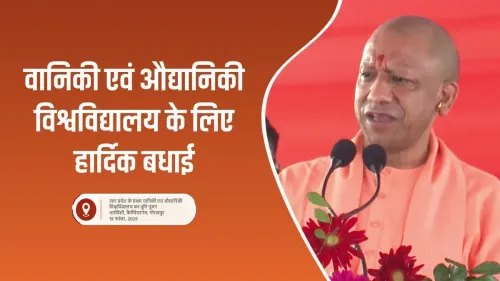
The Uttar Pradesh government has announced the establishment of a dedicated Vaaniki evam Audyaniki Vishwavidyalaya (Forestry and Horticulture University).
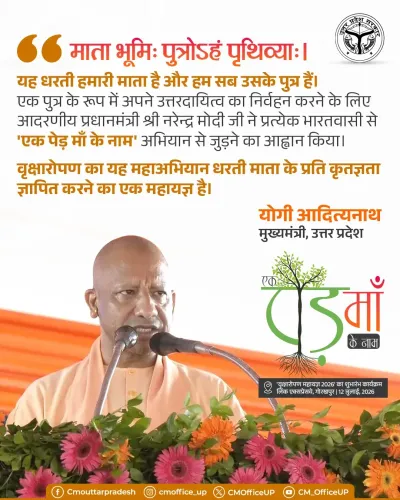
CM Yogi Adityanath anchored the announcement in the Vedic verse 'Mata Bhumih Putro'ham Prithivyah' — 'This earth is our mother and we are all her children.' The announcement was made on 19 November 2026 via the official Chief Minister's Office account on X.
No location, budget, or launch timeline has been specified; official government orders are awaited.
A standalone forestry and horticulture university would be significant for UP, which has a large Terai forest belt and an expanding horticulture sector.
The move continues Yogi Adityanath's pattern of linking cultural and civilisational references to institutional and policy announcements.
Rooted in a Vedic verse that declares the Earth a mother, Uttar Pradesh Chief Minister Yogi Adityanath has announced on Thursday, 19 November 2026 that the state government will establish a dedicated Vaaniki evam Audyaniki Vishwavidyalaya — a Forestry and Horticulture University — to drive environmental conservation across the state.
The Chief Minister's Office quoted the Sanskrit invocation 'Mata Bhumih Putro'ham Prithivyah' — 'This earth is our mother and we are all her children' — as the philosophical foundation for the new institution. The announcement frames what is an administrative and academic decision in the language of civilisational duty, a signature approach of the current Lucknow administration.
A university born from an ancient verse
India's Vedic tradition has long treated land stewardship as a sacred obligation, and CM Yogi Adityanath has consistently woven such references into policy messaging throughout his tenure since 2017. The proposed university is positioned not merely as a technical college but as an institutional embodiment of that worldview — where forestry science and horticulture practice are pursued as extensions of cultural reverence for nature.
Specialised agriculture and natural-resources universities are not new to India — several states host dedicated forestry colleges under broader agricultural universities — but a standalone institution exclusively for vaaniki (forestry) and audyaniki (horticulture) would mark a significant step for Uttar Pradesh, the country's most populous state and one with considerable forest cover in its Terai belt and an expanding horticulture sector in its western districts.
What the announcement does — and does not — say
The post confirms the government's intent to establish the university but does not specify a location, a budget outlay, or a launch timeline. Those details — including whether a site in the Terai, the Vindhya region, or a major urban centre has been identified — will emerge through official government orders or state assembly proceedings.
The horticulture and forestry sectors in Uttar Pradesh employ hundreds of thousands of farmers and forest-dependent communities. A dedicated university could, in time, channel research on agroforestry, medicinal plant cultivation, and timber management directly into district-level extension services — closing a gap that general agricultural universities often struggle to fill.
The ancient verse has been spoken; now the question is what the foundation stone will read — and when.
Point of View
Lending new institutions a sense of historical legitimacy beyond bureaucratic necessity. For Uttar Pradesh, a state that contributes significantly to India's horticulture output and contains ecologically sensitive Terai forests, a dedicated university could meaningfully shift research and extension capacity — but the absence of specifics keeps it at the level of intent for now. The move also signals that environmental credentialing is becoming a political priority in the state ahead of future electoral cycles. Watchers should track whether a government order formalises the institution, and which constituency — Terai, Vindhya, or western UP's mango belt — ultimately hosts it.
NationPress
19 Nov 2026
Frequently Asked Questions
What is the Forestry and Horticulture University announced by CM Yogi?
It is a new specialised university — called Vaaniki evam Audyaniki Vishwavidyalaya — announced by Uttar Pradesh Chief Minister Yogi Adityanath on 19 November 2026 to promote environmental conservation and education in forestry and horticulture.
Where will the new Forestry University in Uttar Pradesh be located?
No location has been announced yet. The government is expected to specify the site through official orders or state assembly proceedings.
What is the Sanskrit verse CM Yogi quoted for the university announcement?
CM Yogi cited the Vedic verse 'Mata Bhumih Putro'ham Prithivyah,' which translates as 'This earth is our mother and we are all her children,' as the philosophical foundation for the new institution.
Why is a separate forestry university needed in Uttar Pradesh?
Uttar Pradesh has a significant Terai forest belt and a large horticulture sector. A dedicated university can focus research and training on agroforestry, medicinal plants, and timber management more intensively than general agricultural universities.
What is the budget for the new UP Forestry and Horticulture University?
No budget or funding details have been disclosed in the announcement. Those figures are expected to appear in formal government orders or the state budget.