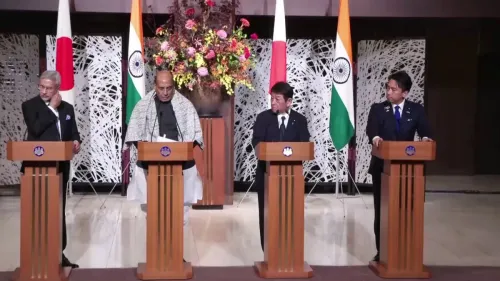
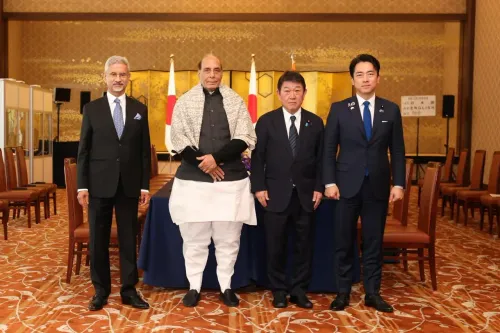
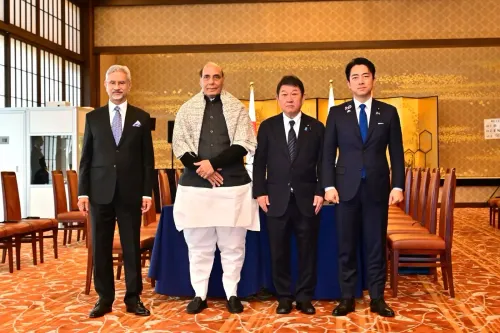
Jaishankar addresses press after India-Japan 2+2 Dialogue in Tokyo
Synopsis
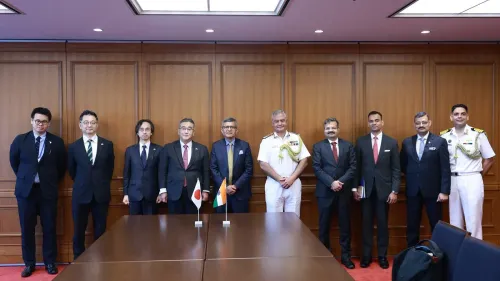
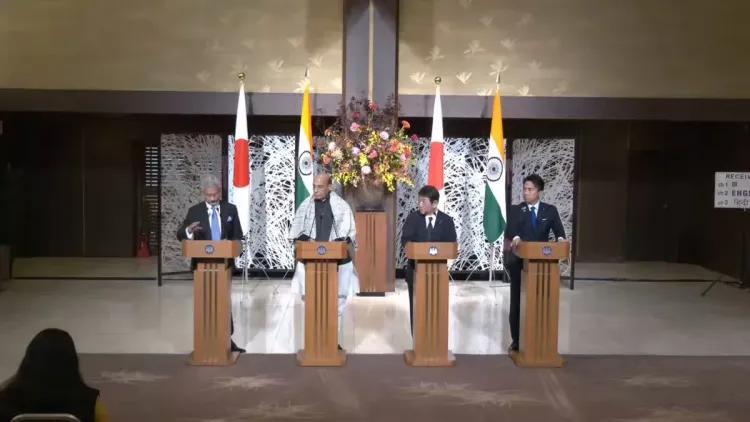
Union External Affairs Minister Dr. S. Jaishankar addressed the press in Tokyo on 19 November 2026 after the conclusion of the India-Japan 2+2 Foreign and Defence Ministers' Dialogue, one of India's highest-tier bilateral strategic consultations in the Indo-Pacific.
Key Takeaways
Union External Affairs Minister Dr.
Jaishankar made press remarks in Tokyo on 19 November 2026 after the India-Japan 2+2 Foreign and Defence Ministers' Dialogue concluded.
The 2+2 format brings together both foreign and defence ministers simultaneously, synchronising diplomatic and military coordination.
India first launched this dialogue format with Japan in 2019 , reflecting the depth of the bilateral strategic partnership.
The mechanism is part of India's broader effort to build a network of high-level strategic dialogues anchored in its Indo-Pacific outlook.
Post-conclusion watch-points include any joint statement, follow-on agreements, and the confirmed date for the next round.
In Tokyo on Thursday, 19 November 2026, Union External Affairs Minister Dr. S. Jaishankar stepped before cameras to deliver his press remarks at the conclusion of the India-Japan 2+2 Foreign and Defence Ministers' Dialogue — one of the highest-tier strategic consultations India holds with any partner in the Indo-Pacific.
What the 2+2 format actually means
The 2+2 Dialogue is not routine diplomacy. It places foreign and defence ministers in the same room simultaneously — a deliberate architecture designed to synchronise political intent with military planning, cutting across the bureaucratic silos that often slow strategic coordination. India first institutionalised this format with Japan in 2019, making Tokyo one of a small group of capitals that hold this level of combined access.
The structure signals mutual trust: both sides are willing to let their defence establishments engage directly alongside their foreign services, locking in coherence between what is said diplomatically and what is prepared militarily.
India-Japan strategic ties and the Indo-Pacific backdrop
Japan has been among India's most consequential strategic partners across defence technology, infrastructure finance, and economic cooperation. The relationship sits at the heart of India's broader Indo-Pacific architecture — an outlook that has grown sharper and more institutionalised over the past decade as regional security pressures have intensified.
India has rolled out the 2+2 format with only a handful of key partners, reserving it for relationships where the convergence of foreign and defence policy is both deep and urgent. Each round in Tokyo builds on the last, tracking the evolution of shared concerns and translating them into coordinated positions.
What follows a 2+2 conclusion
Dr. Jaishankar's press statement marks the formal close of this round's deliberations. The standard watch-points now are any joint statement released by both governments, follow-on agreements at the defence or foreign ministry level, and confirmation of when the next round convenes. Those signals will tell observers how much ground the two sides actually covered — and how fast they intend to move on it.
India's network of 2+2 dialogues is, in effect, a map of its most consequential strategic relationships. Every Tokyo round adds another layer to that map.
Point of View
New Delhi signals that the relationship is durable enough to survive political cycles on either side. Dr. Jaishankar's presence — as a former ambassador and long-serving foreign-policy architect — adds institutional continuity to what is already a structurally significant mechanism. The real measure of this round will come in the follow-on paperwork, not the press statement.
NationPress
19 Nov 2026
Frequently Asked Questions
What is the India-Japan 2+2 Dialogue?
The India-Japan 2+2 Foreign and Defence Ministers' Dialogue is a bilateral mechanism that convenes the foreign and defence ministers of both countries together to coordinate on security and strategic issues. It was first instituted in 2019.
Where was the 2+2 Dialogue held in November 2026?
The meeting was held in Tokyo, Japan, with Dr. S. Jaishankar representing India's foreign ministry side of the dialogue.
Why does India use the 2+2 format with select partners?
India reserves the 2+2 format for its most consequential strategic relationships because it allows foreign and defence ministries to coordinate simultaneously, ensuring diplomatic messaging and military planning are aligned.
Which other countries does India hold a 2+2 dialogue with?
India holds 2+2 ministerial dialogues with a small group of key strategic partners as part of its broader Indo-Pacific engagement architecture. Japan was among the first, with the format instituted in 2019.
What comes next after the India-Japan 2+2 concludes?
After the conclusion of a 2+2 round, observers typically watch for a joint statement from both governments, any follow-on agreements at the defence or foreign ministry level, and the announced date for the next round of talks.