CM Gujarat highlights PM Modi's 12 years of Garib Kalyan welfare push
Synopsis
The Chief Minister's Office of Gujarat on 8 June 2026 shared PM Modi's statement marking 12 years of Garib Kalyan-centred governance, spotlighting a decade-plus of financial inclusion, food security, and health cover programmes targeting India's poor.
Key Takeaways
The CMO Gujarat amplified PM Modi's statement on 8 June 2026 via the NaMo App, marking 12 years of Garib Kalyan-focused governance.
The Pradhan Mantri Jan Dhan Yojana , launched in August 2014 , underpins the financial-inclusion architecture for welfare transfers.
Direct Benefit Transfer (DBT) reforms linked payments to Aadhaar-seeded accounts to reduce leakages across welfare schemes.
Ayushman Bharat–PM Jan Arogya Yojana (2018) and PM Garib Kalyan Anna Yojana (2020) are among the landmark schemes in this 12-year arc.
Gujarat has consistently positioned itself as an early adopter of central welfare schemes, amplifying Union government messaging at the state level.
Analysts will watch the next Union Budget for possible extensions or mergers of existing Garib Kalyan programmes.
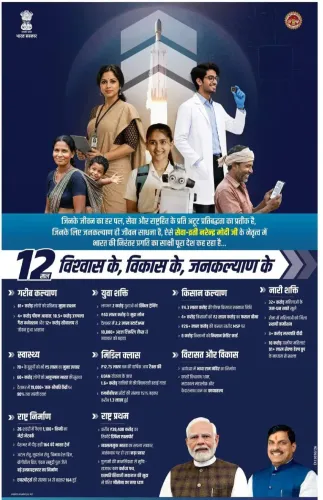
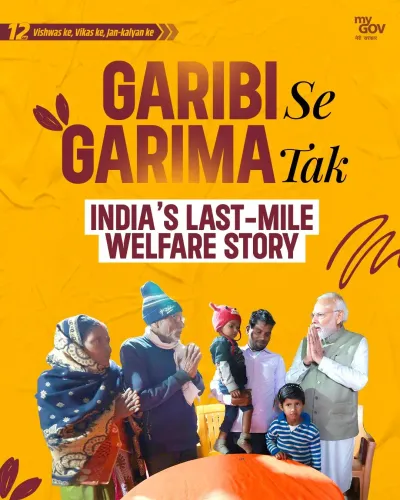
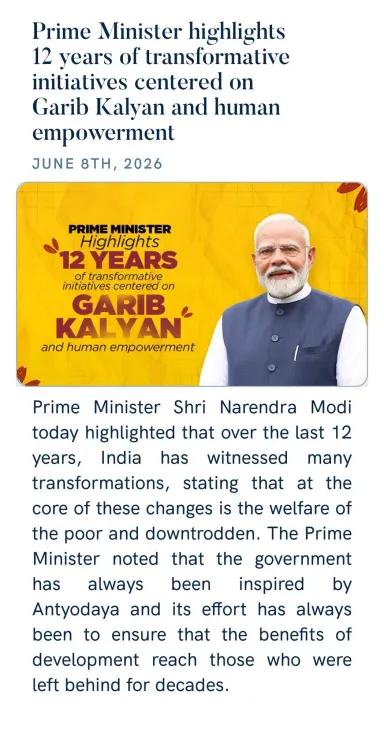
The Chief Minister's Office of Gujarat on Monday, 8 June 2026 amplified a statement by Prime Minister Narendra Modi highlighting 12 years of transformative initiatives centred on Garib Kalyan and human empowerment, sharing the message via the NaMo App.
Context
The post marks a significant milestone in the BJP-led central government's welfare narrative, framing the period since May 2014 as one defined by targeted programmes for the poor. The Prime Minister's statement, as amplified by the CMO Gujarat, underscores the ideological continuity of 'Garib Kalyan' — loosely translated as 'welfare of the poor' — as the central organising theme of governance over the past decade-plus.
Gujarat's official state account has consistently served as a relay point for central government messaging, particularly on welfare delivery and scheme implementation, reinforcing alignment between state and Union government priorities.
Policy Backdrop
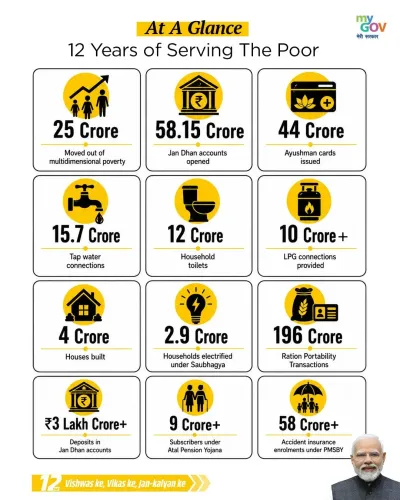
The 12-year arc spans a range of flagship schemes. The Pradhan Mantri Jan Dhan Yojana, launched in August 2014, opened bank accounts for crores of previously unbanked households, forming the financial infrastructure for subsequent welfare transfers. Direct Benefit Transfer (DBT) reforms, rolled out from 2014 onward, linked welfare payments to Aadhaar-seeded accounts to reduce leakages and ensure last-mile delivery.
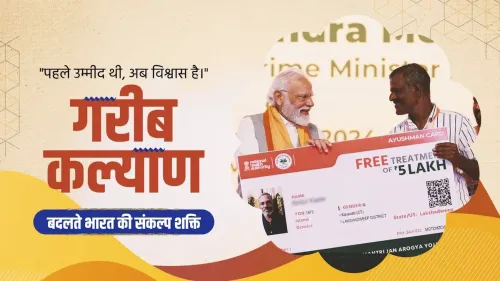
In 2018, the Ayushman Bharat–Pradhan Mantri Jan Arogya Yojana extended health insurance cover to economically vulnerable families, while the Pradhan Mantri Garib Kalyan Anna Yojana — launched during the COVID-19 pandemic in 2020 — provided free grain distribution to priority households and was extended multiple times. Together, these programmes represent a shift toward technology-enabled, targeted welfare rather than generalised subsidy spending.
Stakeholders and Impact
The primary beneficiaries of this policy ecosystem are priority households, the rural poor, and women self-help groups across India. Gujarat has positioned itself as an early adopter of many central schemes, frequently citing state-level implementation metrics as evidence of effective delivery.
The human empowerment framing in the Prime Minister's statement signals a broader intent: welfare is presented not merely as subsidy distribution but as a pathway to economic agency — through bank accounts, health cover, and food security working in combination.
What's Next
Observers will watch for any extension or merger of existing Garib Kalyan schemes in the forthcoming Union Budget or during a national address by the Prime Minister. The 12-year milestone framing may also presage a formal review or expansion of the welfare architecture, with Gujarat likely to feature prominently in any implementation showcase. The political salience of this messaging is expected to remain high as the government consolidates its welfare record ahead of future electoral cycles.
Point of View
Reinforcing Gujarat's identity as a model state within the BJP's welfare narrative. The '12-year' framing is not incidental — it anchors the entire period of Modi-led central government to a single, voter-legible theme of pro-poor governance. By channelling this through the NaMo App ecosystem, the communication strategy bypasses conventional media and speaks directly to a party-aligned digital base. This pattern suggests the welfare record will be a centrepiece of political messaging well into the next electoral cycle.
NationPress
24 Sept 2026
Frequently Asked Questions
What is Garib Kalyan and why is it significant in Indian politics?
'Garib Kalyan' means 'welfare of the poor' in Hindi and has been the central branding theme of the Modi government's social programmes since 2014, encompassing food security, financial inclusion, and health insurance schemes targeting low-income households.
What schemes are part of PM Modi's 12-year Garib Kalyan record?
Key schemes include the Pradhan Mantri Jan Dhan Yojana (2014) for bank accounts, Direct Benefit Transfer reforms for subsidy delivery, Ayushman Bharat–PM Jan Arogya Yojana (2018) for health insurance, and the PM Garib Kalyan Anna Yojana (2020) for free grain distribution.
Why did the Chief Minister's Office of Gujarat share PM Modi's welfare statement?
The CMO Gujarat routinely amplifies central government welfare messaging to reinforce the state's alignment with Union government priorities and to highlight Gujarat's role as an early adopter of flagship schemes.
What is the NaMo App and how is it used for government communication?
The NaMo App is a BJP-linked digital platform used by PM Modi and aligned accounts to share policy updates, speeches, and welfare messaging directly with supporters, bypassing conventional media channels.
What welfare scheme changes can be expected in the next Union Budget?
Analysts are watching for possible extensions or mergers of existing Garib Kalyan schemes — particularly the PM Garib Kalyan Anna Yojana — in the forthcoming Union Budget, given the government's emphasis on this 12-year welfare milestone.