Rajasthan CMO directs DISCOMs to coordinate on power supply
Synopsis
The Chief Minister's Office of Rajasthan has instructed the state's three DISCOMs to coordinate closely to ensure uninterrupted electricity supply, tagging Chief Minister Bhajan Lal Sharma. The directive, posted on 4 June 2026, signals direct CMO oversight of utility operations amid peak summer demand and continues Rajasthan's long-running focus on distribution reliability and reform.
Key Takeaways
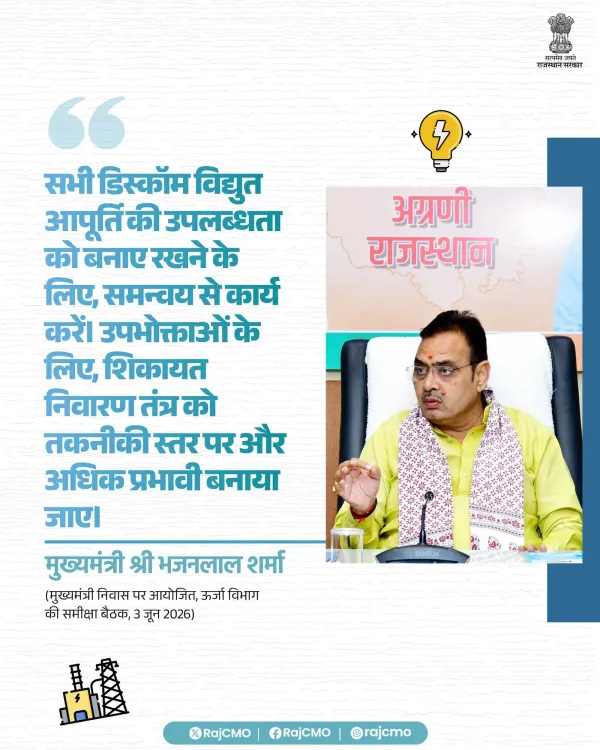
The Chief Minister's Office of Rajasthan on 4 June 2026 directed all DISCOMs to coordinate on power supply availability.
The post tagged Chief Minister Bhajan Lal Sharma and carried the hashtag #आपणो_अग्रणी_राजस्थान .
Rajasthan's distribution is run by three utilities serving Jaipur , Jodhpur and Ajmer zones.
The state was part of the Centre's UDAY scheme launched in 2015 for DISCOM reform.
The directive coincides with the high-demand summer window in Rajasthan.
A formal review of DISCOM performance is the likely next administrative step.
The Chief Minister's Office of Rajasthan on 4 June 2026 publicly directed the state's electricity distribution companies to work in coordination to maintain uninterrupted power supply. The instruction, posted on the official handle of the CMO and tagging Chief Minister Bhajan Lal Sharma, signals direct administrative oversight of the utility network as the state navigates peak summer demand.
'All DISCOMs should work in coordination to maintain the availability of electricity supply,' the post read in Hindi (सभी डिस्कॉम विद्युत आपूर्ति की उपलब्धता को बनाए रखने के लिए, समन्वय से कार्य करें). The message carried the government's signature hashtag #आपणो_अग्रणी_राजस्थान ('Our Leading Rajasthan'), used by the administration to brand its governance push.
Context
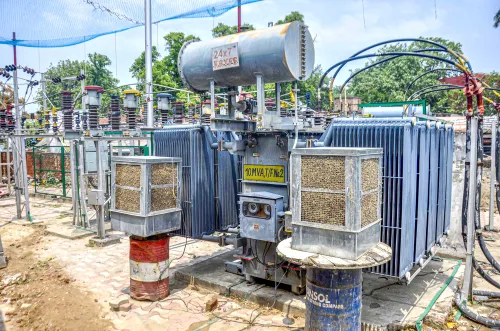
Rajasthan's power distribution is handled by three state-owned utilities — the Jaipur, Jodhpur and Ajmer DISCOMs — which together cover the entire state's last-mile supply and consumer billing. Directives for tighter coordination among the three typically emerge during periods of grid stress, when load balancing and inter-utility power transfers become operationally critical.
The CMO's intervention places the responsibility for service reliability squarely on the DISCOMs while signalling to consumers that the political leadership is monitoring the situation. Chief Minister Bhajan Lal Sharma, who assumed office in December 2023 after the BJP's victory in the assembly elections, has used the CMO handle to issue periodic instructions to line departments.
Policy backdrop
Rajasthan's distribution utilities have been the subject of sustained reform for over a decade. The state was a participant in the UDAY scheme launched by the Centre in 2015, which required DISCOMs to bring down aggregate technical and commercial (AT&C) losses, improve billing efficiency and align operationally with the state government's fiscal framework.
Since the mid-2010s, the state's power sector strategy has focused on two parallel tracks: improving distribution efficiency in the older urban and agricultural networks, and integrating large volumes of renewable energy — particularly solar generation from the western desert districts — into the grid. Coordination among the three DISCOMs becomes especially important during summer, when air-conditioning load in cities collides with high agricultural pumping demand in rural feeders.
Stakeholders and impact
The most immediate stakeholders are the state's electricity consumers — households, farmers, industrial units and commercial establishments — for whom continuity of supply during the peak demand months is a political-economy issue. Agricultural feeders in particular face load-shedding pressures, and any directive emphasising 'availability' is likely to be read by farm groups as an assurance.
For DISCOM management and staff, the public nature of the directive raises the visibility of operational performance. Field engineers, control-room teams and procurement officers will be expected to align on demand forecasting, short-term power purchases and outage management. The tag to the Chief Minister underscores that the instruction carries political weight beyond a routine administrative note.
What's next
Attention will turn to whether the CMO follows the public directive with a formal review meeting of the three DISCOMs, and whether the state energy department issues fresh targets on AT&C losses or summer demand management. Any announcements on short-term power purchase agreements, additional load from exchanges, or feeder-level outage protocols would indicate how the coordination instruction translates into operational change.
The broader implication is that the Sharma administration is positioning reliable power supply as a governance deliverable under its 'आपणो अग्रणी राजस्थान' ('Our Leading Rajasthan') framing — a metric on which the government is likely to be judged through the summer.
Point of View
The Sharma administration converts an operational matter into a visible governance commitment. It also continues the post-UDAY arc in which DISCOM performance is treated as a frontline metric of state delivery. The real test will be whether coordination translates into measurable reductions in outages and losses.
NationPress
20 Oct 2026
Frequently Asked Questions
Who issued the directive to Rajasthan DISCOMs on 4 June 2026?
The Chief Minister's Office of Rajasthan issued the directive on 4 June 2026, tagging Chief Minister Bhajan Lal Sharma. It asked all DISCOMs to coordinate to maintain power supply availability.
How many DISCOMs are there in Rajasthan?
Rajasthan has three state-owned distribution companies, covering the Jaipur, Jodhpur and Ajmer zones. Together they handle last-mile electricity supply and billing across the state.
What does 'आपणो अग्रणी राजस्थान' mean?
It translates to 'Our Leading Rajasthan' and is used by the state government as a governance and outreach hashtag. It frames the administration's delivery agenda across sectors.
Why is DISCOM coordination important in summer?
Summer brings simultaneous spikes in urban cooling load and rural agricultural pumping demand. Coordination among DISCOMs helps balance the grid, manage power purchases and reduce outages.
What is the UDAY scheme referred to in Rajasthan's power reforms?
UDAY is a central scheme launched in 2015 to financially and operationally turn around state DISCOMs. It required utilities to cut AT&C losses and align with state government finances, and Rajasthan was a participant.