Congress MP Imran Masood detained at Jamia amid students union protest
Synopsis
For the first time in nearly two decades, the question of student democracy at Jamia Millia Islamia has spilled well beyond campus gates — drawing MP detentions, a parliamentary letter, and a 'Free Kashmir' slogan row that threatens to overshadow the core demand: a simple election notification that the university has withheld since 2006.
Key Takeaways
Delhi Police detained Congress MP Imran Masood and SP MP Mohibbullah Nadvi at Jamia Millia Islamia on 23 October 2026 ; Nadvi was later released.
Students have been on an indefinite hunger strike since 12 October , demanding restoration of the JMISU and an election schedule for 2026-27 .
Jamia Millia Islamia has had no elected students' union since 2006 ; the last elections were held in 2005 .
Slogans including 'Free Kashmir' and 'Free Sharjeel Imam' reportedly appeared on campus walls; protesters deny involvement and blame planted elements.
CPI(M) MP John Brittas wrote to Union Education Minister Pralhad Joshi on 21 October , citing UGC guidelines and Lyngdoh Committee recommendations.
The university has begun a constitution-drafting process but students insist only an immediate election notification will end the agitation.
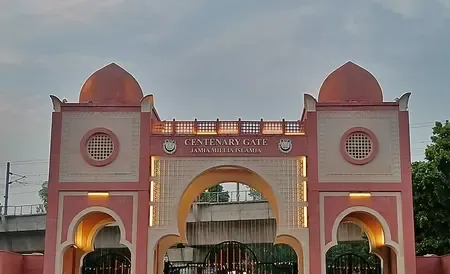
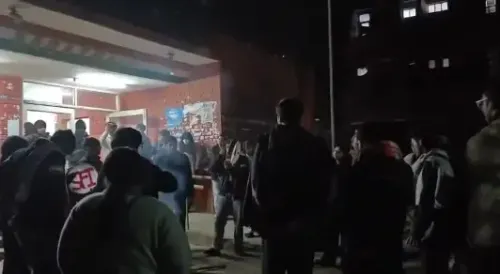
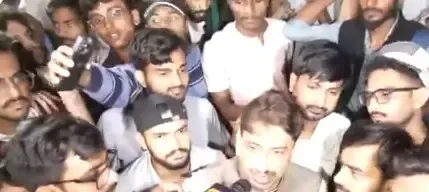
Delhi Police on Friday, 23 October 2026 detained Congress MP Imran Masood and Samajwadi Party MP Mohibbullah Nadvi while they were attempting to meet students at Jamia Millia Islamia in New Delhi, where an indefinite protest has been underway since 12 October over the restoration of an elected students' union. Nadvi was later released; visuals of his detention circulated on social media.
The Protest at a Glance
Students at Jamia Millia Islamia launched an indefinite hunger strike on 12 October, demanding the restoration of the Jamia Millia Islamia Students' Union (JMISU) — dissolved in 2006, the last elections having been held in 2005 — along with an official notification announcing the election schedule for the 2026-27 academic session. Their grievances also extend to the withdrawal of disciplinary action against protesters, better academic facilities, attendance policies, hostel conditions, scholarships, and research stipends.
This is not a narrow procedural dispute. Students argue that without elected representation, there is no democratic mechanism to escalate welfare concerns to university decision-makers. The protest has stretched for over a week with no resolution in sight.
MPs Detained — What Happened
Congress MP Imran Masood arrived at the Jamia campus on Friday to express solidarity with the protesters and was detained by police upon arrival. While on campus, Masood unequivocally rejected slogans advocating the division of India, which had reportedly appeared on campus walls alongside 'Free Kashmir' and 'Free Sharjeel Imam' graffiti.
'Look, we do not support any slogan that talks about breaking up India. We will not support those who talk about breaking up India under any circumstances. Kashmir is an integral part of India and will always remain so. Attempts are being made to derail this entire movement through these posters,' Masood said.
He also questioned why the university had not reinstated the union. 'The students' demands are justified. Why is the student union not being reinstated? These students are the future of the country. Why are attempts being made to crush the future of the country?' he said.
SP MP Mohibbullah Nadvi, a Jamia alumnus, alleged he was detained while travelling to meet the protesters. He described supporting the students as his duty and was subsequently released.
The 'Free Kashmir' Slogan Controversy
The discovery of slogans including 'Free Kashmir' and 'Free Sharjeel Imam' reportedly written on campus walls has widened the controversy and given the protest a sharper political edge. The university administration condemned the slogans, began removing the writing using chemical agents, and initiated efforts to identify those responsible. A university official said strict action would follow.
The official also alleged that some CCTV cameras in the areas where the slogans appeared had been tampered with and their wiring disconnected or damaged.
Hunger-striking student Jasim Ali squarely rejected the allegations, blaming the university administration instead. 'We completely refute this thing. And this thing that has happened, the Jamia administration is entirely at fault. This is not our job; it is the Jamia administration's job to stop such mischievous elements. But they themselves have been planted among us by the Jamia admin so that our peaceful protest can be ended,' Ali said.
Masood echoed this suspicion, alleging that the Bharatiya Janata Party (BJP) itself puts up such posters before creating controversy over them — a charge that has not been independently verified.
Parliamentary Attention and CPI(M) Letter
The issue has reached Parliament's doors. In a letter to Union Education Minister Pralhad Joshi dated 21 October, Communist Party of India (Marxist) MP John Brittas highlighted that Jamia has been without an elected union for nearly two decades. Brittas cited constitutional provisions guaranteeing freedom of speech and association, University Grants Commission (UGC) guidelines on students' entitlements, and the Lyngdoh Committee recommendations on student elections as grounds for immediate action.
Where Things Stand
The university has initiated a constitution-drafting process and promised a review of disciplinary action against protesters. However, students insist these measures are insufficient and cannot substitute for an immediate, formal election notification. The central deadlock remains unresolved. With MPs now detained and parliamentary correspondence on record, pressure on the university administration and the Centre to respond is intensifying.
Point of View
Which hands the administration a convenient diversion. The pattern is familiar: a legitimate welfare-and-governance grievance gets buried under a controversy over slogans, and the original accountability question — why has a central university flouted student election norms for twenty years? — goes unanswered. The Education Ministry's response to Brittas's letter will be the next real test of whether the Centre treats this as a law-and-order problem or a democratic deficit.
NationPress
24 Oct 2026
Frequently Asked Questions
Why were MPs detained at Jamia Millia Islamia on 23 October?
Delhi Police detained Congress MP Imran Masood and SP MP Mohibbullah Nadvi on 23 October 2026 while they were attempting to meet students protesting for the restoration of the elected students' union at Jamia Millia Islamia. Nadvi was subsequently released.
What are Jamia students demanding in the 2026 protest?
Students are demanding the restoration of the Jamia Millia Islamia Students' Union (JMISU), an official election schedule for the 2026-27 session, and withdrawal of disciplinary action against protesters. They also want improvements in academic facilities, hostel conditions, scholarships, and research stipends.
How long has Jamia been without an elected students' union?
Jamia Millia Islamia has been without an elected students' union since 2006, when the body was dissolved. The last elections were held in 2005, making it nearly two decades without democratic student representation.
What is the 'Free Kashmir' slogan controversy at Jamia?
Slogans including 'Free Kashmir' and 'Free Sharjeel Imam' were reportedly found written on campus walls, widening the political controversy around the protest. The university administration condemned the slogans and began removing them; protesting students denied involvement, alleging the slogans were written by elements planted to disrupt their agitation.
What action has Parliament taken on the Jamia students' union issue?
CPI(M) MP John Brittas wrote to Union Education Minister Pralhad Joshi on 21 October 2026, highlighting that Jamia has lacked an elected union for nearly twenty years. He cited UGC guidelines on student entitlements and the Lyngdoh Committee recommendations on student elections as grounds for immediate intervention.