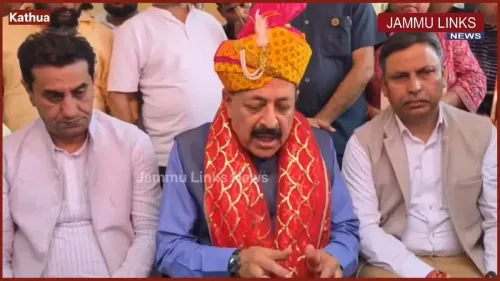
Dr. Jitendra Singh: CSIR-IIIM Jammu Leads India's First Cannabis Medicine Project

Synopsis
Union Minister Dr. Jitendra Singh has announced that India's first Cannabis Medicine project is led by CSIR-IIIM in Jammu, aiming to develop treatments for chronic pain conditions including diabetic neuropathy and cancer-related pain — a landmark moment for India's plant-derived pharmaceutical research.
Key Takeaways
India's first Cannabis Medicine project is being led by CSIR-IIIM, Jammu , as announced by Union Minister Dr.
Jitendra Singh on 9 November 2026 .
The project targets treatment for chronic pain , specifically pain from diabetic neuropathy , other neuropathies, and cancers.
CSIR-IIIM is a natural-product drug discovery laboratory under the Council of Scientific and Industrial Research, based in Jammu .
Cannabis remains regulated under India's NDPS Act ; medical research requires approvals from CDSCO and relevant state authorities.
The initiative fits a broader pattern of CSIR institutes expanding into plant-derived pharmaceuticals for non-communicable diseases.
Tens of millions of Indians with diabetic neuropathy and those requiring cancer palliative care represent the primary potential beneficiary populations.
A laboratory tucked in the hills of Jammu is now at the centre of one of India's most consequential — and legally sensitive — medical research bets. Union Science and Technology Minister Dr. Jitendra Singh announced on Monday, 9 November 2026 that India's first Cannabis Medicine project is being led by CSIR-IIIM (Council of Scientific and Industrial Research — Indian Institute of Integrative Medicine) in Jammu, targeting treatment for chronic pain conditions including diabetic neuropathy, other neuropathies, and cancers.
What CSIR-IIIM Is Attempting — And Why It Matters
CSIR-IIIM is India's premier natural-product drug discovery laboratory, with a long track record in phytopharmaceuticals — medicines derived from plant compounds. Its location in Jammu is no accident: the region has historically been associated with indigenous botanical knowledge and medicinal plant cultivation. Turning that heritage toward a modern, regulated cannabinoid medicine is a significant pivot.
Chronic pain — particularly the nerve-damage pain of diabetic neuropathy — remains notoriously difficult to treat. Existing analgesics carry addiction risks or diminishing efficacy. Cannabis-derived compounds, particularly cannabidiol (CBD) and tetrahydrocannabinol (THC) in controlled formulations, have shown promise in international trials for exactly these pain profiles. India's public-sector entry into this space signals an intent to build domestic pharmaceutical capability rather than import solutions.
Navigating India's Tight Regulatory Fence
Cannabis remains a narcotic plant under Indian law, governed by the Narcotic Drugs and Psychotropic Substances (NDPS) Act. Any research programme — let alone a path to clinical trials and eventual medicine — requires specific approvals from multiple authorities, including the Central Drugs Standard Control Organisation (CDSCO) and state governments. That CSIR-IIIM is leading this project suggests the regulatory clearances necessary for research-grade work are already in place.
India has expanded public-sector research into plant-derived pharmaceuticals through its CSIR network over the past decade, with institutes targeting non-communicable diseases from cancer to metabolic disorders. This cannabis medicine initiative fits that broader arc — but it breaks new ground by taking on a compound class that has remained politically and legally fraught.
Who Stands to Benefit
The patient populations named by the Minister are vast. India carries one of the world's largest burdens of diabetes — and diabetic neuropathy, the painful nerve damage that follows years of uncontrolled blood sugar, affects tens of millions. Cancer pain management, too, is a persistent gap in palliative care access. A domestically developed, affordable cannabinoid medicine — if it clears trials and regulatory hurdles — could reach patients who currently have no effective option.
The next milestones to watch: preclinical study results from CSIR-IIIM, any regulatory filings with CDSCO for phase-one human trials, and signals from the Ministry of Health on a wider policy framework for medical cannabis. India has the science infrastructure. Now the regulatory clock starts ticking.
Point of View
Reinforcing the government's strategy of building public-sector capacity in high-barrier drug classes. The choice of Jammu as the host site carries deliberate regional symbolism, projecting the Union Territory as a serious node in India's scientific map. If CSIR-IIIM navigates the NDPS regulatory framework successfully, it could set a precedent that unlocks broader medical cannabis research across Indian institutions. The real test, however, lies ahead: translating laboratory promise into clinical trial approvals and eventually affordable, accessible medicine for the country's enormous chronic-pain burden.
NationPress
9 Nov 2026
Frequently Asked Questions
What is India's first Cannabis Medicine project?
It is a drug discovery initiative led by CSIR-IIIM (Indian Institute of Integrative Medicine) in Jammu to develop cannabis-derived medicines targeting chronic pain conditions such as diabetic neuropathy and cancer-related pain, as announced by Union Minister Dr. Jitendra Singh .
What is CSIR-IIIM and where is it located?
CSIR-IIIM (Indian Institute of Integrative Medicine) is a laboratory under the Council of Scientific and Industrial Research, located in Jammu . It specialises in natural-product drug discovery and integrative medicine research.
Is medical cannabis legal in India?
Cannabis is regulated as a narcotic under India's NDPS Act . Research use requires specific approvals from authorities including CDSCO and relevant state governments; it is not freely available as a medicine but can be studied under sanctioned programmes.
What diseases will India's cannabis medicine project target?
The project aims to develop treatments for chronic pain , specifically pain related to diabetic neuropathy , other neuropathies, and cancers, according to the minister's announcement.
What are the next steps for CSIR-IIIM's cannabis medicine research?
Key milestones to watch include the completion of preclinical studies, any regulatory filings with CDSCO for human trial permissions, and broader policy signals from the Ministry of Health on a framework for medical cannabis in India.