Gadkari addresses Ayurveda cancer care seminar in Nagpur
Synopsis
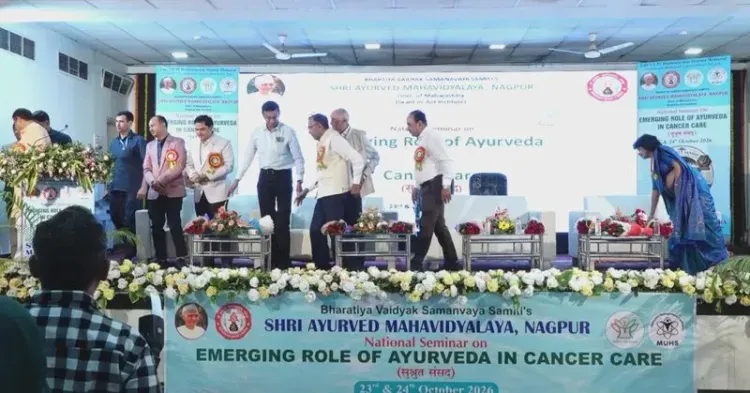
Union Minister Nitin Gadkari addressed a national seminar on the emerging role of Ayurveda in cancer care, hosted by Shri Ayurvedic Mahavidyalaya in Nagpur on 24 October 2026, reflecting India's sustained policy push to integrate AYUSH systems into mainstream oncology care.
Key Takeaways
Nitin Gadkari addressed a national seminar on 'Emerging Role of Ayurveda in Cancer Care' in Nagpur on 24 October 2026 .
The event was organised by Shri Ayurvedic Mahavidyalaya , an Ayurvedic educational institution based in Nagpur.
The Ministry of AYUSH , established in November 2014 , and the National AYUSH Mission (2015) provide the policy framework underpinning such initiatives.
National Health Policy documents since 2017 have encouraged evidence-based use of traditional medicine alongside allopathic cancer treatment.
Oncology is one of the most active frontiers for AYUSH-allopathy integration, particularly in supportive and palliative care.
Gadkari's participation underscores broad political ownership of the AYUSH agenda beyond the health ministry.
Where ancient medicine meets modern oncology, Union Road Transport and Highways Minister Nitin Gadkari stepped into a different kind of policy conversation on Saturday, 24 October 2026 — addressing a national seminar on the emerging role of Ayurveda in cancer care, hosted by Shri Ayurvedic Mahavidyalaya in Nagpur.
A senior Cabinet voice at an AYUSH platform
Gadkari's presence at the seminar is notable precisely because of who he is not: a health minister. A senior BJP leader and former party president, his decision to address a forum dedicated to Ayurvedic oncology signals the breadth of political ownership around India's traditional medicine push. The seminar — organised by Shri Ayurvedic Mahavidyalaya, a Nagpur-based institution focused on traditional medicine training and research — brought together practitioners and scholars to explore how Ayurveda can contribute to cancer care, particularly as a supportive or complementary pathway alongside conventional treatment.
Nagpur, AYUSH policy, and the oncology frontier
The gathering sits within a well-established policy trajectory. The Ministry of AYUSH, created in November 2014, was built expressly to mainstream Ayurveda, Yoga, Unani, Siddha and Homeopathy within the national health architecture. A year later, the National AYUSH Mission (2015) injected dedicated funding into infrastructure and research for traditional disciplines. Oncology has emerged as one of the more ambitious frontiers in this effort — National Health Policy documents since 2017 have explicitly encouraged evidence-based integration of traditional medicine alongside allopathic protocols, including in cancer care settings.
Seminars like this one form the connective tissue between policy intent and clinical practice: they are the spaces where Ayurvedic practitioners document interventions, compare notes on patient outcomes, and build the evidentiary base that regulators and research bodies eventually rely on. For cancer patients — especially those navigating the physical and emotional toll of chemotherapy and radiation — supportive Ayurvedic care has become an active area of inquiry, covering everything from managing treatment side-effects to palliative support.
Why Nagpur, and why now
Nagpur, Maharashtra's winter capital, carries a layered significance here. It is Gadkari's home constituency and political base, and it hosts a cluster of medical and educational institutions that have long engaged with both modern and traditional medicine. Shri Ayurvedic Mahavidyalaya's choice to convene a national-level seminar here reflects the city's growing profile as a hub for AYUSH education in the Vidarbha region.
With national cancer control programmes under periodic revision and AYUSH-oncology research collaborations increasingly on the agenda of health policymakers, what gets said — and what gets committed to — at forums like this can quietly shape the next round of programme guidelines. The spotlight is small today. The implications may not be.
Point of View
Reinforcing its status as a cross-cutting government priority rather than a niche health ministry concern. The choice of oncology as the focal theme is significant: cancer care is where the credibility stakes for AYUSH integration are highest, and where the demand for evidence is most intense. If follow-up research collaborations or programme inclusions emerge from forums like this, they would represent a measurable step in the decade-long effort to move AYUSH from the margins of public health to its mainstream. The broader arc points toward a health system that explicitly attempts to blend traditional and modern medicine — a model with both genuine clinical promise and significant regulatory complexity still to resolve.
NationPress
24 Oct 2026
Frequently Asked Questions
What was the seminar Nitin Gadkari attended in Nagpur about?
The seminar, titled 'Emerging Role of Ayurveda in Cancer Care', was organised by Shri Ayurvedic Mahavidyalaya in Nagpur to explore how Ayurveda can contribute to cancer treatment and supportive care alongside conventional medicine.
What is Shri Ayurvedic Mahavidyalaya?
Shri Ayurvedic Mahavidyalaya is an Ayurvedic educational institution based in Nagpur, Maharashtra, focused on traditional medicine training and research.
What is the Ministry of AYUSH and when was it set up?
The Ministry of AYUSH was established in November 2014 to promote and mainstream Ayurveda, Yoga, Unani, Siddha, and Homeopathy within India's national health system.
Can Ayurveda be used in cancer treatment in India?
National Health Policy documents since 2017 have encouraged evidence-based integration of traditional medicine, including Ayurveda, alongside allopathic treatment, particularly for supportive and palliative care in cancer patients.
Why is Nitin Gadkari speaking at a health seminar when he is the Road Transport Minister?
Senior Cabinet ministers in India frequently address events outside their direct portfolio, especially on priority government agendas. Gadkari's participation reflects the BJP government's broad political support for the AYUSH mission across ministries.