Amit Shah credits Modi's leadership since 2014 for ending dynasty, corruption
Synopsis
Home Minister Amit Shah used a Mumbai press briefing on the Seva Sankalp Abhiyaan to mount a sweeping defence of a decade of Modi governance — crediting it with ending dynasty politics, casteism and corruption while citing 54 crore health beneficiaries, 16 crore new tap-water connections and 13 crore toilet-equipped homes as proof of structural change.
Key Takeaways
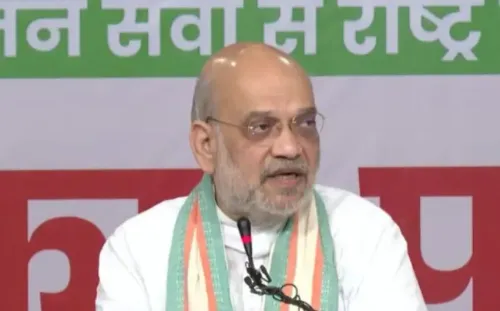
Home Minister Amit Shah briefed media in Mumbai on 13 September about the month-long Seva Sankalp Abhiyaan .
Shah credited PM Modi 's governance since 2014 with eliminating dynasty politics, casteism, and corruption from India's political space.
54 crore people are covered for medical expenses up to ₹5 lakh ; 16 crore households received tap water for the first time.
13 crore farmers receive ₹6,000 annually under PM-Kisan ; 13 crore homes were provided toilets under Swachh Bharat.
GST consolidated 16 purchase taxes ; the JAM Trinity and banking reforms were cited as pillars of economic transformation.
Modi has set a national goal of a Viksit Bharat by 15 August 2047 , the centenary of Independence.
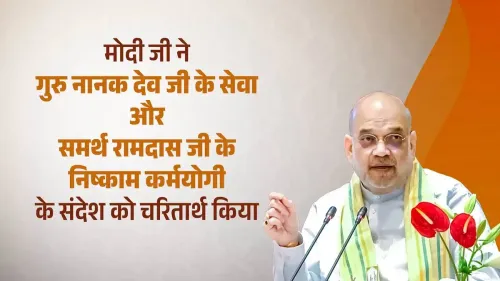
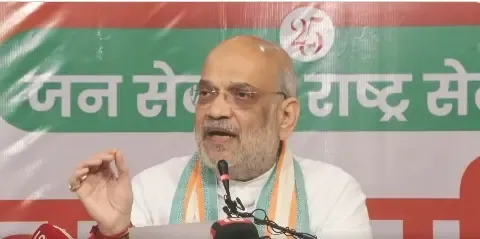
Home Minister Amit Shah on Sunday, 13 September credited Prime Minister Narendra Modi's governance since 2014 with eliminating what he described as three deep-rooted systemic evils — dynasty politics, casteism, and corruption — and replacing them with what he called a 'politics of performance'. Shah made the remarks while briefing media in Mumbai on the contours of the month-long Seva Sankalp Abhiyaan.
Shah's Case for a Transformed Political Culture
Speaking at the press briefing, Shah argued that Modi had redefined the role of the Prime Minister by introducing himself from the ramparts of the Red Fort as the 'Pradhan Sevak' — a public servant — and had, in Shah's words, 'firmly worked to realise this vision' across more than a decade in office. Shah said he believed 'very few leaders have led this country in such a distinctive manner since Independence.'
The Home Minister added that the overarching objective of public service would remain the guiding principle of the Seva Sankalp Abhiyaan, framing it as an extension of Modi's broader governance philosophy of 'seva' — service — to the backward and downtrodden.
Welfare Numbers Shah Cited
Shah listed a series of government schemes to illustrate what he characterised as structural upliftment of the poor and marginalised. Among the figures he cited:
54 crore people are covered for medical treatment up to ₹5 lakh under the Ayushman Bharat scheme. 16 crore households have received tap water connections for the first time since Independence, he claimed. 13 crore farmers receive ₹6,000 annually under the PM-Kisan Samman Nidhi. And 13 crore homes have been equipped with toilets under the Swachh Bharat Mission, which Shah said 'brought dignity to the daughters and mothers of these households.'
Economic Reforms and Infrastructure Push
Shah also pointed to a range of economic and governance reforms as evidence of the administration's record. He credited the Goods and Services Tax (GST) with consolidating 16 different purchase taxes into a single framework, realising what he called the dream of 'One Nation, One Tax.' He cited the JAM Trinity — Jan Dhan, Aadhaar, and Mobile — as the foundation for digital governance.
On the economic front, Shah claimed that banking sector reforms had pulled India out of the non-performing assets (NPA) crisis and returned public sector undertakings to profitability. He also pointed to record foreign direct investment (FDI), the Production-Linked Incentive (PLI) scheme, and the Make in India initiative as factors that had transformed the country into 'a credible global manufacturing and export hub.'
Infrastructure acceleration — spanning roads, railways, airports, Metro networks, ports, waterways, and digital infrastructure — was also highlighted as a defining achievement of the period.
Viksit Bharat and the Road Ahead
Shah said Modi had inspired 140 crore citizens to work towards the goal of a 'Viksit Bharat' (Developed India) by 15 August 2047, the centenary of Independence. The Seva Sankalp Abhiyaan, a month-long outreach initiative, is being positioned as a vehicle to carry that vision to the grassroots.
How the Abhiyaan translates these stated objectives into measurable outcomes on the ground will be closely watched in the weeks ahead.
Point of View
But contested: independent assessments of PM-Kisan's income impact and Ayushman Bharat's coverage depth diverge sharply from government tallies. The 'politics of performance' framing also sidesteps the Opposition's counter-narrative on unemployment data and rising inequality. With state elections on the horizon, the Seva Sankalp Abhiyaan is clearly designed to carry this scorecard to the booth — and Shah's choice of Mumbai as the venue signals that the Maharashtra political battlefield remains front of mind for the party's top brass.
NationPress
13 Sept 2026
Frequently Asked Questions
What is the Seva Sankalp Abhiyaan announced by Amit Shah?
The Seva Sankalp Abhiyaan is a month-long outreach initiative centred on the BJP government's welfare and governance record, with a focus on public service or 'seva' for the poor and marginalised. Home Minister Amit Shah briefed media in Mumbai on 13 September about its contours and objectives.
What three evils did Amit Shah say Modi's government has eliminated?
Shah claimed that PM Modi's leadership since 2014 has ended dynasty politics, casteism, and corruption from India's political space, replacing them with what he called a 'politics of performance'.
What welfare milestones did Amit Shah highlight?
Shah cited 54 crore people covered for medical treatment up to ₹5 lakh, tap water reaching 16 crore households for the first time since Independence, 13 crore farmers receiving ₹6,000 annually under PM-Kisan, and 13 crore homes receiving toilets under Swachh Bharat.
What economic reforms did Shah credit to the Modi government?
Shah pointed to GST consolidating 16 purchase taxes into one, the JAM Trinity enabling digital governance, banking sector reforms resolving the NPA crisis, and record FDI, PLI and Make in India turning India into a global manufacturing hub.
What is the Viksit Bharat goal mentioned by Amit Shah?
Viksit Bharat — meaning Developed India — is a national goal set by PM Modi for India to achieve developed-nation status by 15 August 2047, the centenary of Independence. Shah said Modi had inspired 140 crore citizens to work towards building it.